When Heritage Recipes Seek Chef Endorsements
A collaboration between Won Halmoni and Chef Kim Hee-eun signals how legacy food operators borrow culinary authority to reposition everyday dining.
SINGAPORE
Communal dining institutions rarely alter their core formulas without calculating what might be lost in translation. Across long-standing culinary traditions, domestic food habits have rested on the quiet reliability of scale, where heritage establishments build enduring followings by repeating simple preparations with unwavering consistency. Yet as consumer appetites shift toward authorial prestige, established kitchens increasingly look outside their own walls for external validation.
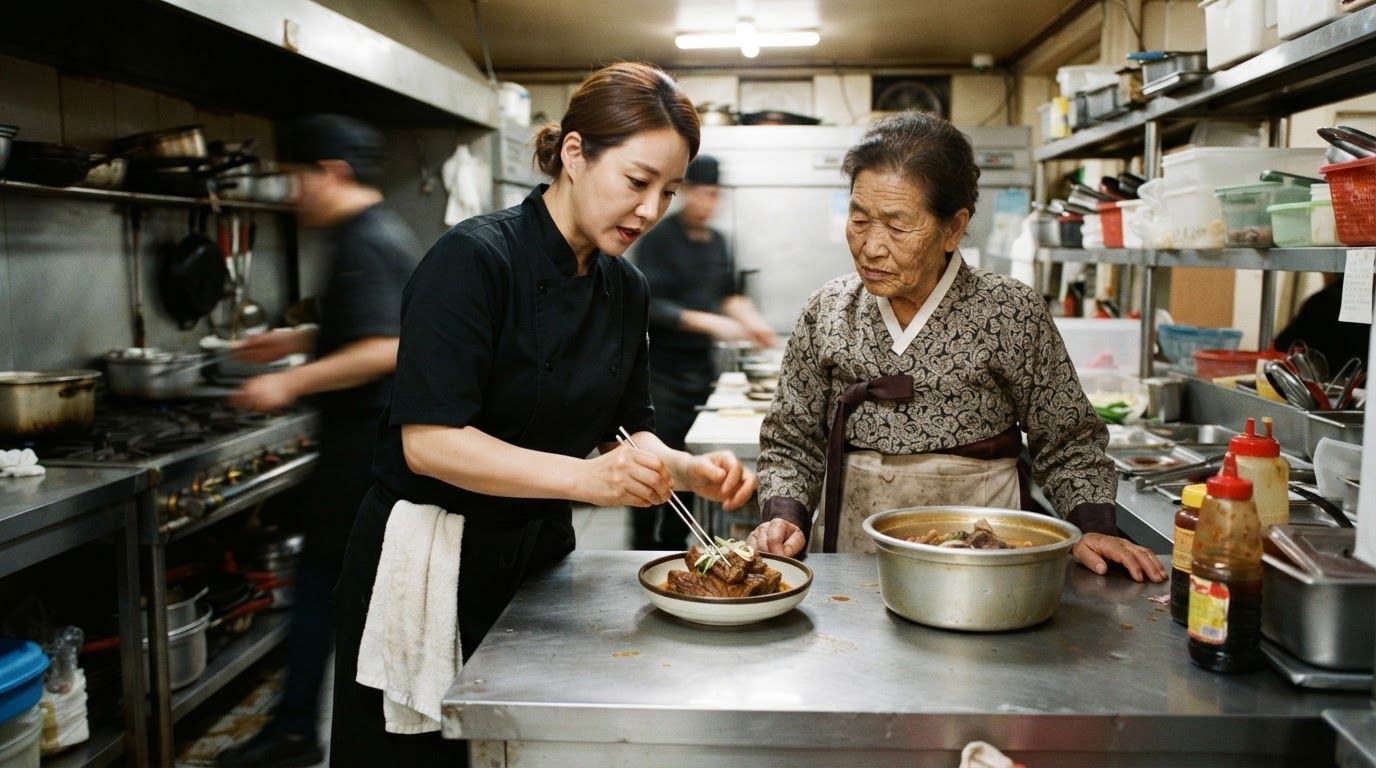
That tension surfaces in South Korea, where legacy brand Won Halmoni and Chef Kim Hee-eun have partnered to introduce an oyster bossam offering, according to reporting from the Seoul Economic Daily. On paper, the move unites a household name rooted in boiled pork wraps with an individual culinary practitioner. At a structural level, however, the arrangement reflects a broader regional impulse: casual dining operations attempting to insulate their heritage against changing tastes by enlisting individual culinary figures.
The Mechanics of Borrowed Authority
Traditional bossam built its appeal on democratic accessibility, serving tender cuts of pork paired with salted fermented condiments, fresh leaves, and preserved radish. When oysters enter that equation, seasonal abundance historically dictates the rhythm of consumption, marking the colder months with perishable maritime freshness. Bringing an established culinary figure like Chef Kim into the formulation alters that customary compact, transforming what was once a neighbourhood constant into a curated seasonal release.
Such collaborations reveal an operational reality facing heritage operators across the Asia-Pacific. Long-running institutions frequently discover that institutional longevity alone no longer guarantees generational relevance among younger urban diners who prize named authorship. By affixing the imprimatur of Chef Kim Hee-eun to a standard menu item, Won Halmoni attempts to purchase culinary distinction while retaining its commercial scale.
Yet this strategy carries an inherent friction that corporate food groups often overlook. When everyday staples absorb the stylistic signatures of personal fine dining, the democratic ethos that originally sustained the brand risks dilution. Diners who patronise established chains generally demand predictability rather than authorial interpretation, creating an operational balancing act between novel prestige and fundamental brand trust.
Regional Repercussions for Street Classics
Comparable patterns have reshaped urban foodscapes across the wider region, where operators of legacy eateries and heritage franchises increasingly recruit prominent kitchen names to recalibrate perception. While corporate executives view these alignments as straightforward exercises in premiumisation, the cultural consequence is often more ambiguous. What begins as an effort to celebrate heritage frequently ends by formalising recipes that previously thrived on informal, collective familiarity.
Advocates of these partnerships maintain that formal culinary input revitalises traditional formulas, introducing refined technique and heightened ingredient standards to mass-market operations that might otherwise stagnate. There is validity in that perspective; without periodic adaptation, heritage brands risk fading into mere nostalgia. Still, an unresolved question lingers over whether consumers embrace such offerings for their inherent flavour or merely out of curiosity toward the collaborative pedigree.
Whether the pairing between Won Halmoni and Chef Kim succeeds over the long term will depend on how cleanly the offering respects the source material. A restaurant brand built on maternal domesticity faces distinct reputational limits when reframing comfort food as chef-led product design. When diners sit down before a platter of pork and oysters, their loyalty ultimately rests on memory, a currency that external signatures can amplify, but never entirely replace.
Sources
Newsletter
Pacific Daily
A curated briefing from Thailand, Asia-Pacific and the world.