Bangkok's transit ambitions test the endurance of Sam Sen Road
Extending street closures for the Purple Line protects subterranean engineering, but passing the friction onto neighborhoods carries an escalating civic cost
BANGKOK
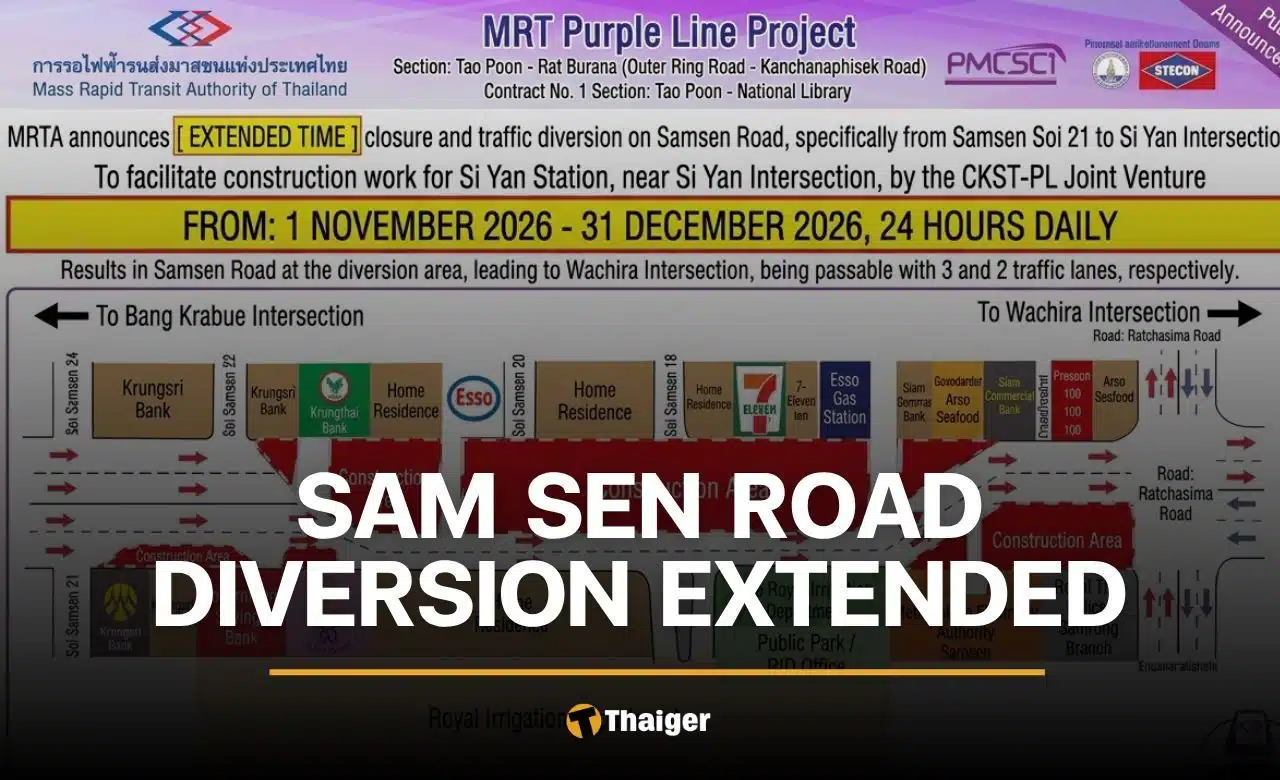
A street diversion in Bangkok rarely ends on the date painted on the construction hoardings. When the Mass Rapid Transit Authority of Thailand confirmed that vehicular traffic on Sam Sen Road between Soi Sam Sen 21 and the Sri Yan intersection would remain diverted through December 31, the decision confirmed what local drivers had already suspected. Rather than lifting the restrictions as originally intended, transit authorities extended the around-the-clock diversion from November 1 through to the end of the year. The prolonged closure accommodates ongoing heavy underground works on Sri Yan station, a transit stop on the southern section of the Purple Line running between Tao Poon and Rat Burana.
On the asphalt, these operational adjustments dictate daily routines for entire residential blocks. Vehicles traveling toward the Wachira intersection must negotiate an altered corridor where lane configurations contract, leaving three lanes available along one stretch and narrowing down to two on another. State authorities emphasize that local residents retain normal vehicle access to their properties throughout the period. Even so, maintaining restricted road capacity around the clock shifts congestion directly onto neighboring district arteries, turning routine errands into protracted navigational exercises.
Behind the corrugated construction hoardings, the CKST-PL joint venture is tasked with designing and constructing the running tunnels and underground stations. Delivering deep underground transit infrastructure along an established urban thoroughfare involves substantial engineering hurdles. Memories of ground disruption along the corridor, notably when a massive sinkhole opened on Samsen Road near Vajira Hospital in September 2025, remain prominent for nearby shopkeepers and drivers. Bangkok's soft subsoil conditions demand exceptional geotechnical prudence, frequently forcing contractors to choose between strict timetable compliance and underground structural stabilization.
The local friction of delayed delivery
Capital megaprojects are frequently defended through the promise of long-term civic convenience. Modern urban rail corridors eventually reduce vehicular congestion, improve regional mobility across Bangkok, and provide dependable mass transit alternatives. Yet the multi-year gestation period concentrates acute economic and spatial burdens onto immediate neighborhood communities. Small businesses along Sam Sen Road depend heavily on open frontage and effortless street-level foot traffic. Successive diversion extensions quietly deplete commercial revenue while small proprietors absorb construction inconveniences without formal financial compensation.
Engineering teams can legitimately argue that methodical tunneling takes precedence over hurried deadlines. Accelerating subterranean excavations through crowded historical quarters creates risks of soil displacement, utility ruptures, and structural settling. Dedicating extra weeks to ensure the geotechnical integrity of Sri Yan station reflects responsible engineering risk management, particularly in areas vulnerable to sudden ground instability.
Managing urban patience
The institutional blind spot lies in treating recurring construction extensions as harmless administrative updates. When temporary barricades evolve into semi-permanent street fixtures, civic confidence in public transport timelines inevitably weakens. Neighborhood commuters must absorb recurring delays, local delivery logistics face daily disruption, and connecting side streets handle redirected traffic flows without dedicated municipal oversight.
Mass transit development across Thailand relies fundamentally on local endurance to navigate years of surface disruption. If government authorities and private contractors like the CKST-PL joint venture normalize open-ended construction timelines, community support for capital infrastructure projects will deteriorate. Completing the underground works at Sri Yan station without pushing barricades deeper into the coming year will test whether administrative accountability can genuinely match public patience.
Sources
Newsletter
Pacific Daily
A curated briefing from Thailand, Asia-Pacific and the world.