Nineteen Minutes Through Bangkok Rain Exposes the Fragility of Everyday Transit
A police escort for an organ transport unit reveals how manual intervention substitutes for functional urban mobility
BANGKOK
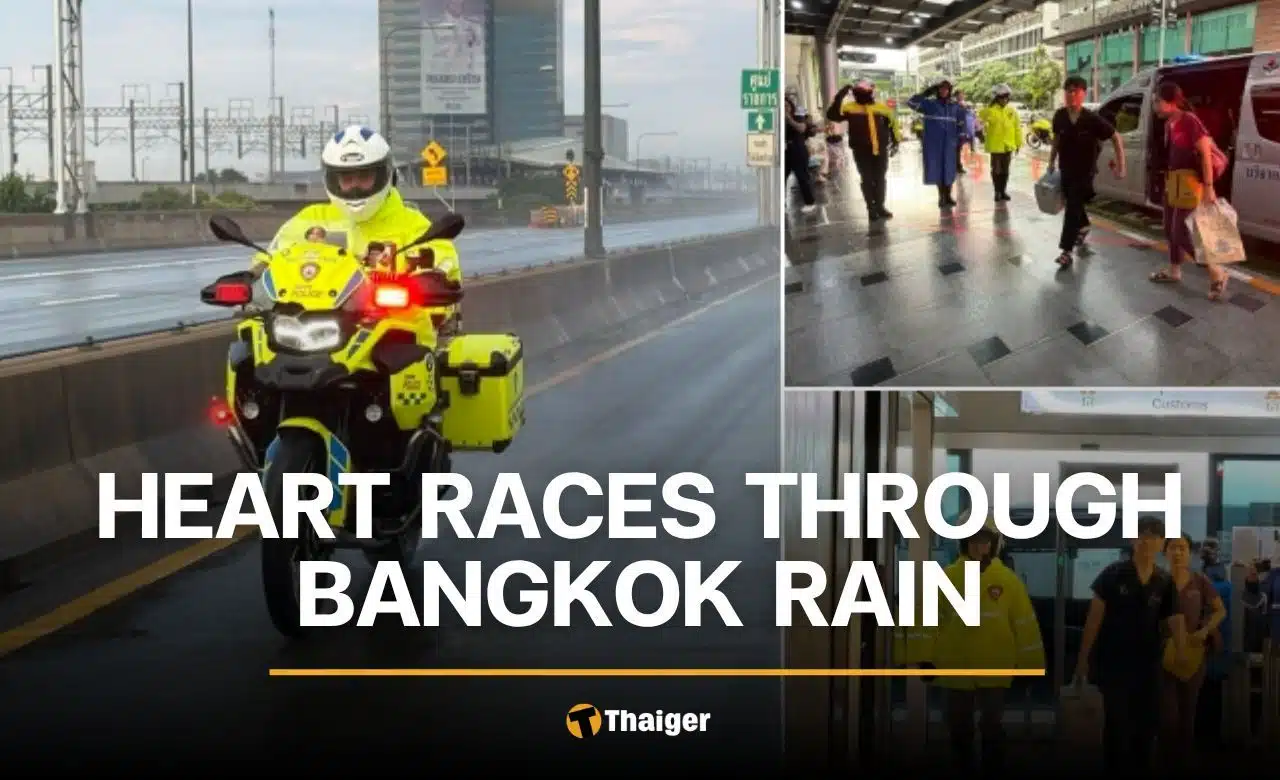
A medical transport vehicle moved a donor heart across Bangkok from Don Mueang Airport to King Chulalongkorn Memorial Hospital in nineteen minutes on Thursday evening. Official logs show the call reached the radio room of the Royal Initiative Project traffic police at 5.15pm on October 22, coinciding with the peak of the evening commute during heavy rain. Under ordinary road conditions without intervention, typical cross-city transit along that corridor can take significantly longer. To manage the transfer, police coordinated rapid-response officers, mechanics, local precinct personnel, expressway police and staff from the Expressway Authority to clear and hold corridors open along the metropolitan route.
Police records indicate this delivery was the 197th heart transfer escorted by the unit. Earlier in the year, on February 3, the same division handled its 156th run, moving another organ from Don Mueang toward Thammasat University Hospital. The tally suggests that what began as an occasional emergency protocol has evolved into a regular municipal service. By deploying personnel to manually carve out clear lanes, the authorities produce an engineered exception to the city's prevailing traffic flow.
The Cost of Manual Flow
For residents watching from stationary vehicles, the operation highlights how mobility functions across the capital. When state agencies deploy dedicated personnel across multiple jurisdictions, vehicles can travel at expressway speeds even during torrential rain. Yet that velocity appears to depend on holding back ordinary commuter traffic at entry ramps and junctions along the corridor. The procedure solves an acute medical delivery by temporarily pausing surrounding movement across intersecting streets.
Physical intervention by expressway police can suspend the city grid for minutes, but it cannot solve the daily friction beneath it.
Medical logistics explain the procedural urgency behind such operations. Every minute saved during transport between Don Mueang and operating theatres at King Chulalongkorn Memorial Hospital limits cold ischemic time and supports surgical outcomes. From an operational perspective, assembling escorts alongside the Expressway Authority represents a practical method to manage time-sensitive cargo. The arrangement avoids infrastructural delays by substituting immediate administrative coordination and radio dispatches.
The Limits of Exceptionalism
Supporters of these operations maintain that specialised escorts demonstrate public sector cooperation working as intended. In this view, organ transfers represent exceptional life-saving tasks where collective road traffic should reasonably yield right of way. That operational argument is defensible on medical grounds. Emergency medical teams require unobstructed routes when time determines whether a surgical procedure succeeds.
The structural implication, however, involves what this dependence reveals about baseline mobility across the capital. Relying on specialised police units to create temporary corridors demonstrates that smooth transit remains conditional on direct physical intervention. When ordinary transit networks encounter regular evening rain and commuter volume, surface movement frequently slows down. The regular use of manual escorts indicates an operational adaptation to existing congestion rather than a remedy for everyday transit constraints.
Emergency convoys show what coordinated authority can achieve across Bangkok when every barrier is removed. The nineteen-minute transit confirms that rapid movement across the metropolitan area is possible under coordinated police enforcement. Until broader surface networks provide predictable journey times for standard commuter traffic without manual intervention, urban transit will continue to depend on these engineered passages.
Sources
Newsletter
Pacific Daily
A curated briefing from Thailand, Asia-Pacific and the world.