The Drained Ledger of Thailand's Seasonal Inundation
Administrative accounting that drops casualties as provinces dry obscures the prolonged disruption of central river basin life.
SINGAPORE
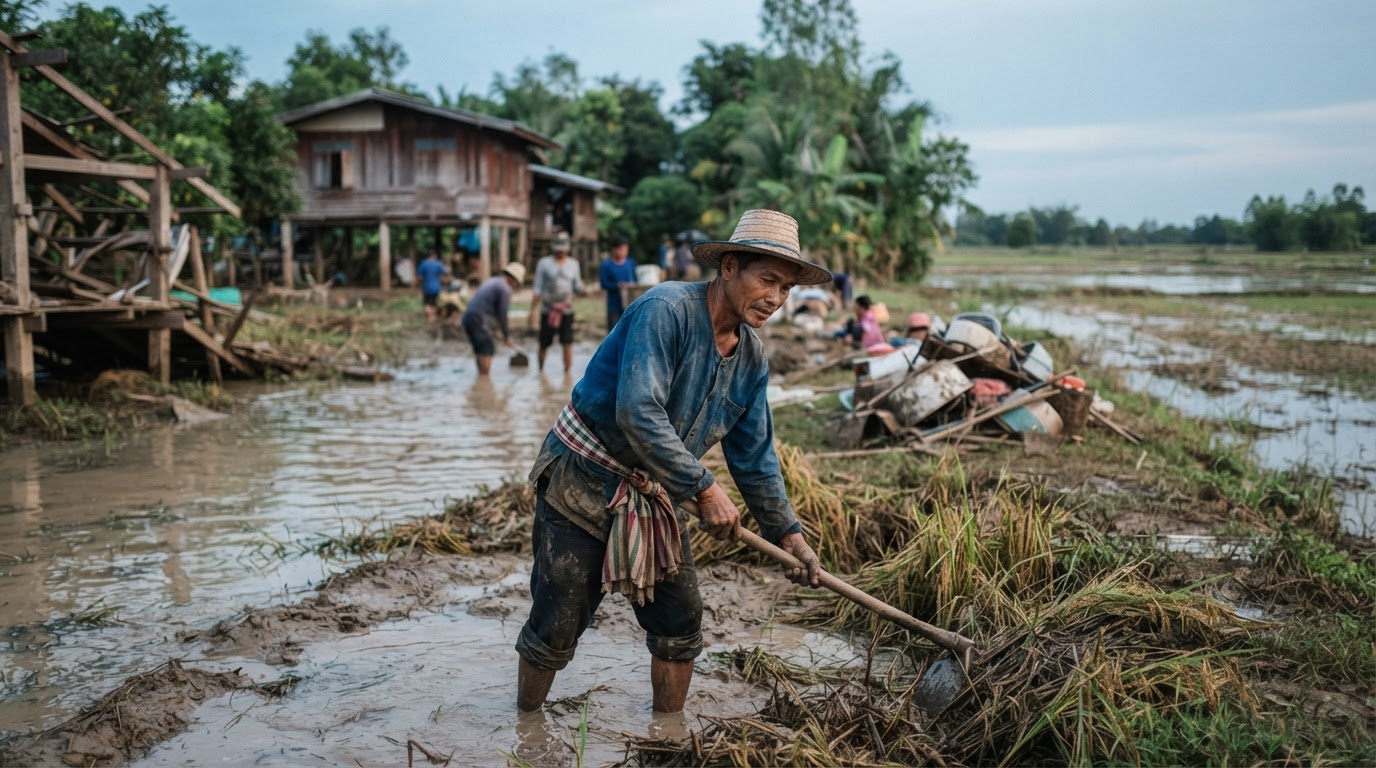
Central river settlements across Thailand were historically arranged to accommodate seasonal overflows, treating the rising monsoon currents as an expected condition of alluvial plains rather than an unprecedented emergency. Communities built their wooden houses upon tall stilts, accepting cyclical displacement as an annual rhythm dictated by the swelling of local waterways. Modern administrative governance, by contrast, approaches water through bureaucratic categorization, transforming physical upheaval into fluctuating registers of active declarations.
This administrative logic produces peculiar discrepancies when disaster impact is measured solely by current submerged surface area. According to figures released by the Department of Disaster Prevention and Mitigation, seasonal flooding has pulled back to 16 provinces and Bangkok, leaving 64 recorded deaths within active flood zones. That figure does not represent a cumulative national toll. Because the department tracks fatalities only within provinces currently catalogued as inundated, the recorded loss of life actually diminishes as provincial land dries out, dropping from 67 on October 16 when 20 provinces were submerged, after standing at 52 on October 7 across 27 provinces.
The Vanishing Toll of the Dry Margin
Under this accounting framework, human distress is statistically subtracted the moment ground re-emerges above the waterline. The official register at 6am on Friday recorded 60 districts, 432 subdistricts and 2,988 villages still submerged, disrupting 375,726 households and 1,131,401 people across central territories including Ayutthaya and Suphan Buri. Yet as floodwaters recede from outer districts like Prachin Buri or Chachoengsao, the bureaucratic perimeter contracts, leaving families who suffered bereavement outside the immediate ledger of disaster.
State agencies maintain that dynamic registries allow emergency resources to shift toward areas requiring immediate rescue. Administrative efficiency certainly demands targeting active peril rather than settled crises. When dynamic operational tallies double as the primary public record of disaster impact, however, they generate a systemic blind spot. The prolonged displacement and agricultural losses experienced across recovering communities in Kanchanaburi or Ratchaburi become statistical afterthoughts the instant water levels recede.
Shifting Basins and Urban Priorities
Water management across the central lowlands has increasingly prioritized peripheral diversion to shield high-value commercial centers. Outer fringes of Bangkok, including Nong Chok and Lat Krabang, alongside coastal provinces like Samut Prakan and Samut Songkhram, frequently bear the burden of extended drainage to safeguard capital districts. This geographic triage indicates an evolving policy preference where metropolitan continuity takes precedence over traditional agrarian retention zones.
The administrative ledger contracts as water recedes, but communal disruption outlasts the official boundary of disaster.
What is being preserved through such interventions is urban economic stability, while older practices of shared river basin vulnerability are quietly supplanted. In historic central plain hamlets, the retreat of water once signaled communal restoration rooted in shared rural obligations. Today, technical drainage canals and compartmentalized municipal borders divide that collective experience into detached territorial statistics managed by Director-General Nirat Pongsitthawon and provincial administrators.
A river basin does not instantly restore livelihoods when surface water drains away into the sea. Tracing vulnerability solely through the presence of standing water overlooks how slowly normal trade reconstitutes itself across dried mud. The practice of tying human loss strictly to active inundation ensures that once provincial soil clears, the structural exposure that repeatedly submerges Nakhon Nayok will recede from administrative scrutiny until the arrival of the next monsoon.
Sources
Newsletter
Pacific Daily
A curated briefing from Thailand, Asia-Pacific and the world.