The Parliamentary Calendar as an Instrument of Executive Control
Bargaining between legislative whips over debate allocations exposes the narrow institutional bounds within which constitutional scrutiny operates in Bangkok.
SINGAPORE
Procedural disputes rarely disguise ideological differences; they define the exact physical boundary where executive authority refuses to yield. In parliament, that boundary currently measures twenty-four hours.
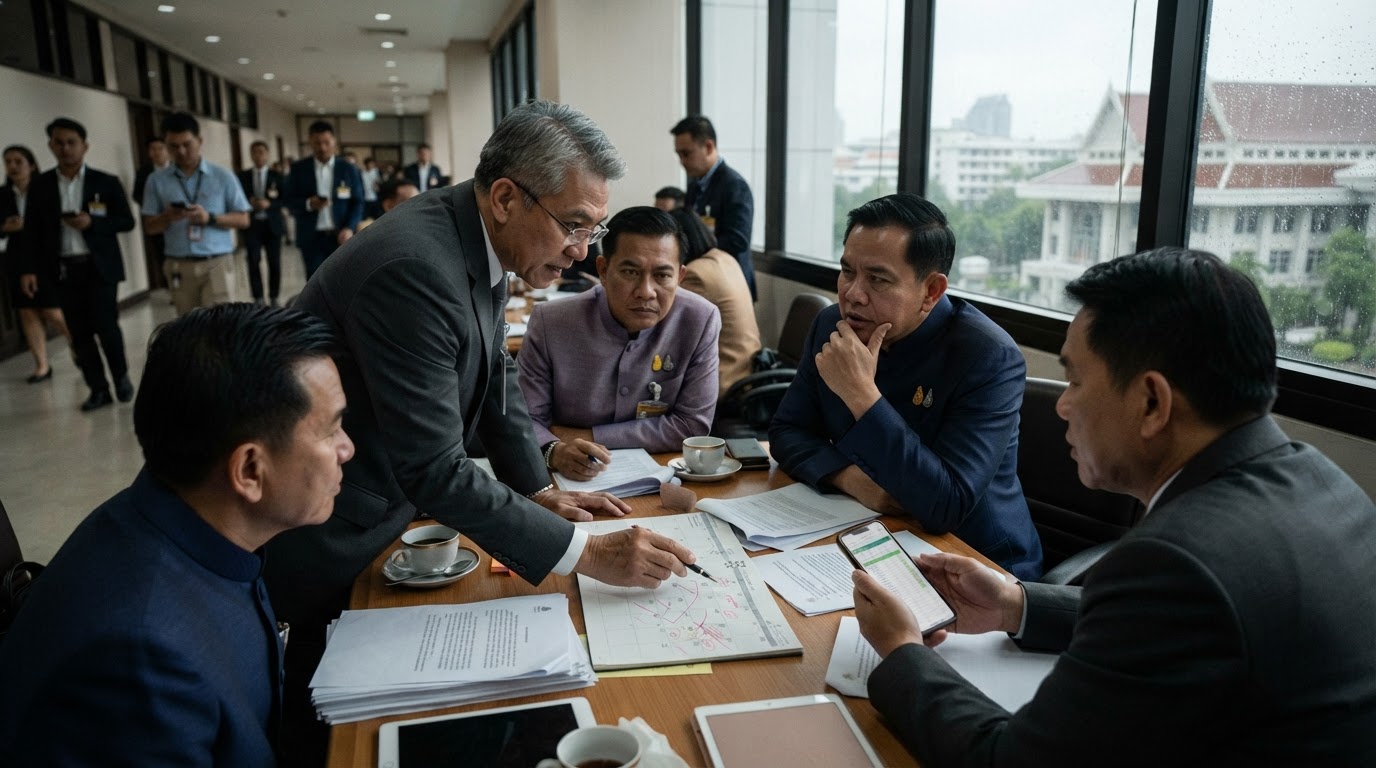
House Speaker Sophon Zarum intervened directly this week, urging government and opposition whips to break their deadlock over the calendar for an impending no-confidence debate. Two rounds of formal discussions collapsed on Wednesday after opposition lawmakers walked out, refusing to accept the executive coalition's rigid ceiling. At issue is neither the substance of the censure motions nor the legal eligibility of the targets, but the raw arithmetic of speaking time across November and December.
Opposition whips opened negotiations demanding five full days on the floor. When that position met entrenched resistance, they adjusted their request to four days, contingent on holding the proceedings before the end of the year. The government offered three. When mediators floated a four-day compromise, the opposition chose a walkout over acquiescence, demonstrating that procedural concessions carry diminishing returns when parliamentary scrutiny is already structurally compressed.
The Mechanics of Procedural Attrition
Controlling the legislative clock remains the most dependable lever an executive majority possesses. By compressing debate into three calendar days, a governing coalition dilutes the evidentiary impact of each censure allegation. Ministerial targets face fewer hours of sustained examination, while backbench interventions consume proportional space, effectively shielding cabinet figures from prolonged cross-examination under public view.
Sophon acknowledged the institutional limits of his own chair when addressing the impasse. While confirming his readiness to write directly to the cabinet regarding acceptable dates, he insisted the dispute must be settled through bilateral bargaining rather than unilateral decree. That instruction sounds balanced, yet it leaves the structural imbalance untouched.
Unilateral scheduling breaks the appearance of institutional parity, but prolonged procedural stalemate quietly accomplishes the exact same objective for the governing majority.
The opposition's concession—dropping from five days to four—signals an acute awareness of seasonal leverage. Demanding floor time in November or December forces the cabinet to defend its policy record precisely when budgetary implementation and end-of-year administrative milestones demand legislative attention. Pushing the censure session into early 2027 would dissolve whatever political urgency currently animates the opposition's investigative dossiers.
Limits of Legislative Mediation
Cabinet ministers hold an inherent institutional advantage in every scheduling duel. Because the executive must formally verify its availability before the legislative calendar is finalized, a prime minister's office can indefinitely run down the clock under the benign guise of ministerial scheduling conflicts. Sophon's offer to consult the cabinet directly highlights who holds the ultimate veto: the very officials designated to face censure.
One counterargument holds that three days provide ample duration for a disciplined parliamentary opposition. Proponents of this view maintain that unfocused floor debates frequently devolve into performative theater, and that condensing speeches forces interrogators to present concise, documentary evidence rather than rhetorical filler. Under strict floor management, three days might suffice to interrogate core administrative failures without exhausting the public or disrupting regular legislative business.
That calculation ignores how power actually concentrates during parliamentary interrogations. Compressing the timetable inevitably shifts floor priority to party leadership, squeezing out junior backbenchers who frequently hold the detailed documentation on procurement irregularities and local governance failures. A truncated schedule does not sharpen debate; it rations exposure.
Negotiations will resume because neither side benefits from a total collapse of the censure mechanism. The opposition cannot abandon its petition without surrendering its constitutional mandate, while the government cannot completely block the motion without signaling political fragility to domestic and regional observers. What remains unresolved is not whether a compromise date will be discovered, but whether four days on the floor can still enforce executive accountability when the cabinet dictates the calendar.
Sources
Newsletter
Pacific Daily
A curated briefing from Thailand, Asia-Pacific and the world.