Road 3027 and the Everyday Cost of Navigational Failure
A fatal wrong-way crash in Prachin Buri exposes how provincial transport corridors leave ordinary commuters absorbing the risk of navigational confusion.
SINGAPORE
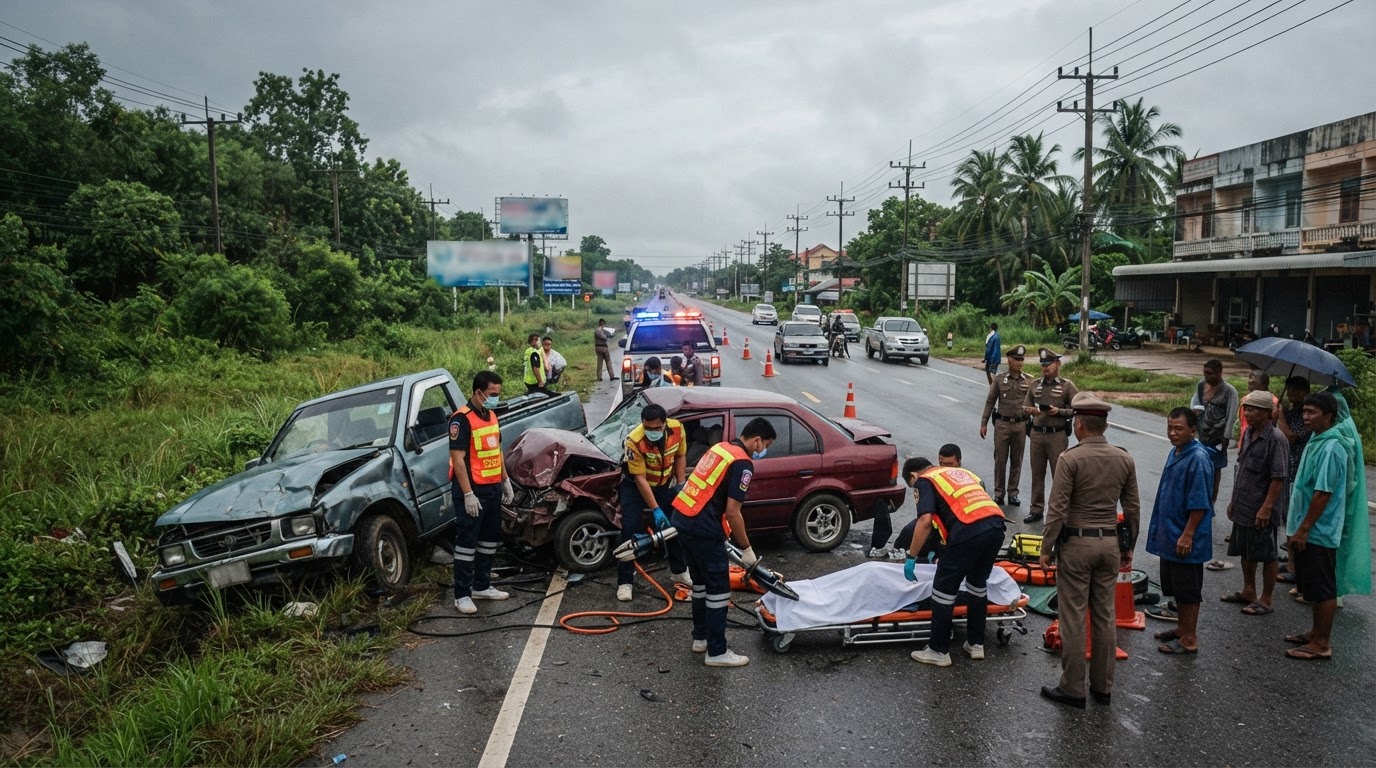
A black car moved against traffic for more than 200 metres along Road 3027 before striking an oncoming vehicle head-on. The collision occurred in Tha Tum subdistrict within the Si Maha Phot district of Prachin Buri during the early hours of Saturday, October 17. Rescuers arrived to extract a Thai woman named Sunita from her white sedan. Emergency workers performed CPR after she lost consciousness, but she succumbed to her injuries. Another woman sustained injuries in the crash.
Circulated footage documenting the run-up to the impact spread quickly across social platforms. Most initial reaction centred on the driver, identified in reporting as a Chinese national operating on the wrong side of the road. That reaction is understandable. Yet examining the recorded sequence closely points to an infrastructure gap behind the immediate outrage. A motorist traversed several hundred metres in reverse orientation on a major carriageway without meeting a single physical barrier, channelised island, or rumble strip capable of halting the mistake before impact.
The route carries regular shift workers through an industrial belt.
For factory staff and service employees heading home during late-night shifts, personal safety depends entirely on predictable lane discipline. Monthly household budgets among working families leave zero cushion for catastrophic road trauma. Drivers moving through unlit connectors assume oncoming vehicles will remain separated by roadway geometry. When that structural expectation fails, evasive options disappear within seconds.
Infrastructure and Orientation Gaps
Motorists arriving from right-hand traffic jurisdictions face acute spatial confusion when navigating left-hand systems, especially late at night. In secondary industrial hubs such as Si Maha Phot, minimal directional signage and absent visual lane demarcations multiply that disorientation. The obvious counterargument attributes the event strictly to individual recklessness: any licensed motorist holds an unambiguous legal duty to heed directional flow, and driving into oncoming traffic represents severe negligence. Legal liability unquestionably rests with the driver. However, reducing the incident solely to personal fault obscures how highway design either arrests or accommodates human error before it turns fatal.
The Asymmetric Burden on Working Families
When a sudden fatality occurs on a provincial connector, the financial ruin hits working households immediately. The abrupt loss of a primary earner shatters domestic stability, creating sudden funeral expenses and long-term income deficits that no ordinary wage can absorb. Medical costs for injured survivors deplete family savings just as rapidly. Road risk is not borne equally across society; it settles heavily on commuters compelled to use secondary arterial routes at unusual hours.
Preventing similar crashes requires physical intervention rather than public anger.
Eliminating wrong-way access along corridors like Road 3027 requires channelised junctions, high-visibility reflective markers, and physical medians that make counter-flow driving physically difficult. Whether regional transport authorities alter these dangerous intersections now depends on their willingness to treat access design as an urgent economic protection for working commuters rather than dismissing navigational failure as mere private misconduct.
Sources
Newsletter
Pacific Daily
A curated briefing from Thailand, Asia-Pacific and the world.