Suburban Road Tolls Cut Through Provincial Digital Personas
A fatal crash on Bang Kruai-Sai Noi Road highlights the daily commuter risks facing both officers and an aging driving public
SINGAPORE
Traffic along Bang Kruai-Sai Noi Road in Ban Krang subdistrict moves under the routine friction of mismatched speeds, sudden turning manoeuvres, and uncontrolled suburban access points. On October 18 at around 6pm, that ordinary evening pattern turned lethal. A collision between a brown sedan and a dark blue motorcycle left Police Sergeant Thanawat Kaojaikarn dead in Nonthaburi. Thanawat had built a notable local presence across social networks under the moniker Nonthaburi RoboCop, managing the Facebook page โจ้เม็ดกะจี๊ to engage nearby residents. The physical dynamics of secondary arterial transit, however, operated without regard for administrative rank or online familiarity.
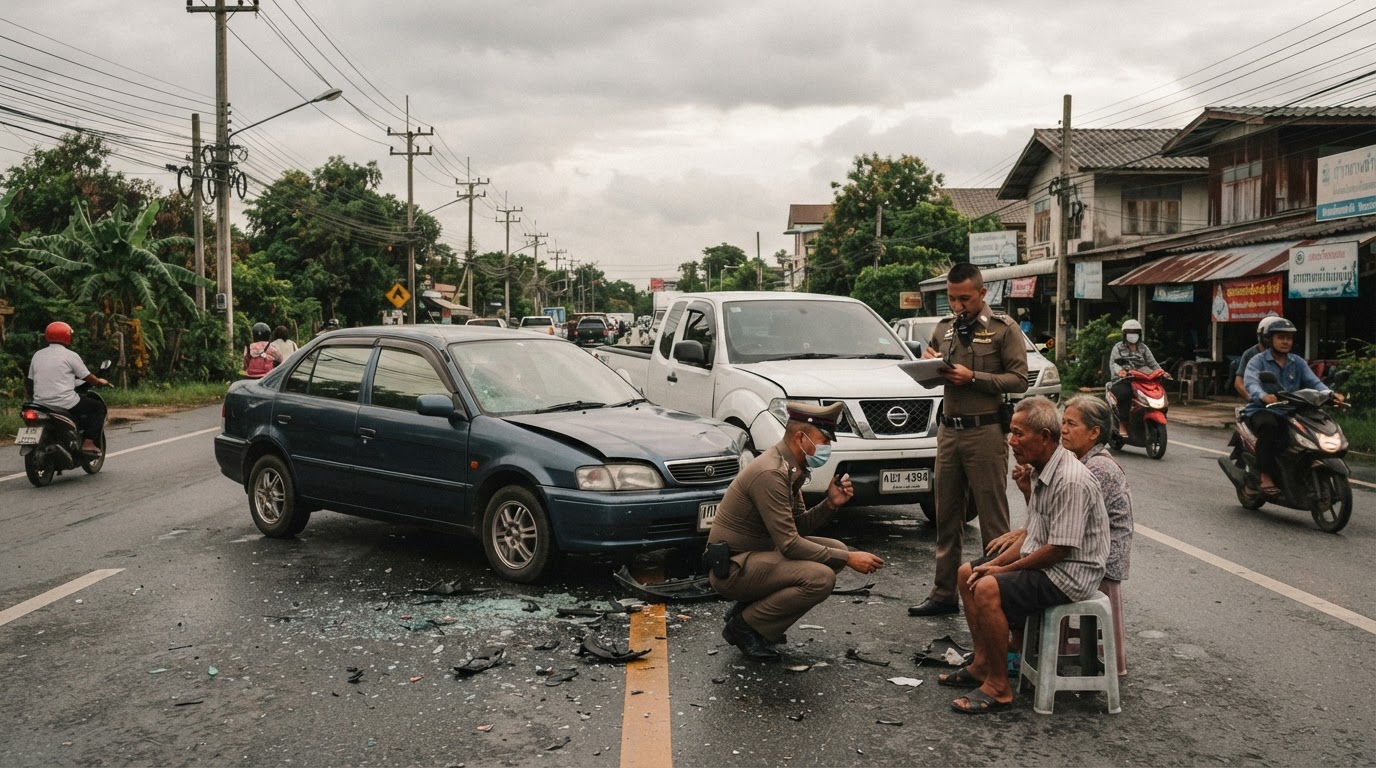
Responding officers from Bang Si Mueang Police Station recorded a brown passenger car parked in the left lane with a damaged windscreen and crumpled driver-side door. Beside the car lay the wrecked motorcycle, attended by rescue personnel from the Por Teck Tung Foundation and a team from the Institute of Forensic Medicine. Driving the sedan was a 70 year old man. This encounter involved no pursuit or emergency operation. Rather, initial scene reports indicate a standard commuter passage that collapsed into a fatal crash.
The Mechanics of Commuter Risk
Suburban corridors like Bang Kruai-Sai Noi serve simultaneously as regional conduits and neighbourhood thoroughfares. Commercial traffic mixes directly with local cars executing turns across live traffic lanes. For riders on two wheels, these configurations present continual physical hazards whenever a passenger vehicle slows unexpectedly or pivots into a property entrance. The mechanical damage recorded at the site—fractured windscreen glass and compressed door paneling—illustrates the severe kinetic disparity between an enclosed automobile and an exposed motorcyclist.
These physical conditions intersect with visible demographic realities. A motorist at age 70 must manage visual changes and altered reaction times, particularly under the demanding conditions of dusk. Across Thailand, older individuals frequently continue to drive because decentralized suburban growth offers few alternative transit routes for basic domestic obligations. When slower perception times encounter rapid two-wheeled traffic during evening rush hours, safety margins narrow dramatically. While physical roadway design cannot eliminate human error, inadequate street lighting and complex mixed-use corridors place heavy demands on aging reflexes.
Physical vulnerability on provincial asphalt levels every administrative title and social following.
A sceptic could reasonably argue that drawing systemic conclusions from a single evening collision risks overinterpreting what may simply be an isolated driving mistake. Driver distraction, abrupt braking, or poor judgment can occur at any age and along any roadway. Official findings have not yet determined legal responsibility or final fault. Even so, the recurring pattern of two-wheeled fatalities on peripheral thoroughfares suggests that such crashes stem from structural transit conditions rather than purely disconnected misfortunes.
Behind the Digital Persona
Online platforms frequently transform public officials into recognized figures, providing community visibility through personal branding. The moniker Nonthaburi RoboCop and the updates shared through โจ้เม็ดกะจี๊ established an informal bridge between local law enforcement and surrounding neighbourhoods. Yet an online following provides no barrier against the physical forces of a suburban roadway. Off duty or on patrol, an officer on two wheels navigates the same immediate exposure as any civilian worker riding home through peak traffic.
Determining the specific sequence of movements now rests on the formal inquiry coordinated by Bang Si Mueang Police Station and forensic examiners from the Institute of Forensic Medicine. Legal conclusions will depend on physical impact measurements, vehicle positioning, and recorded witness accounts. Beyond that legal determination, the Ban Krang collision demonstrates the ongoing toll exacted by mixed suburban transit across Thailand. Until local road planning and commuter safety frameworks adapt to mixed-speed travel and an aging population behind the wheel, everyday transit will remain hazardous for civilians and public servants alike.
Sources
Newsletter
Pacific Daily
A curated briefing from Thailand, Asia-Pacific and the world.