The Annual Test of Official Reassurance in Southern Thailand
Declarations of flood preparedness in Songkhla measure administrative confidence against urban disruption, yet daily life still bears the cost of water management.
SINGAPORE
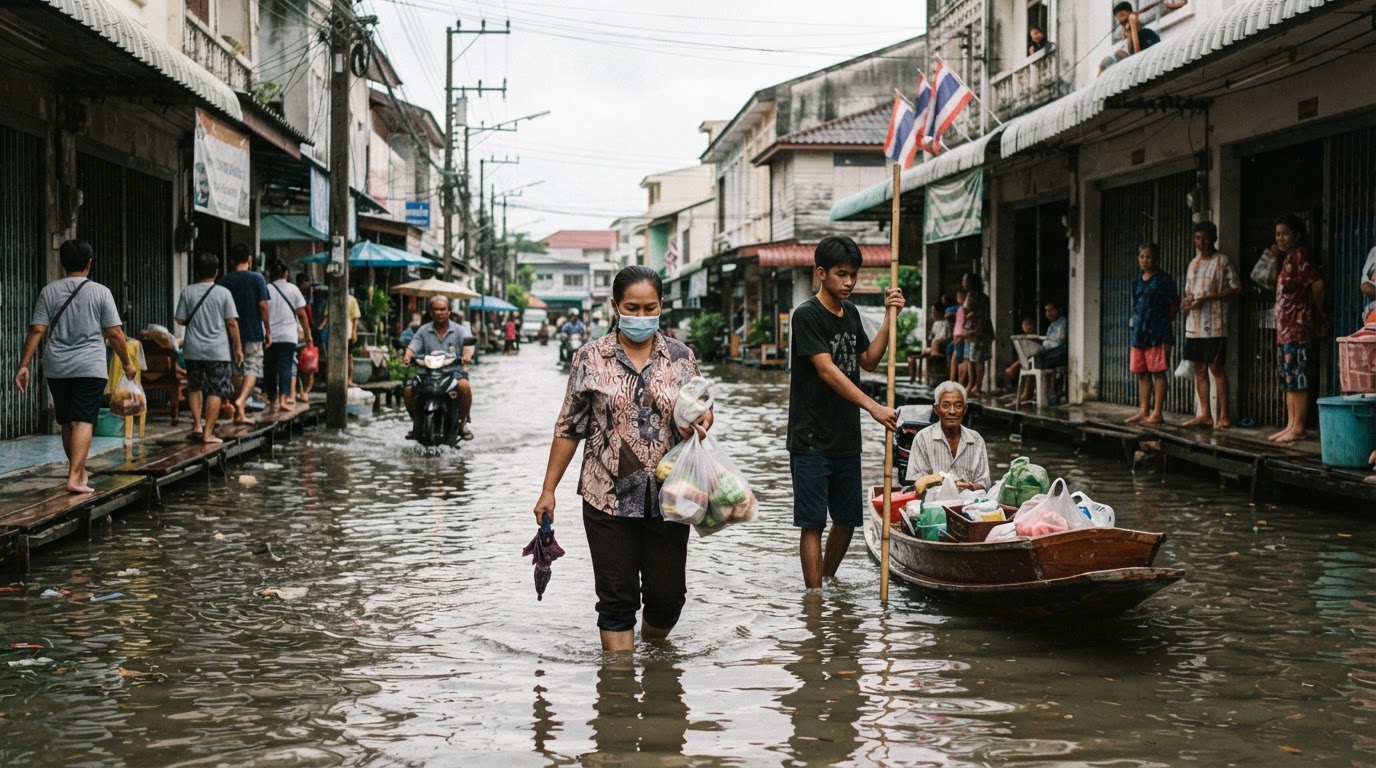
Heavy rainfall in Songkhla has once again brought street water and administrative reassurances to the commercial center of Hat Yai. Prime Minister Anutin Charnvirakul announced that authorities are fully prepared to manage urban inundation across the district, responding to widespread local anxiety over a potential repeat of last year's severe floods. Such statements are intended to steady public confidence, yet they also expose the persistent vulnerability that defines the wet season across southern commercial hubs.
For residents, shopkeepers and foreign arrivals navigating the district, official declarations matter far less than whether drainage canals actually carry surplus water away from storefront thresholds. Rain in this corner of Thailand is an expected seasonal reality, not an unexpected shock. What changes in a household's month is the practical friction of moving inventory to higher shelves, re-routing daily commutes around submerged curbs, and calculating whether drainage infrastructure will hold through another continuous downpour.
Central government leadership frames the response around readiness, deploying state resources and administrative oversight directly from Bangkok. That political posture serves a necessary purpose. Clear signals from leadership can prevent panic buying, ensure local agencies maintain round-the-clock monitoring, and establish accountability if critical drainage systems fail. The government must demonstrate competence in regional hubs that anchor provincial trade, especially where cross-border commerce with neighboring economies depends on stable logistics.
The Gap Between Management and Reality
Administrative readiness cannot eliminate the fundamental disruption of water entering an urban basin. Even with monitored water levels and state agency protocols in motion, urban centers with dense concrete cover remain structurally prone to sudden accumulation. A partly flooded road on a Tuesday night in Hat Yai district illustrates how quickly ordinary transit slows when run-off outpaces local retention.
Local businesses operate under a continuous calculation during these weeks. Small enterprises rarely possess the financial cushion to absorb repeated inventory write-downs or prolonged commercial downtime. When civic leaders promise that a district can handle flood threats, they establish a standard against which every blocked drainage line and flooded alley will inevitably be judged.
Official readiness offers reassurance on paper, but commercial survival depends on the physical capacity of ground infrastructure to keep streets dry.
Advocates of the state approach argue that centralized coordination and modern engineering protocols are demonstrably superior to ad hoc local reactions. Their argument carries weight: without central resource mobilisation and systematic monitoring, regional commercial centers would face far worse outcomes during severe meteorological shocks. Government intervention provides a baseline operational response that local municipal budgets cannot match independently.
Long-Term Infrastructure and Urban Routine
This counterargument assumes that technical readiness alone resolves what is ultimately an urban planning challenge. Hat Yai serves as the primary economic hub for Songkhla, drawing regional trade, seasonal labor and border traffic. Repeated threats of inundation impose a quiet tax on commercial activity, forcing businesses to invest in redundant physical protections rather than expansion.
Urban resilience is measured not by press statements delivered from the capital, but by the quiet continuity of street life during periods of heavy weather. If consumers cannot access local markets, or if transport links become intermittent, the economic cost accumulates regardless of whether regional disaster thresholds are officially breached.
For residents, whether the intervention by Anutin Charnvirakul and municipal authorities matters depends entirely on whether drainage upgrades can consistently outpace severe rainfall. Until those systems function reliably during storms, daily routines in Songkhla will continue to be decided by weather reports rather than political assurances.
Sources
Newsletter
Pacific Daily
A curated briefing from Thailand, Asia-Pacific and the world.