The Spatial Reordering of Bangkok's Everyday Table
In Asok, the coexistence of shophouse stir-fries and imported dining formats charts how transit corridors recalibrate domestic culinary habits.
BANGKOK
Shophouse architecture in Bangkok historically functioned as an unhurried threshold between family commerce and neighbourhood ritual. Ground floors opened outward, venting wood smoke and oil into side lanes where foot traffic followed familiar daylight routines. Along the intersecting lines of transit hubs like Asok, that street-level rhythm has undergone an unmistakable functional transformation. The physical structures often endure, yet the spatial reordering of Bangkok's everyday table demonstrates how culinary life conducted inside them increasingly serves an accelerated urban geography defined by corporate office towers and commercial junctions around Terminal 21.
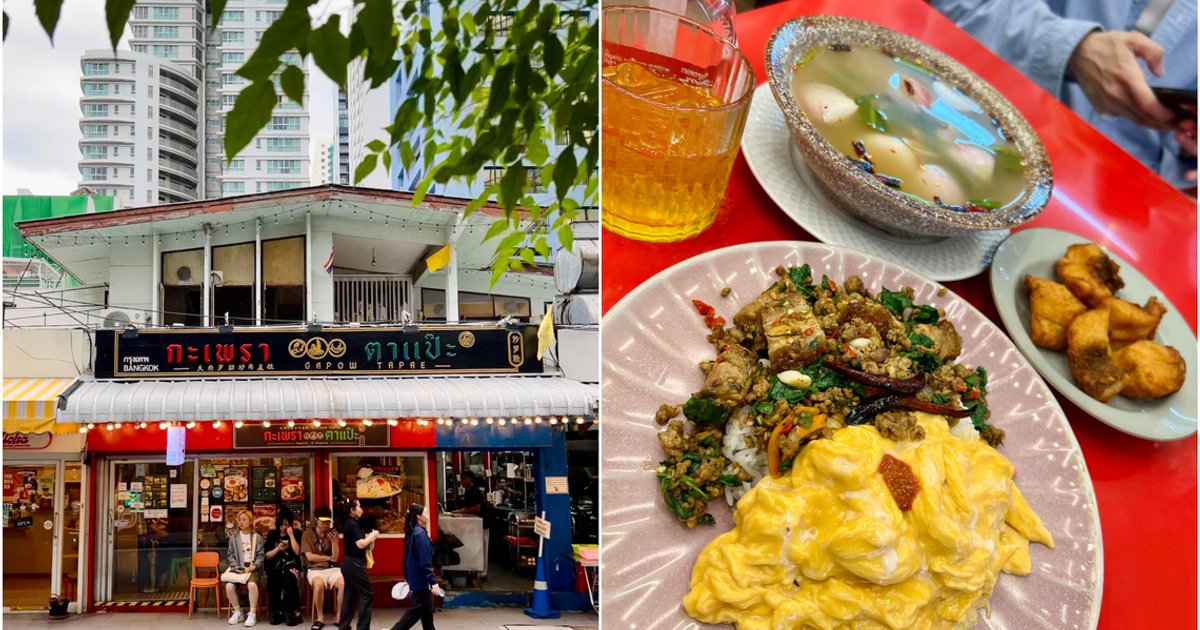
Consider the contrast visible across a few hundred paces of pavement documented in recent culinary dispatches from the district. Outside Gapow Tapae, patrons occupy stools for plates of pad krapow, the stir-fry of meat and holy basil that constitutes one of the Thai working lunch's enduring staples. The dish relies on high heat, pungent herb oil, and rapid consumption, served in notably generous, spicy portions. Steps away, within the same commercial orbit, sit establishments that speak to an entirely different lifestyle rhythm. Scuba operates as a seafood brasserie dispensing oysters, mussels, and horse mackerel sashimi. Nearby, Bartels provides hearty sandwiches alongside work-friendly coffee designed for patrons balancing remote tasks on digital screens.
Shifting Thresholds of the Shophouse
What is preserved in this ecosystem, and what is quietly being replaced? On the surface, the survival of a shophouse serving fiery basil plates suggests continuity. Yet the environment enclosing it points toward a deliberate functional shift, re-engineered around commercial transit and commuter velocity. Pad krapow at Gapow Tapae ceases to be solely a local neighbourhood subsistence meal. It becomes an essentialised culinary signpost operating in direct proximity to cosmopolitan imports.
The neighbourhood table no longer anchors residential stability; it services a transient workforce shifting between commuter platforms and glass lobbies.
This convergence reveals how Southeast Asian metropolitan nodes renegotiate their vernacular culture. The presence of European-style sandwich counters and raw seafood bars alongside holy basil stir-fries reflects more than eclectic consumer appetites. It demonstrates the zoning pressure exerted when high-density transit turns domestic streets into lifestyle enclosures. When an eating house shares foot traffic with an oyster brasserie and a coffee outpost catering to remote workers, property values and commuter foot traffic alter the social purpose of eating, advancing the spatial reordering of the district's everyday table.
The Economy of the Commuter Lunch
The counterargument holds that such coexistence demonstrates cultural resilience rather than erasure. Thai urban foodways have absorbed foreign elements for centuries without forfeiting their distinct vernacular foundation. A customer can consume street-style meat stir-fried with holy basil at noon and gather over sashimi or sourdough bread by evening. Proponents of this view argue that commercial diversity strengthens the urban fabric by accommodating diverse incomes and cosmopolitan tastes within a single district.
Yet that tolerance arguably obscures an economic sorting mechanism. Culinary formats requiring leisure, higher capital overhead, and laptop tables steadily set the rental baseline for the surrounding blocks. Establishments serving traditional street-style staples remain viable largely by intensifying volume, serving huge plates under compressed turnaround times. The vernacular everyday table survives, but under conditions set by commercial rent dynamics rather than community settlement.
Asok illustrates how modern infrastructure reframes domestic sustenance across Southeast Asia. The holy basil stir-fry retains its fragrant punch on the perimeter of Terminal 21, but the communal soil from which it grew has yielded to transient foot traffic and office schedules. Seating remains full, even as its historic purpose quietly moves on.
Sources
Newsletter
Pacific Daily
A curated briefing from Thailand, Asia-Pacific and the world.