The Frustration Behind the Wheel: When Public Space Becomes a Crucible
Incidents of road rage in Singapore, while distinct in their severity, reveal a broader friction present in Asia's urban centers, where shared spaces amplify individual pressures.
SINGAPORE
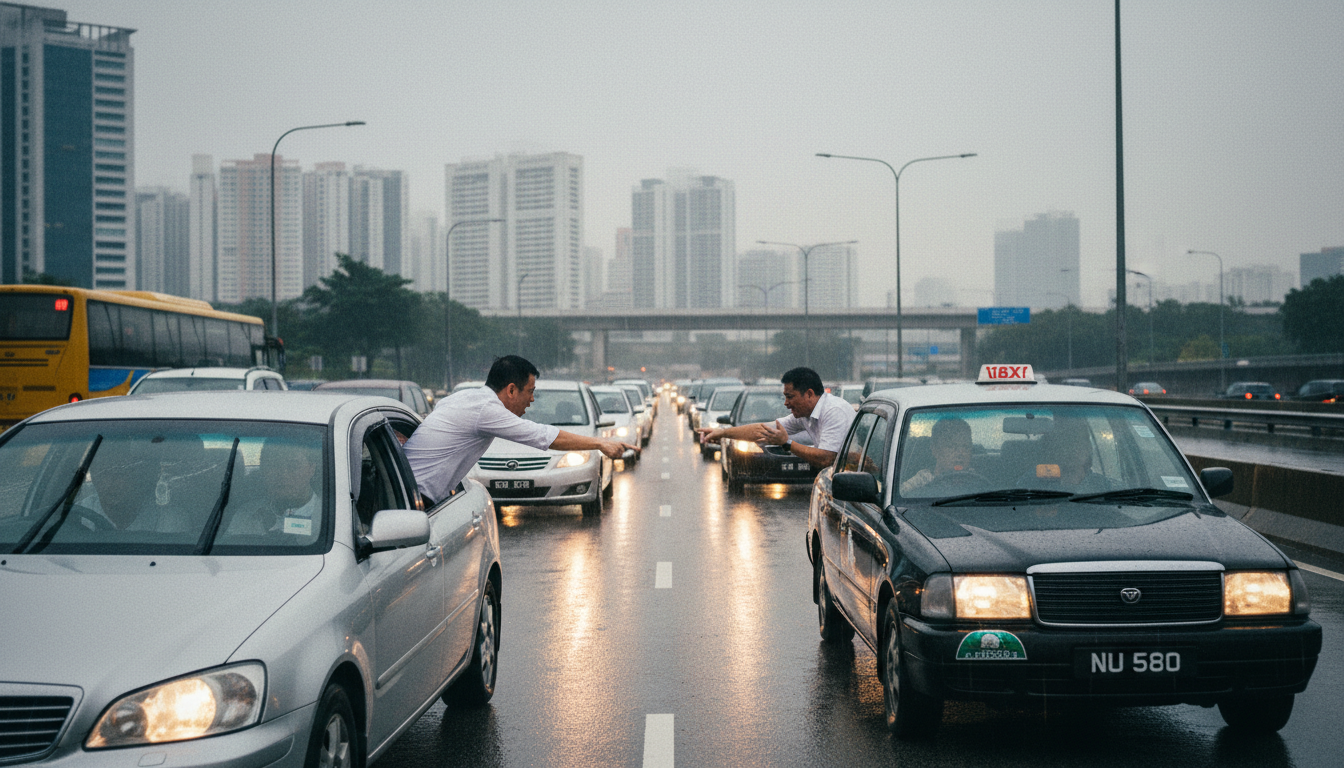
The public record of Jereme Quek Han Fei's actions on August 28, 2026, details a sharp escalation of frustration on Singapore’s roads. Angered by a van driver using a mobile phone, Quek repeatedly sounded his horn and shouted vulgarities. His subsequent act – stopping his car, confronting the driver, and slapping him – resulted in a jail sentence. This incident is presented as a singular event, yet it resonates with an undercurrent of tension found in dense urban landscapes across Asia.
The act of one driver stopping another to mete out personal justice (Angered after seeing the van driver use his mobile phone, the man sounded his horn repeatedly and shouted vulgarities at the driver before stopping his car and approaching him. — CNA Lifestyle, 2026) is not an isolated phenomenon in regional traffic narratives. Reports from Hong Kong (4 more men arrested over chaotic stand-off involving Hong Kong minibus. — South China Morning Post, 2025) and previous incidents in Singapore (Private-hire driver with poor driving record cut in front of cars and braked, gets jail, driving ban. — CNA, 2026; Ex-actor Edmund Chen jailed 5 days over AYE accident that caused motorcyclist to suffer fractures. — The Straits Times, 2026) illustrate how the road can transform from a functional conduit to a stage for conflict. This pattern suggests that the shared space of the road, particularly in cities designed for efficiency and high throughput, often asks a degree of patience and restraint from its users that is not always met.
Singapore’s urban planning prioritises order and often, efficiency. Its transport infrastructure is designed to move people and goods effectively. Yet, into this structured environment, individuals bring their own stresses and expectations. The demand placed on drivers — to navigate dense traffic, adhere to strict regulations, and contend with the perceived infractions of others — can become a significant psychological burden. The mobile phone, in this context, serves not only as a distraction but often as a focal point for grievance, symbolising a breach of the shared, unspoken rules of the road. It represents a common perceived disregard for collective safety and efficiency, sparking reactions that defy the intended order of public spaces.
The challenge for cities across Asia, including those in Thailand and the wider Asia-Pacific, is how to manage the psychological landscape of urban travel. While strict penalties for transgressions are in place (Man jailed after abruptly stopping car to confront, slap van driver who was using phone while driving. — CNA, 2026), these measures address the consequence, not necessarily the root cause of the tension. The city, in its relentless push for progress and density, compresses individual lives into tighter spatial and temporal constraints. This compression, in turn, can heighten sensitivities and shorten tempers, manifesting in public displays of frustration such as road rage.
Consider the contrast: the city offers anonymity and efficiency, yet simultaneously strips away personal space and privacy, particularly in transit. This paradox means that while individuals may feel less accountable to a specific community on the road, they are simultaneously more exposed to the frustrations engendered by others. The strictness of Singaporean law provides a framework for addressing such outbursts after the fact, but it does not, and perhaps cannot, prevent the friction that arises from the daily negotiation of shared urban arteries. The street, then, becomes a reflection of the city's broader compact with its inhabitants: a promise of opportunity and order, often delivered at the cost of personal forbearance and sometimes, in moments of acute tension, self-control.
Sources
Newsletter
Pacific Daily
A curated briefing from Thailand, Asia-Pacific and the world.