The Silent Reckoning of Supply Chains in Asia's Shifting Demands
Beyond the gleaming factory floors of Henan, the deployment of robotic systems signals a deeper re-evaluation of how goods move, and what it asks of the places they touch.
SINGAPORE
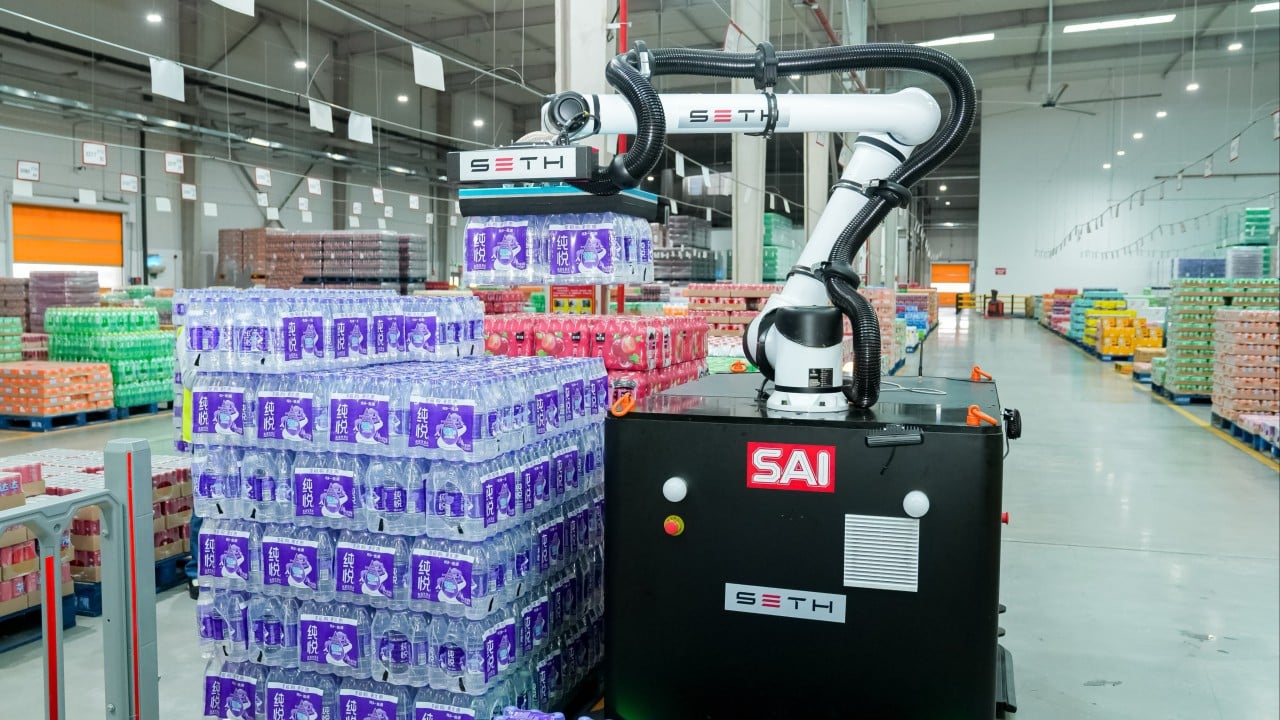
The capital of Henan province, Zhengzhou, might not immediately evoke images of cutting-edge automation. Yet, it is within one of its industrial facilities that Swire Coca-Cola recently introduced a robotic system for order picking. The company states that this move, part of a 900 million yuan (US$134.3 million) investment, is in response to Chinese consumers demanding more variety from their drinks sections. Peter Mills, chief supply chain officer, described China as a "growth market" with "changing consumer habits." This localized scene of industrial upgrade suggests a quiet but profound transformation occurring across the broader Asia-Pacific region.
While the company frames this as a proactive response to evolving tastes, the introduction of automation, specifically for order picking, reflects a more fundamental consideration: the labor required for distribution. Robotics addresses the physical demands of "heavy lifting" mentioned by the South China Morning Post (2026-09-21), but it also addresses the cost and availability of human labor. The decision to invest heavily in fixed automation for logistics implies a long-term calculation regarding operational efficiencies and, perhaps, the increasing expense or scarcity of manual labor in China’s industrial heartlands. Such an investment is not made lightly, particularly when Swire’s China Coca-Cola business was described as "mired in 'subdued' spending" by asia.nikkei.com (2024-08-08) just two years prior.
This shift in supply chain mechanics has implications far beyond a single factory floor. If this model proves efficient and scalable, it suggests a future where the physical movement of goods, from factory to shelf, relies less on human hands and more on integrated robotic systems. For Thailand, and other Southeast Asian nations that have increasingly become hubs for manufacturing and logistics, this trend raises a pivotal question: What new demands will these automated supply chains place on their existing infrastructure and workforce? The challenge might not just be adopting new technology, but adapting entire logistical ecosystems to accommodate a new paradigm of speed and precision, dictated by machines rather than traditional labor flows.
The counter-argument, often presented by companies, is that automation frees up human workers for more complex, higher-value tasks. While this may be true in theory, the immediate reality for many local economies reliant on manual labor in warehouses and distribution centers could be a period of disruption. The scale of this disruption depends on how widely and quickly such systems are adopted. Swire, for its part, has been actively expanding its bottling business in Southeast Asia, notably acquiring Coca-Cola’s operations in Vietnam and Cambodia for US$1 billion in 2022. This expansion, coupled with automation in China, paints a picture of a company optimizing its regional operations, potentially seeking to replicate efficiencies across its entire Asia-Pacific footprint. The question for destinations then becomes: Does this new efficiency enhance their role in the global supply chain, or does it merely reduce the human component of their contribution?
The scene in Zhengzhou is not merely an anecdote of industrial progress; it is a signal. The physical demands of the supply chain are changing, transforming the expectations of what a place must provide to facilitate commerce. It is a quiet reckoning that asks its own question of the region: how will its communities and economies adapt to a landscape increasingly shaped by the precise, relentless rhythm of machines, rather than the varied pace of human hands?
Sources
Newsletter
Pacific Daily
A curated briefing from Thailand, Asia-Pacific and the world.