Sukhumvit Street Arrests Expose the Limits of Street-Level Deportation
Detaining foreign sex workers along Bangkok's tourist corridor satisfies online complaints while leaving cross-border economic pressures untouched.
SINGAPORE
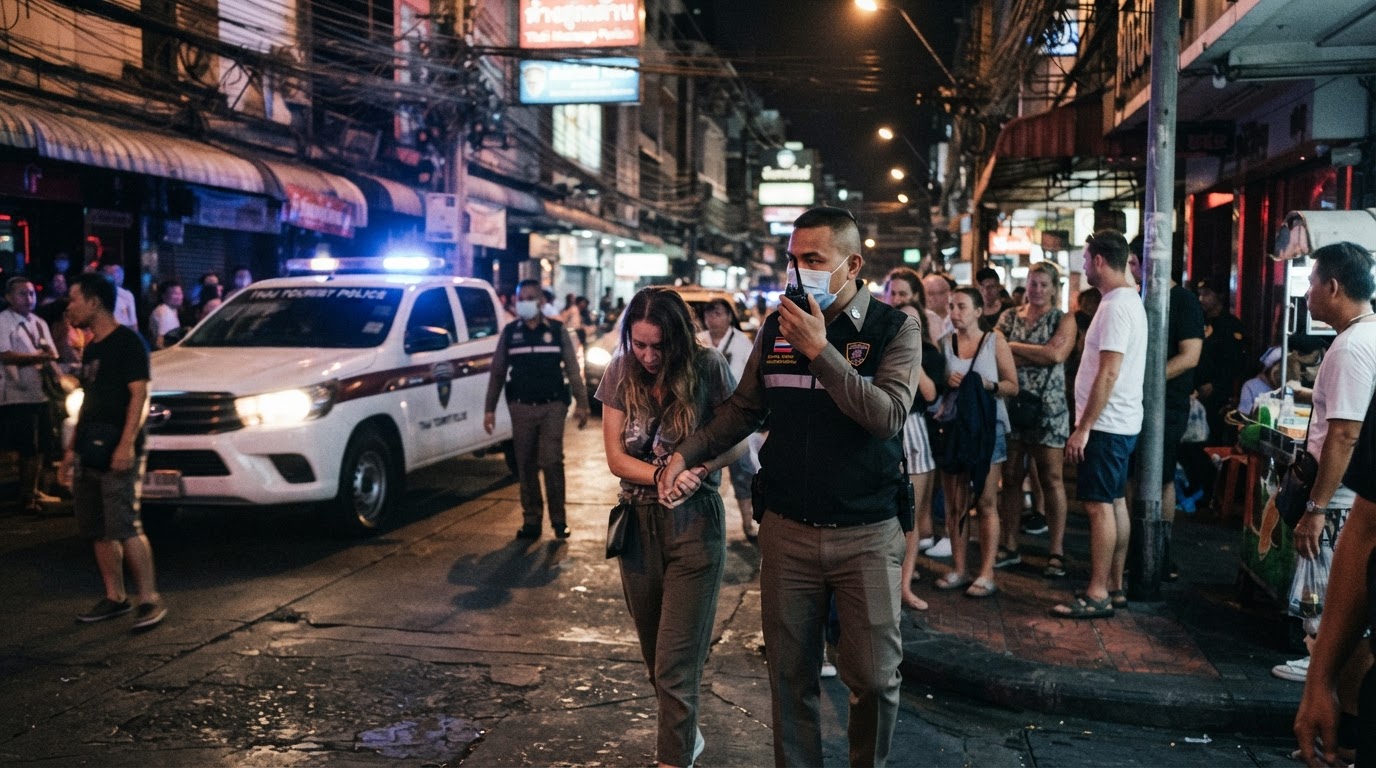
Bangkok police detained seven Vietnamese women on Sukhumvit Road on Friday night. Officers took the women into custody between Soi 4, known as Soi Nana, and Soi 11 at approximately 8pm, preparing them for deportation under charges of soliciting prostitution. Pol Col Yingyot Suwanno, chief of the Lumpini police station, confirmed the operation followed complaints and video reports circulating across social media platforms.
Public crackdowns along this commercial corridor are regular administrative rituals. Similar sweeps targeting foreign nationals occurred along Soi Nana in May 2025 and again in March 2026. The intervention follows an established script: viral digital footage generates civic friction, district police deploy patrol teams, and detainees face rapid transfer toward immigration processing. What results is visible administrative compliance that resolves the immediate public relations exposure of the precinct without touching the structural mechanics of the cross-border sex trade.
Enforcement by Algorithm
Municipal policing in prime commercial zones increasingly responds to digital agitation rather than systematic intelligence. Once footage of overseas workers operating between Soi Nana and Soi 11 begins tracking across feeds, district authorities face immediate pressure to establish physical control over the pavement. The public appearance of order matters more than sustained investigation into recruitment logistics or local coordination.
Advocates of street-level enforcement maintain that visible sweeps are indispensable. District commanders must maintain order along primary retail corridors, uphold immigration laws, and deter unregulated street solicitation that disrupts local commerce. A failure to execute arrests after documented complaints risks projecting institutional paralysis. Frontline officers have a mandate to clear public spaces when statutory violations occur in plain view, regardless of whether underlying regional economic drivers remain active.
Yet administrative deportation shifts the financial burden downward while leaving operating environments intact. The women apprehended on Sukhumvit, aged between 22 and 41, face expulsion and formal travel bans. That penalty falls entirely upon individual migrant workers who absorb the economic shock of arrest and deportation costs. The hospitality establishments, commercial networks, and intermediaries that facilitate the nighttime trade along lower Sukhumvit continue operating without scrutiny or legal liability.
The Cross-Border Labor Reality
Regional labor disparities ensure that removal functions merely as turnover. For informal workers arriving from Vietnam or neighboring jurisdictions, currency differentials and domestic employment deficits outweigh the risk of municipal custody in Thailand. Sukhumvit remains an attractive destination precisely because informal night economies offer immediate cash earnings that formal migrant labor schemes across Southeast Asia do not match.
By treating cross-border sex work as an isolated public order nuisance, authorities guarantee the cycle repeats. Sweeps clear designated sidewalks for several weeks until social media attention migrates to another urban district. Then, new arrivals replace those deported, drawn by the identical financial logic that brought earlier cohorts. The outcome does not alter informal commerce along Soi Nana; it merely rotates the individuals who inhabit it.
Urban governance in Bangkok remains anchored to this friction between visual policing and economic reality. Real disruption would require investigating the infrastructure of commercial spaces, informal work permits, and cross-border transport routes. Until statutory frameworks address the commercial hosts that profit from tourist-belt nightlife, deportation will remain an administrative theater where vulnerable workers pay the entire cost of institutional convenience.
Sources
Newsletter
Pacific Daily
A curated briefing from Thailand, Asia-Pacific and the world.