Re-Exporting the Taco
Chipotle's expansion across Mexico reveals how industrialised assembly reshapes consumer acceptance of foreign fast casual.
Standardising an indigenous culinary tradition for high-volume delivery requires dismantling its core methods, reducing layered braises and fresh salsas to modular, uniform components. When United States chains attempt to sell these industrialised interpretations back to their country of origin, the cultural and economic friction becomes immediate. Yet corporate operator Alsea is preparing three to four additional Chipotle locations across Nuevo León during the first quarter of 2027, followed by an expansion into Mexico City later that year, after a July 2026 launch exceeded corporate forecasts.
The venue in San Pedro Garza García, part of the greater Monterrey metropolitan area, tested whether an American fast-casual brand built on Tex-Mex vernacular could survive in a domestic market defined by ubiquitous street-level competition. Taco Bell attempted similar incursions into Mexico in 1990 and again in the 2000s, failing both times because consumers rejected its low-cost fast-food format as an inferior simulation of domestic staples. Fast-casual dining, however, operates on an entirely distinct commercial logic.
Industrialised Assembly
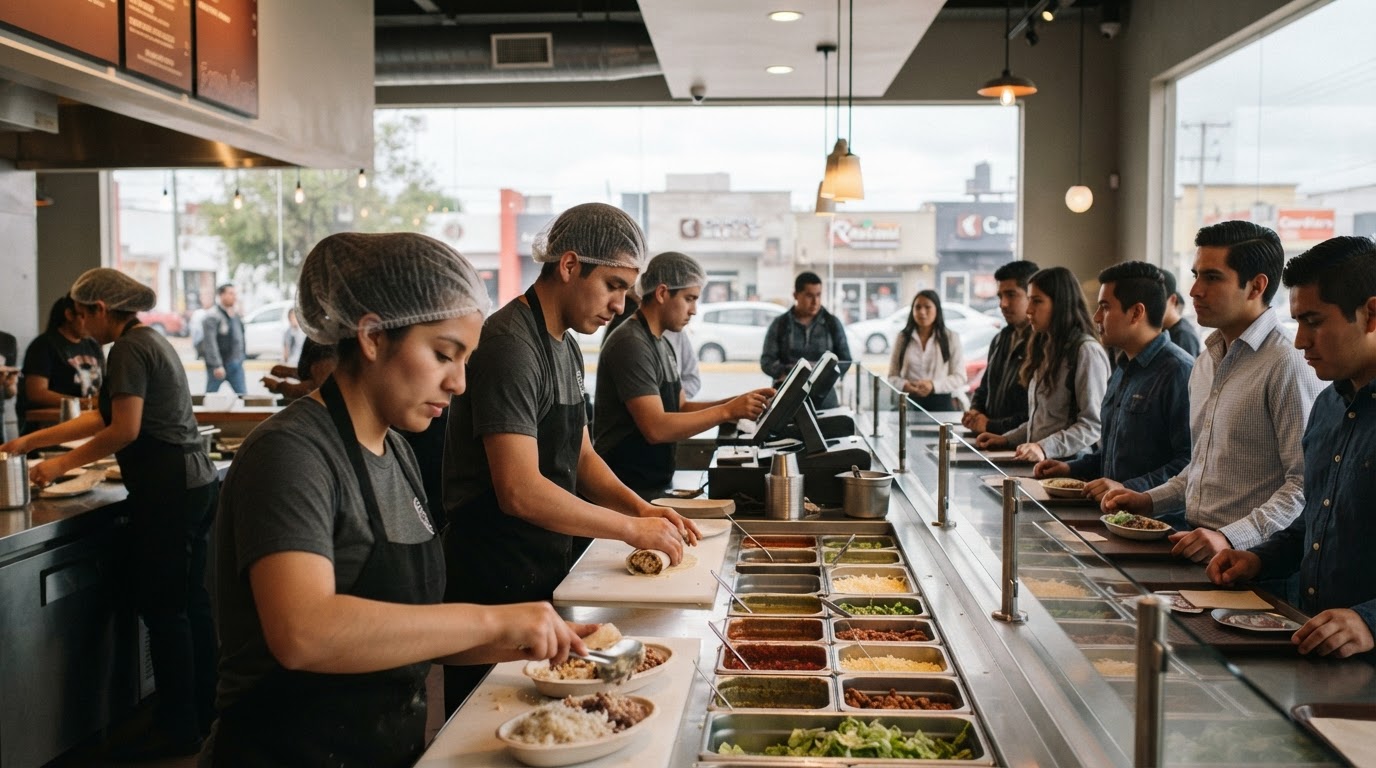
Chipotle relies on visible assembly line preparation rather than pre-wrapped, concealed production. Ingredients sit in heated and chilled stainless steel pans behind transparent glass shields, allowing patrons to dictate individual portions of seasoned rice, pinto beans, braised meats, and pressed salsas. This visual presentation mimics the transparency of an open kitchen or a neighbourhood street stall, even though the underlying logistics remain completely centralised.
By framing the process as bespoke assembly using whole ingredients, the concept manages consumer perception differently than legacy fast food. The customer observes raw lettuce chopped, grilled chicken sliced, and guacamole mashed, associating these tactile steps with culinary freshness. This operational choreography bridges the gap between mass processing and culinary legitimacy, convincing diners that industrial convenience does not necessarily compromise fundamental culinary standards.
Yet this model depends on pricing power and specific demographic enclaves. Selecting San Pedro Garza García—a high-end municipality—sheltered the initial launch from broader price sensitivities. When a meal costs between USD 7.98 and USD 10.64, it positions the product well above the cost structure of local taquerías, competing instead against established mid-tier dining options.
The Limits of Re-Imported Cuisine
Expansion into Mexico City will present a fundamentally different operational test. The capital maintains one of the dense, highly varied urban food economies in the Pacific Rim, where regional preparations from across the nation compete on every corner at fractionally lower prices. In such an ecosystem, novelty diminishes rapidly once the operational rhythm settles into routine commerce.
The operational choreography bridges the gap between mass processing and culinary legitimacy.
Sustaining 150 to 200 daily transactions in an affluent enclave does not prove long-term viability across diverse urban neighbourhoods. The counterargument to Chipotle's early traction is that novelty and curiosity frequently inflate foot traffic during inaugural quarters, particularly among internationally mobile consumers already familiar with foreign consumer brands. Alsea CEO Christian Gurr must demonstrate that high-throughput fast casual can maintain customer loyalty once the novelty subsides and consumers evaluate the food purely against native street food standards.
Across the wider Pacific Rim, where global chains frequently adapt Asian culinary staples for export before attempting to re-import them to their native markets, this rollout offers an instructive precedent. Survival does not hinge on claims of authenticity, which crumble under close domestic scrutiny. Success depends instead on process control, hygiene presentation, and customer agency along the counter. The unresolved constraint remains whether high-cost foreign assembly can permanently supplant domestic food cultures, or whether it simply occupies an expensive corporate niche that struggles to outgrow its initial perimeter.
Sources
Newsletter
Pacific Daily
A curated briefing from Thailand, Asia-Pacific and the world.