Drifting Torpedo Highlights Operational Stress Points in Pacific Exercises
A lost practice device near Ensenada reveals vulnerabilities in military training, with direct implications for Asia-Pacific stability.
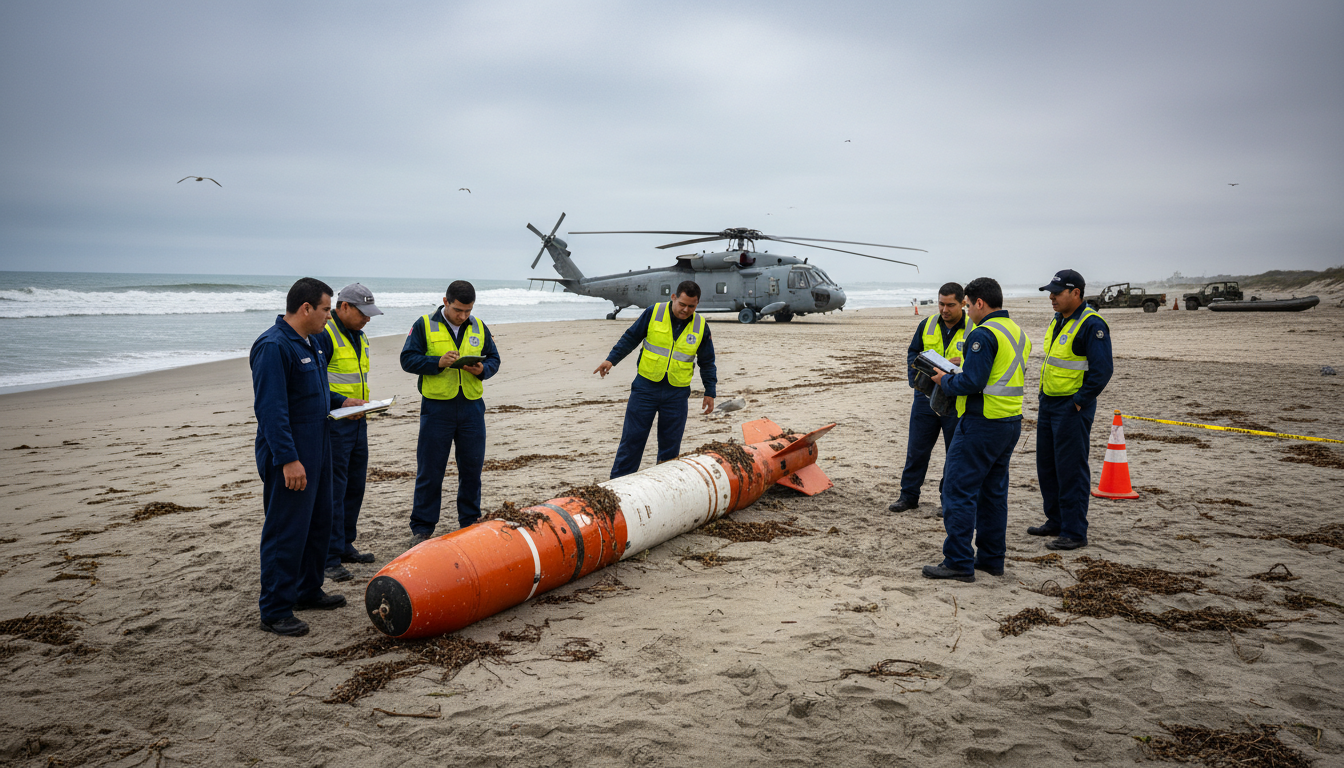
The recovery of a nonexplosive U.S. Navy MK 54 REXTORP practice torpedo near Ensenada, Mexico, following its drift from a Southern California training exercise, offers a specific observation on the operational realities of naval maneuvers. While the device, designed for training launches from aircraft or ships, was ultimately returned to U.S. authorities, its unsupervised transit into Mexican waters points to a structural challenge in large-scale military operations: the management of assets under dynamic conditions.
The U.S. Navy is scheduled to lead 2026 International Exercises, an event anticipated by Forbes. These exercises, which historically involve substantial deployments, inherently carry risks of equipment loss or operational deviation. The fact that a practice torpedo, identified by Mexico’s Navy, traveled 42.7 kilometers southwest of the port of Ensenada suggests a gap in tracking or recovery protocols. Such an incident, though seemingly minor, indicates that even non-combat materiel can become unmoored and drift across jurisdictional boundaries. The Mexico News Daily reported this event on September 22, 2026, noting that fishermen alerted the Navy.
In the Asia-Pacific region, where naval exercises are frequent and increasingly complex, such operational oversights present a distinct set of implications. China and Russia are preparing for Pacific Rim drills, as reported by the South China Morning Post in 2024, responding to activities by the U.S., Japan, and South Korea. This escalating frequency and scale of naval activity, sometimes termed a 'Rim of China' by the East Asia Forum, increases the probability of similar incidents. A lost torpedo, whether practice or live, entering another nation's territorial waters can quickly escalate from an operational oversight to a diplomatic flashpoint.
The critical question for naval operations, particularly at full capacity, remains the integrity of asset control. While a practice torpedo is not a direct threat, its uncontrolled movement suggests that other equipment, potentially more sensitive, could also be misplaced. The sinking of a former Navy cargo ship as part of a scaled-back naval exercise in 2020, as reported by ABC News, demonstrates that even controlled destruction can encounter complexities. The primary limitation of such incidents is not the immediate danger posed by a non-explosive device but the systemic vulnerability it exposes. Each piece of equipment lost or unaccounted for during exercises represents a potential security or diplomatic challenge. The current system’s capacity to prevent and manage such occurrences during high-tempo operations remains largely untested under sustained, multi-domain pressure.
The outcome now depends on whether these isolated events are treated as minor anomalies or as indicators of systemic stress points requiring reassessment of operational protocols and international coordination mechanisms.
Sources
Newsletter
Pacific Daily
A curated briefing from Thailand, Asia-Pacific and the world.