An Urban Drainage Deficit in Plain View
When routine tropical downpours paralyze Pattaya's primary bypass arteries within minutes, municipal deployments expose the cost of treating emergency traffic management as a substitute for subterranean capacity.
SINGAPORE
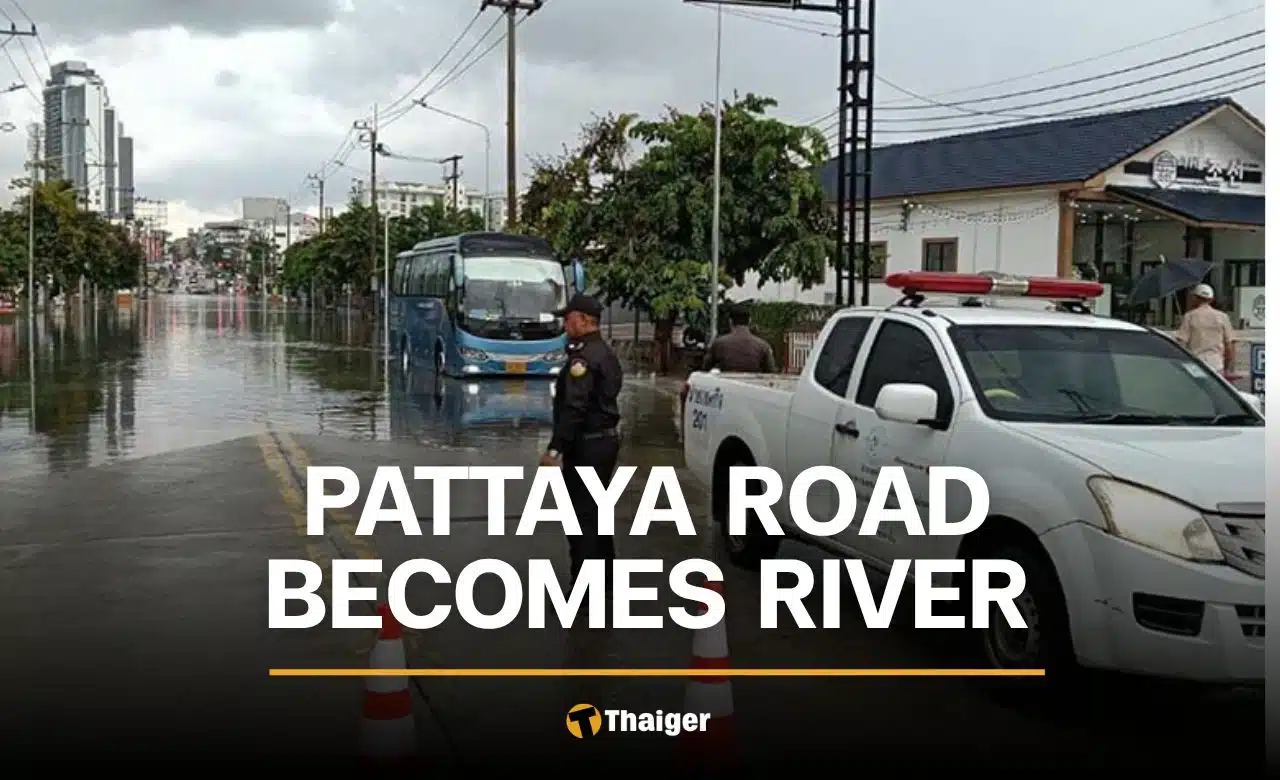
Urban drainage networks reveal their operational limits during sudden cloudbursts rather than catastrophic storms. On October 29, sudden heavy rain across Pattaya submerged primary transit routes, shutting the Moom Aroi junction on Pattaya Third Road to both small and large vehicles within minutes. Pattaya municipal officers logged the flooding at 2.56pm, dispatching personnel into standing water to assist stranded motorists and reroute local traffic at several flood-prone locations. By 3.02pm, municipal officers were also stationed near Mega Home on the inbound Sattahip side, where rising floodwater squeezed moving traffic into just two right-hand lanes, slowing vehicles heading in that direction.
Such recurring standstills along Pattaya Third Road illustrate how rapid commercial development outpaces municipal drainage. When a primary urban junction becomes impassable to all vehicular classes, the immediate economic friction falls directly upon local delivery drivers, daily commuters, and small transport operators moving between Pattaya and Naklua. Public advisories urged drivers to proceed carefully, yet submerged asphalt leaves virtually no margin for individual caution. Deploying municipal staff to push stalled vehicles and wave traffic away from deep water represents an operational triage, functioning as a temporary stopgap rather than a durable civil engineering remedy.
The Mechanics of Recurrent Gridlock
Surface runoff along coastal urban corridors follows gravity, but unchecked concrete expansion dictates where that water collects. The intersection at Moom Aroi has repeatedly functioned as a collection point whenever rainfall intensifies, leaving public officials to manage the resulting queue rather than the underlying volume. Motorists attempting to traverse the inbound Sattahip stretch past Mega Home faced bottlenecks that rippled backward through connected feeder routes, slowing transit across the district. Without permeable ground to absorb surface water, every sudden downpour converts asphalt corridors into artificial canals, trapping vehicles that have no alternative diversion routes once they enter the grid.
Urban administrators frequently classify these disruptions as unavoidable flash floods driven by erratic tropical weather. Municipal authorities point out that localized cloudbursts can drop immense water volumes in brief periods, temporarily overwhelming even modern storm sewer networks. Regional reporting underscores that severe hydrological events have battered settlements across Asia, from deadly Himalayan flash floods in Nepal and China to devastating cloudbursts in Pakistan documented by The Japan Times. Five people went missing in Nepal flash floods that swept away houses, showing the extreme ends of monsoon volatility. From an administrative vantage point, expecting urban storm networks to absorb violent downpours without surface accumulation is technically and financially daunting.
Containment Versus Correction
That explanation offers small comfort to the residents who absorb the daily financial toll of waterlogged engines, missed working hours, and compromised road safety. Conflating extreme regional weather phenomena with predictable urban runoff obscures a localized planning deficit. The Moom Aroi junction and adjacent sectors along the Pattaya-Naklua Road network sit in known low-lying depressions where runoff patterns recur predictably during the monsoon months.
Treating repetitive inundation as an emergency event requiring hands-on rescue work normalizes an infrastructure gap. Drainage systems, holding capacity, and culverts remain undersized relative to the pace of commercial construction and roadway paving across Pattaya. Rather than redesigning subterranean hydraulic transit to swiftly discharge water toward the coast, municipal management defaults to sending officers into the rain at 2.56pm to redirect cars away from predictable dead ends. Manual intervention masks the underlying engineering shortfall, giving the appearance of an active response while leaving structural vulnerabilities unchanged year after year.
Pattaya municipal officers deserve credit for stepping into rushing surface water to protect stranded drivers and maintain order. Yet relying on physical staffing to mitigate roadway flooding reveals an unresolved conflict between surface expansion and underground investment. When emergency personnel become the default mechanism for managing routine rainfall, civic planning has effectively outsourced infrastructure responsibility to the street level. Until civic investment elevates subterranean drainage capacity to match the scale of asphalt above it, ordinary rainfall will continue to paralyze the city's transport arteries.
Sources
Newsletter
Pacific Daily
A curated briefing from Thailand, Asia-Pacific and the world.