Why Bangkok Flood Compensation Breaks Down at the District Gate
Paper tickets and overnight queues show how civic portals fail when household budgets face water damage
BANGKOK
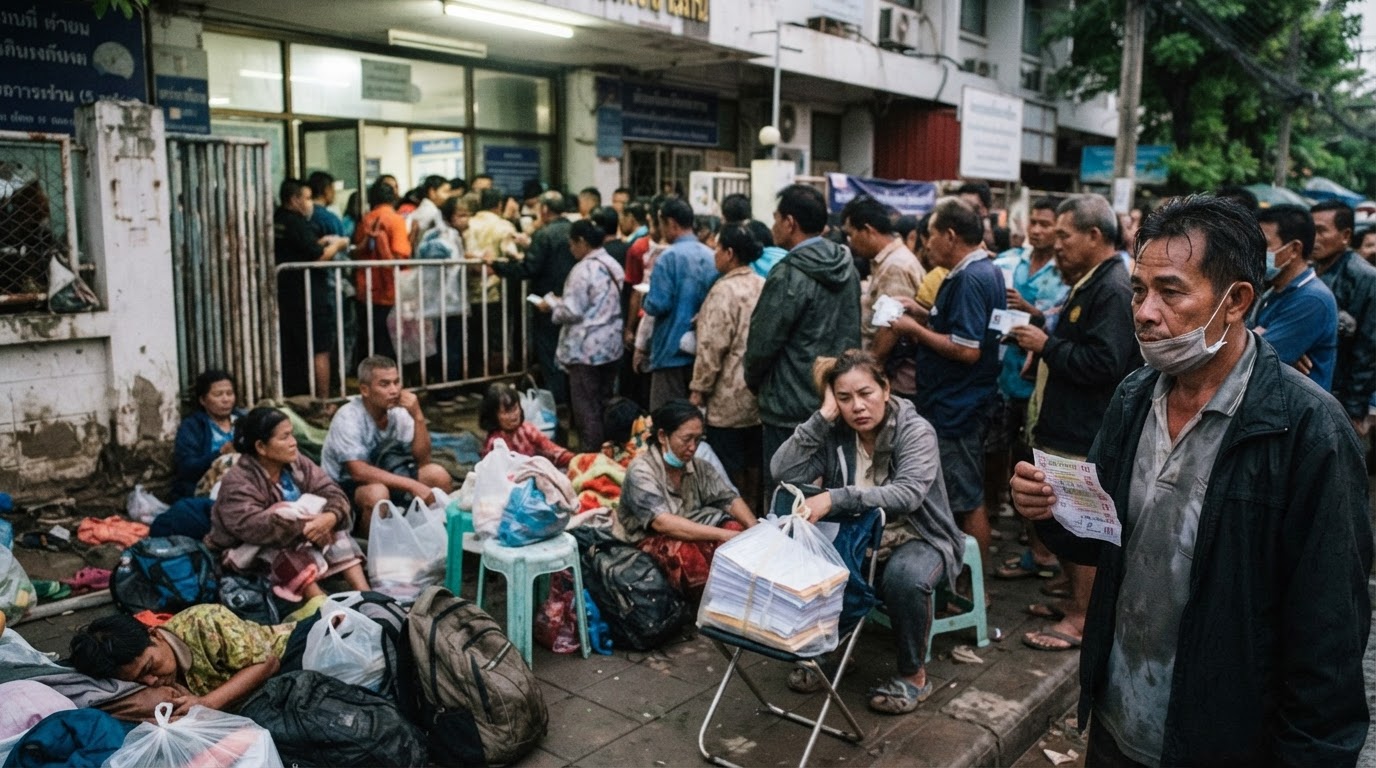
Disaster relief reveals its real administrative design at four in the morning on an unpaved curb. Outside the Sai Mai district office on a recent weekend, residents lined up pairs of shoes and discarded personal belongings to preserve positions on the pavement before dawn arrived. Flood victims had begun gathering on Saturday evening to ensure access to municipal compensation procedures. By nine on Sunday morning, municipal staff had exhausted every single one of the 1,200 queue tickets allocated for the day, sending hundreds of claimants home empty-handed.
Such scenes demonstrate the distance between high-level civic technology and household economics. Families managing submerged ground floors cannot wait indefinitely for remote servers to function. While official portals promise seamless processing, the actual bottleneck lands immediately on physical counter staff and arbitrary daily caps.
The Friction of Digital Portals
When municipal systems deploy an online application to distribute recovery funds, the stated goal is speed and transparent access. In practice, the digital mechanism introduces an administrative barrier for households already handling structural damage. Bangkok residents reported persistent difficulties using the central application to register claims, forcing them to abandon smartphones and seek direct municipal counter service.
Personal logistics shift instantly under these conditions. Taking time off hourly work or domestic repairs to wait through the night represents an uncompensated operational expense. One resident who reached the municipal office at 4am received an entrance ticket numbered in the 600s. The math of physical relief distribution remains unforgiving: half the daily allotment had already vanished before regular municipal operating hours began.
Similar friction points surfaced across the capital, including at the Lat Krabang district office. When local administrative quotas expire before breakfast, the compensation process ceases to be a social safety mechanism and becomes an endurance test. Household survival strategies then mimic pre-digital practices, using footwear as place markers in the dark to secure an interview that may not materialize.
Defenders of administrative rationing maintain that daily ticket allocations prevent dangerous crowd surges and keep overworked municipal desks from collapsing. Orderly queuing protects civil servants from processing errors during emergency declarations, while online portals steadily absorb tech-literate filers off-site. Yet this administrative defense ignores who bears the immediate risk. Rationing by physical queue does not eliminate excess demand; it simply forces vulnerable residents to subsidize administrative incapacity through sleepless nights and lost working days.
The Real Measure of Urban Recovery
Administrative capacity cannot be evaluated by the launch of a software application. Its true test is whether an affected resident can settle a basic claim without sleeping on the street. When municipal agencies set hard physical limits without expanding digital troubleshooting on the ground, they effectively penalize citizens whose neighborhoods took the water.
Urban water management routinely commands capital budgets and political speeches. Compensation delivery, by contrast, relies on clerks stamping slips behind security gates until a box of numbered paper runs out. What changes in a family's month is determined less by the volume of runoff than by whether an administrative counter opens its window to number 1,201.
Progress on municipal resilience ultimately depends on whether administrative workflows adapt to human panic instead of forcing distressed households to conform to bureaucratic processing quotas.
Sources
Newsletter
Pacific Daily
A curated briefing from Thailand, Asia-Pacific and the world.