The Domesticated Street
Marriott’s turn toward vernacular cuisine reveals an unresolved spatial tension between corporate enclosures and the cities outside them
SINGAPORE
A corporate hotel dining room functions primarily as an acoustic and thermal barrier against the city surrounding it. Thick glazing eliminates street traffic, air conditioning strips humidity, and deep acoustic carpeting absorbs the metallic clatter of urban life. For decades, international hotel architecture in Asia-Pacific perfected this spatial isolation. The interior was meant to reassure guests through predictable geometries and an internationalized menu that could belong anywhere. Now, that same architecture is being asked to perform its exact opposite.
According to Marriott International’s Future of Food 2027 report, corporate hospitality across Asia-Pacific excluding China is executing an abrupt pivot toward the vernacular. The survey found that 95 percent of surveyed properties identified demand for local signature dishes as a dominant trend in their markets. Four in five properties reported introducing new local ingredients over the past year. From properties across Thailand and Vietnam to Japan, Cambodia, and Singapore, institutional menus are shedding generic international tropes in favor of regional culinary identity.
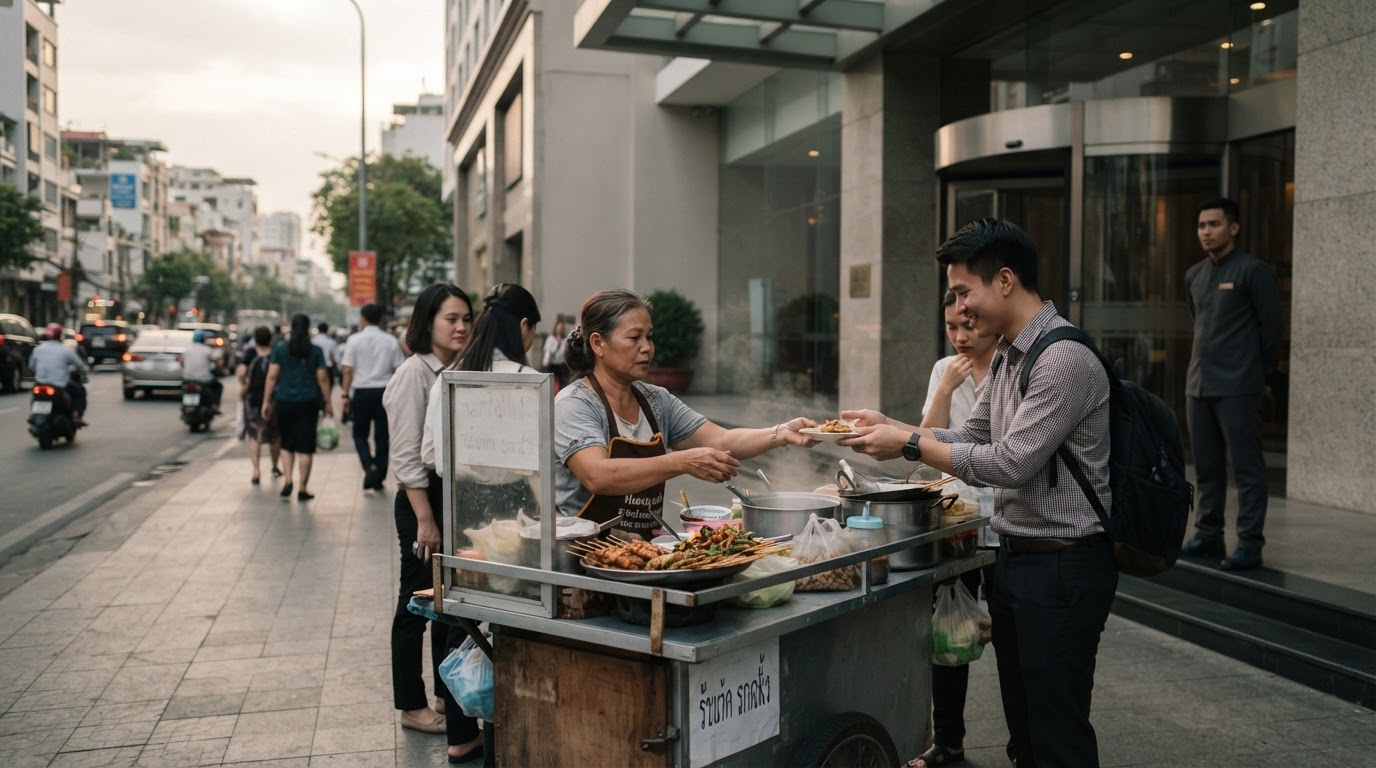
Yet what appears on the surface to be a cultural concession is fundamentally an architectural contradiction. The hotel podium was constructed specifically to filter out the street. Now, corporate operators must manufacture an encounter with that same street inside an environment built to repel it.
The Architecture of Extraction
When a five-star dining room attempts local provenance, the spatial mechanics become instantly visible. Consider the traditional street vendor or neighbourhood market stall in Kyoto or Kampot. Those food spaces are defined by porous perimeters, rapid circulation, direct heat, open ventilation, and direct contact with municipal asphalt. Their dishes reflect tight regional supply chains and an organic integration into the neighborhood fabric.
Transport that food into a sealed tower, and the relationship breaks down. The hotel kitchen operates under rigid sanitary protocols, corporate procurement regulations, and centralized mechanical ventilation. When regional recipes are transposed into an international hotel dining room, they undergo an inevitable aesthetic sterilization. The dish survives, but the spatial friction that produced it is neutralized. It becomes an extract, framed like an artwork in a quiet gallery.
The hotel podium was constructed specifically to filter out the street, yet now tries to simulate its flavours.
This is not accidental. The contemporary hotel guest demands the sensory markers of authenticity without any of its material discomforts. They want regional dishes without street dust, tropical heat, or chaotic queueing. Corporate architecture accommodates this contradiction by sanitizing the vernacular into an edible amenity.
Limits of the Built Enclosure
There is, naturally, an economic defence for this shift. Hospitality operators argue that sourcing local ingredients supports domestic agriculture and meets evolving traveller expectations. Guests no longer travel to South-east Asia to consume continental food, and retaining dining revenue within the property requires matching the culinary sophistication of the surrounding streets. If luxury properties do not offer credible local food, guests simply leave the building to find it.
That commercial pragmatism is real, but it reaches a clear physical ceiling. A building cannot simultaneously isolate itself from a locality and authentically manifest it. When 95 percent of properties claim local alignment, they are adjusting seasonal menus rather than restructuring their spatial relationship to the host city.
The hotel remains an enclave. Its doors are monitored, its spaces are privatized, and its dining rooms remain inaccessible to most residents living outside its walls. Changing the seasoning on the plate does not dismantle the architectural barrier separating global capital from the local street. Until hospitality architecture opens its floor plans to the city itself, the local flavour remains a decorative facade.
Sources
Newsletter
Pacific Daily
A curated briefing from Thailand, Asia-Pacific and the world.