The Heartbreak Racket: Mexico's Nights of Spite and Their Echo in Asia
In Valladolid, a unique cultural response to sorrow takes shape, turning individual pain into a collective, public act. This phenomenon highlights how societies transform personal adversity into communal ritual, a dynamic not unfamiliar across the Pacific.
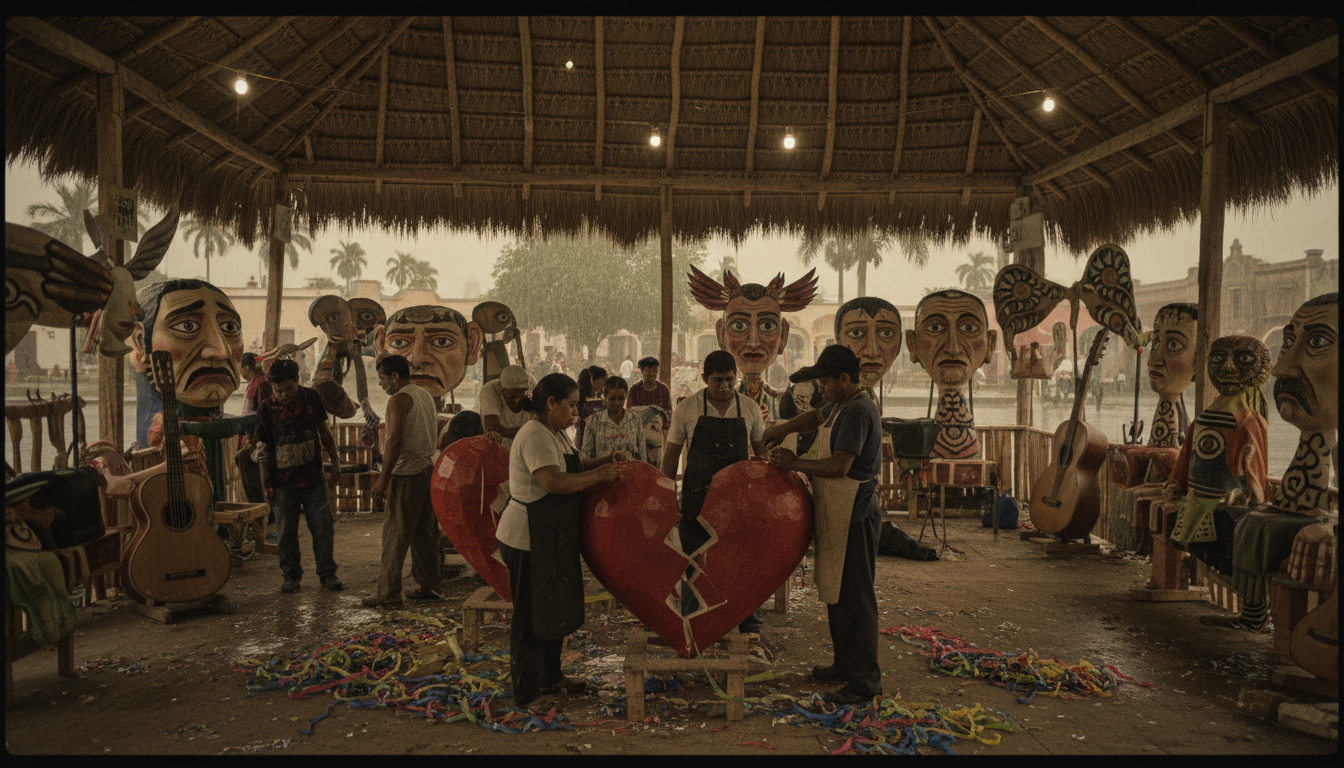
A Friday morning scene unfolds in a cantina in Valladolid, Mexico. Here, a dozen individuals in their fifties sing and dance to Timbiriche’s “Con Todos Menos Conmigo” over two-for-one cantaritos. They pass a microphone, orchestrating the karaoke playlist as a communal offering. Their energy suggests a long session ahead. This gathering is identified as a Noche de Despecho, or "Night of Spite," where, as Ethan Jacobs writes, a broken heart becomes a party.
This specific social custom, where personal grief finds a public stage, offers a lens into how communities manage and express collective emotion. It is not merely a party. Instead, it is a ritualized airing of sorrow, transformed into something robust and shared. The act of singing loudly, stirring tequila and grapefruit juice in earthenware jars, and cooling with hand fans, suggests a physical engagement with a deep-seated feeling. The "Night of Spite" reframes heartbreak from a solitary, internal experience to an outward, cathartic performance, acknowledged and amplified by others.
The communal handling of difficult emotions holds particular resonance for the Asia-Pacific region. While the specific form of a Noche de Despecho may be unique to Mexico, the underlying impulse to process personal hardship through collective cultural mechanisms is pervasive. Across Southeast Asia, for instance, various funeral rites and mourning ceremonies, distinct in their solemnity, serve a similar function: moving individual loss into a structured, community-supported experience. From elaborate cremation ceremonies in Bali to somber wakes in the Philippines, these traditions ensure that grief is not borne in isolation. The public nature of these events, often involving food, music, and shared narratives, helps integrate the pain into the social fabric, allowing for release and eventual acceptance within a supportive environment.
Yet, a crucial distinction emerges. Many Asian traditions channel sorrow into rituals of remembrance, respect, or spiritual transition. The Noche de Despecho, however, overtly embraces "spite" and transformation into a "party." This Mexican approach leans into defiance, a public reclaiming of agency from the ache of a broken relationship. It suggests a proactive, almost confrontational, engagement with heartbreak, rather than a resigned acceptance. The choice of Timbiriche’s “Con Todos Menos Conmigo” or “Mi Historia Entre Tus Dedos,” songs of lost love, provides the communal soundtrack for this transformation.
Connections between Mexico and the Asia-Pacific are not new. Discussions around trade, such as China’s application to join a Pacific Rim trade pact abandoned by the United States, highlight ongoing economic and political ties. Guillermo del Toro, the film director, whose film Pacific Rim explores a cross-Pacific narrative, has offered recommendations for visiting Mexico, pointing to cultural bridges. Even natural events, such as a magnitude 7.3 earthquake off the Mexico coast, underscore shared experiences across the Pacific basin. These connections, however, often focus on economics, politics, or natural phenomena, overlooking the more subtle cultural currents.
The Noche de Despecho is not merely a curiosity from afar; it invites reflection on how different cultures empower individuals to confront and articulate their vulnerabilities. The question this practice poses to societies across the Asia-Pacific is not whether they have their own equivalent, but what their prevailing cultural practices ask of individuals facing deep personal anguish. Is the expectation to endure quietly, to seek solace within private circles, or to find a communal language, however boisterous, to articulate and transcend it? The cantina in Valladolid, with its singing and dancing, offers one powerful answer: that a broken heart, when shared aloud, can become a defiant celebration.
Sources
Newsletter
Pacific Daily
A curated briefing from Thailand, Asia-Pacific and the world.