Storm Margins and the Real Measure of Civil Preparedness
Severe casualty figures from a weakened system reveal the persistent friction between meteorological forecasting and ground-level urban resilience.
SINGAPORE
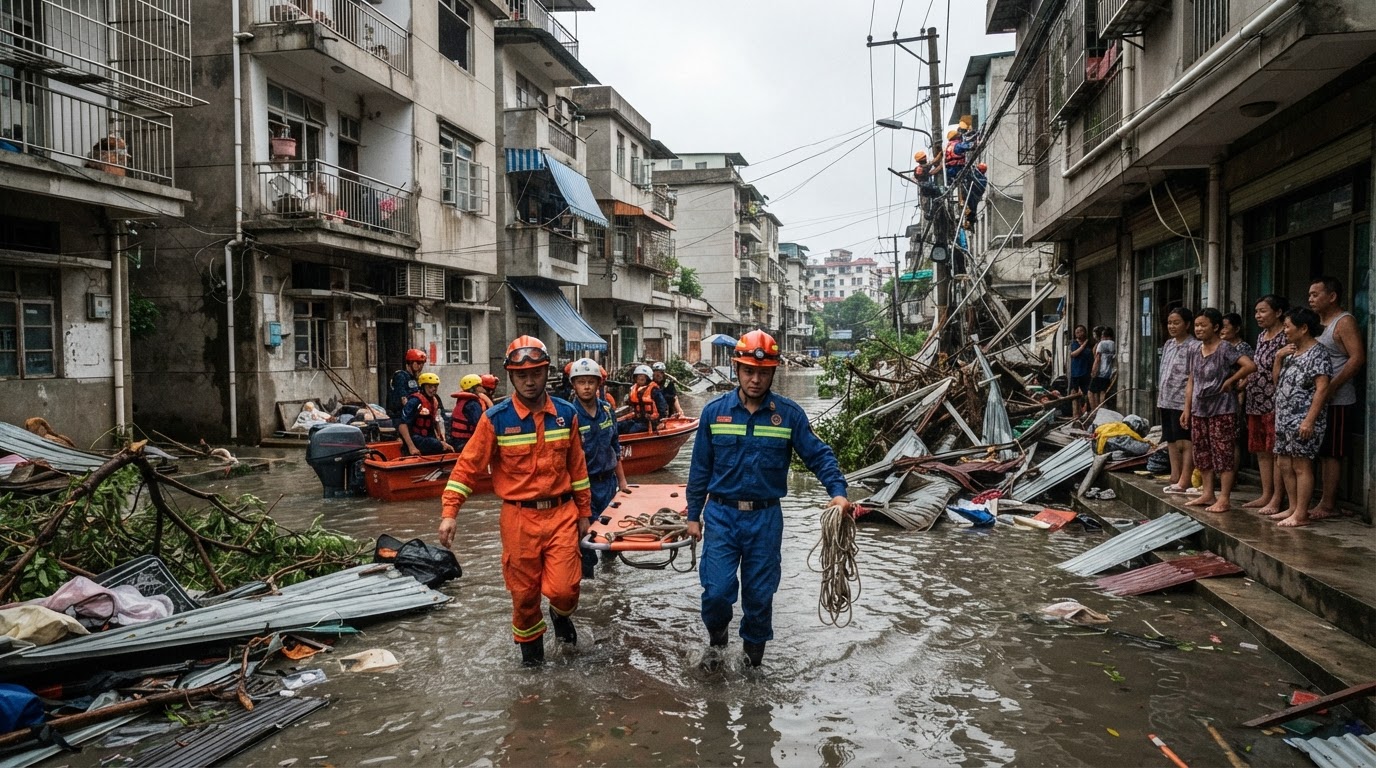
Civil protection architectures across the Western Pacific are routinely evaluated by their ability to withstand direct landfall from maximum-intensity weather systems. Historical storm management in maritime Asia has concentrated capital expenditure and civil defence logistics on the immediate impact zone of an advancing eye. Yet the passage of Typhoon Champi past northern Taiwan demonstrates that a cyclone does not require an onshore landfall strike to test the absolute limits of municipal safety nets. Downgraded from an earlier super typhoon designation, the system bypassed the island's coastline while continuing to generate wind gusts of around 126 kilometres per hour near its centre, according to Taiwan's Central Weather Administration. The administrative response was immediate, but the recorded toll proved substantial: one death and 527 injuries logged across northern and eastern territory, including coastal communities in Yilan and Keelung.
Institutional response protocols in coastal Asia have long treated gross atmospheric intensity as a reliable proxy for structural peril. When a tracking forecast confirms that a super typhoon has diminished from its apex, public vigilance inevitably recedes, even while outer circulation bands interact violently with dense urban topographies. The casualty distribution documented during Saturday's passage illustrates the policy error embedded in that operational habit. Severe wind loads, unanchored exterior fixtures, downed trees, and severed electrical cables create lethal environments that function largely detached from barometric records at sea. The count of 527 injured individuals exposes the friction points where building maintenance enforcement, movement restrictions, and local government cordons failed to isolate civilians from secondary physical trauma.
The Friction of Infrastructure Under Peripheral Wind Loads
Regional civil planning models generally presume that modern grid hardening and satellite tracking neutralize risk once a weather system curves offshore. Reality on the ground shows that structural vulnerability persists under sustained high-speed pressure. Municipal systems remain exposed to flying fragments, collapsing utility conduits, and damaged transport lanes long before a cyclone core approaches. The solitary fatality and the hundreds of casualties documented as Champi turned north toward the Chinese coast confirm that systemic exposure does not evaporate when central landfall is averted.
The transition from forecast awareness to absolute civic containment remains obstructed by the physical realities of the built environment.
Defenders of existing emergency frameworks argue that no municipal governance system can eradicate civilian injury during weather systems packing wind gusts of around 126 kilometres per hour. In this perspective, restricting fatalities to one person while managing hundreds of secondary casualties represents an effective institutional containment outcome for an island repeatedly struck by western Pacific depressions. Regulating every private facade, retail sign, and residential balcony across dense metropolitan corridors presents an administrative burden that statutory guidelines cannot resolve overnight.
Strategic Resilience Beyond Central Landfall
Equating peripheral storm tracks with lowered institutional risk nevertheless misreads the strategic lesson presented by this disruption. Modern meteorological bodies have solved the early detection problem; satellite monitoring ensures that approaching depressions no longer produce operational surprise. The continuing vulnerability across Pacific coastal centres lies in the enforcement gap between macro-level disaster warnings and micro-level municipal infrastructure security.
As Champi drifted north past Taiwan toward the Chinese mainland, the acute storm danger subsided, but the regulatory deficit remained evident. Addressing seasonal weather risks demands more than accurate track projections from weather bureaux. State authorities must reckon with how the built environment behaves under peripheral gale thresholds that shatter windows and down electrical wires without ever bringing a storm eye ashore. Until disaster mitigation doctrine treats peripheral wind envelopes with the same institutional discipline required for direct landfalls, coastal populations will remain vulnerable to storms that technically bypassed them.
Sources
Newsletter
Pacific Daily
A curated briefing from Thailand, Asia-Pacific and the world.