Maritime Volatility and Championship Friction at Phillip Island
Marc Marquez reclaims the MotoGP standings as coastal weather and track demands test the limits of precision racing
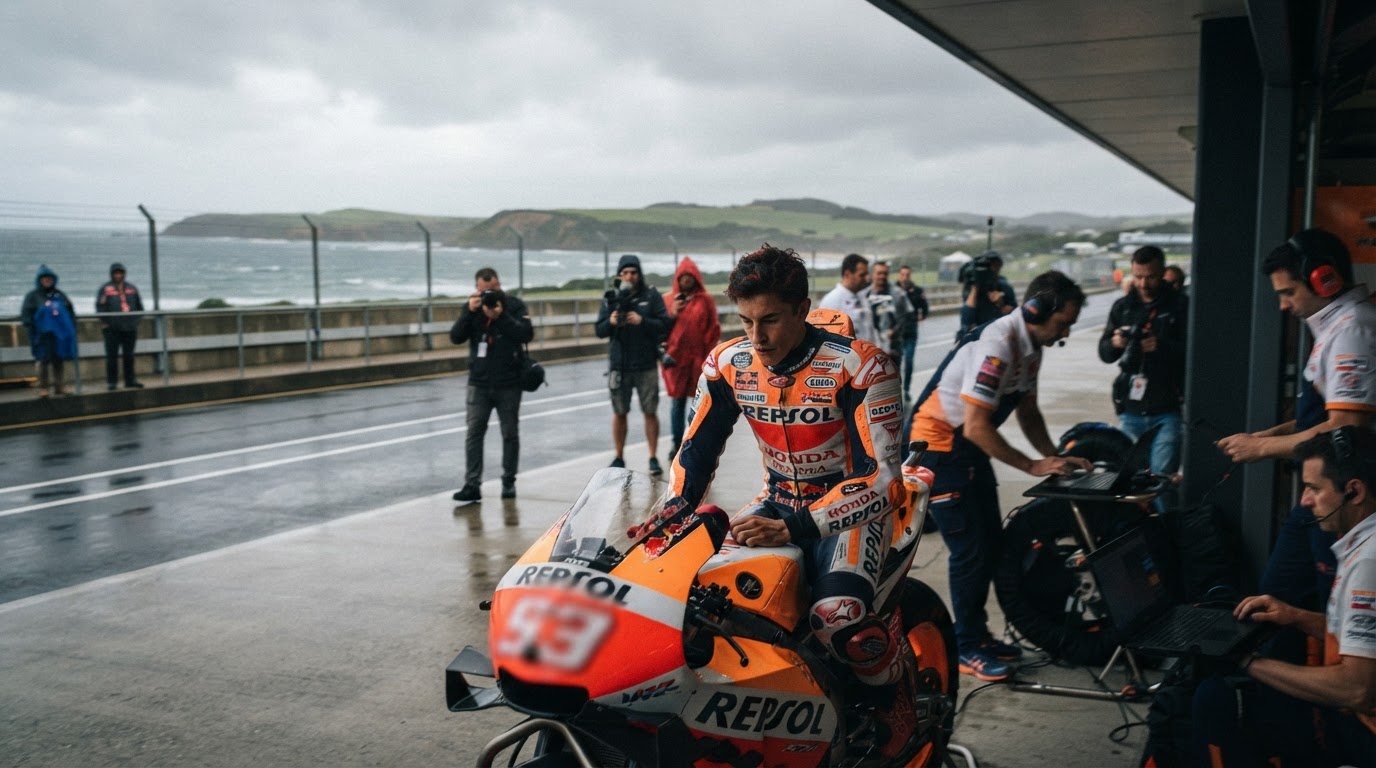
Factory engineering treats racing circuits as uniform thermodynamic baselines, but exposed ocean topography constantly repudiates that assumption. The Phillip Island Grand Prix Circuit operates directly within the path of southern maritime fronts. Weather changes there within minutes. On Saturday, Oct 24, that atmospheric exposure governed the Australian Grand Prix sprint, converting a calculated tactical contest into an immediate points upheaval.
Race timing records confirm that Marc Marquez won the sprint from pole position, advancing to 365 points in the standings and reclaiming the MotoGP championship lead. The turning point occurred when Jorge Martin crashed out during the eighth lap after disputing the lead. Earlier sessions had forced riders through wet qualifying runs before the sprint opened on a dry track under dark clouds. Seven-times MotoGP champion Marquez translated that changing surface into a 10 points advantage over Martin. The outcome demonstrated how rapidly coastal friction exacts mechanical penalties.
Coastal Exposure and Mechanical Risk
Motorsport schedules are assembled in corporate headquarters thousands of kilometres away from the coastlines where prototype machinery must actually perform. Phillip Island offers zero topographical shelter against southern maritime squalls. Wet morning qualifying had already disrupted baseline tire data, forcing garage engineers to recalculate thermal wear and suspension settings on compressed timelines.
The Australian sprint exposed the narrow boundary between calculated pace and total loss of traction.
Technical performance across the premier class rests heavily on aerodynamic stability and sustained lean angles. Those systems depend on stable track adhesion. When maritime gusts cool corner asphalt unpredictably, calculated tire telemetry ceases to reflect reality. Martin encountered that physical threshold on lap eight. His crash produced an immediate non-finish, erasing a standing championship advantage in seconds. Observers could view the incident as rider error; however, the structural reality points to how narrow the operating margins become when cold coastal winds hit drying bitumen.
Marc Marquez adapted to those specific constraints. The pole-sitter protected his trajectory into turn one, husbanded his rear tire across varying track temperatures, and maintained race pace without exceeding mechanical limits. Managing grip on an unstable maritime circuit requires real-time calibration that factory simulations cannot replicate.
Logistical Pressures Across Southern Circuits
Commercial promoters value southern coastal fixtures because dramatic maritime scenery enhances global broadcasts. Yet coastal staging imposes significant physical liabilities on machines built for predictable conditions. Track crews must manage rapid temperature drops. Circuit officials face compressed decision windows when squalls threaten scheduled sessions. Sprints held under looming storm clouds amplify those variables, leaving telemetry engineers unable to model late-race tire wear with certainty.
Australia anchors the southern leg of the global calendar, connecting regional audiences to elite prototype racing. Staging competition on exposed peninsulas generates a persistent friction between commercial geography and mechanical safety. Martin absorbed the mathematical cost of that compromise on Saturday, while Marquez capitalised on it to establish a fragile lead.
The unresolved tension lies in that structural divide. Commercial organisers demand high-speed competition across wild coastal geographies, while the prototypes engineered to contest it require environmental stability that exposed shorelines simply cannot provide.
Sources
Newsletter
Pacific Daily
A curated briefing from Thailand, Asia-Pacific and the world.