Phillip Island Exposes the Thinning Technical Margins of Regional Motorsport
Marc Marquez's wet qualifying recovery at the Australian Grand Prix demonstrates how rider adaptability continues to counter machine volatility across the Asia-Pacific circuit.
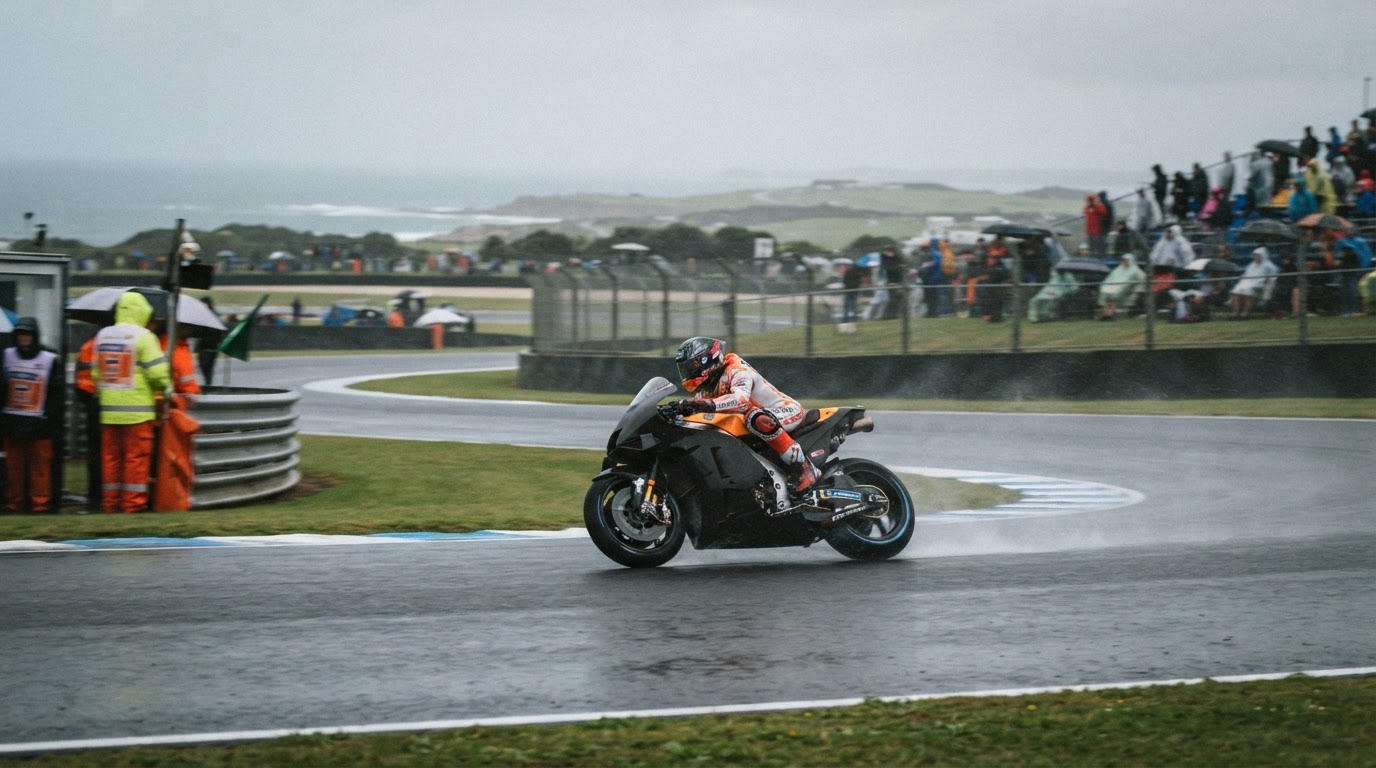
Rain disrupts calculated mechanical superiority faster than engineering telemetry can compensate. On Saturday, Oct 24, 2026, track conditions at the Phillip Island Grand Prix Circuit established that physical recovery and individual risk tolerance still dictate competitive outcomes when adverse weather equalises machinery. Marc Marquez crashed early in the second qualifying session after losing traction on wet grass, yet sprinted back through the paddock unhurt to claim pole position for Ducati. Behind him, championship leader Jorge Martin qualified fourth-quickest. The recorded times indicate how rapidly competitive margins compress when oceanic squalls alter circuit grip.
Grand prix motorcycle racing across the Asia-Pacific corridor has progressively relied on standardised aerodynamic packages and unified engine configurations. However, maritime venues along the Pacific rim consistently challenge whether uniform engineering can withstand severe climatic volatility. Marquez's rapid recovery interrupted what had appeared to be a steady trajectory by Martin toward consolidating his championship advantage. This outcome suggests that technical data systems reach an operational limit in saturated conditions. When baseline grip vanishes, rider reflex rather than calculated throttle modulation determines track position.
Environmental Friction Along the Pacific Calendar
The Australian MotoGP fixture does not occur in a vacuum. It forms a demanding leg of an intense regional itinerary. On October 11, 2026, the championship staged the Indonesian Grand Prix at the Mandalika International Street Circuit in Mandalika, Indonesia. That transition from tropical heat to the cold, saturated asphalt of southern Australia forced structural adjustments within a fortnight. Racing divisions had to reconfigure suspension compliance and tyre temperature management without extended test sessions.
Ducati Lenovo Team has demonstrated consistent mechanical performance throughout 2026, but high-speed coastal layouts strip away raw power advantages. Martin's fourth-place finish reflects a conservative championship approach under treacherous conditions. The tactical dilemma is evident: safeguarding an existing points total through prudent pace risks surrendering qualifying position to a direct rival prepared to risk a crash. Evidence from Saturday shows that Marquez embraced that operational exposure, translating high risk into immediate grid superiority.
The Strategic Balance Across Asia-Pacific Venues
Regional sporting fixtures carry substantial operational and financial demands that magnify competitive strain. Circuits situated in volatile coastal microclimates require drainage and track safety investments capable of handling rapid weather deterioration. At Phillip Island, an error on wet runoff areas threatens both equipment integrity and title standing.
In saturated conditions, technical dominance yields immediately to operational reflex and risk tolerance.
For Ducati, fielding Marquez alongside title rival Martin creates an acute internal friction. Marquez's aggressive recovery demonstrates a unique ability to extract performance from compromised machinery, yet that approach inevitably escalates the hazard of costly mechanical damage. Martin's calculated fourth-place qualification preserves operational continuity and points viability. However, it concedes psychological control to a competitor who demonstrated superior adaptability in adverse weather.
As the championship traverses its Pacific calendar, race engineers and team strategists face persistent trade-offs between computational modelling and human intervention. The central tension between algorithmic setup discipline and the unpredictable variables of severe regional weather remains fundamentally unresolved.
Sources
Newsletter
Pacific Daily
A curated briefing from Thailand, Asia-Pacific and the world.