Ho Chi Minh City’s River Bridge Rejects the Bangkok and Singapore Playbooks
A new pedestrian span across the Saigon River signals an ambition to forge a distinct urban identity while navigating the unresolved friction of urban transit.
BANGKOK
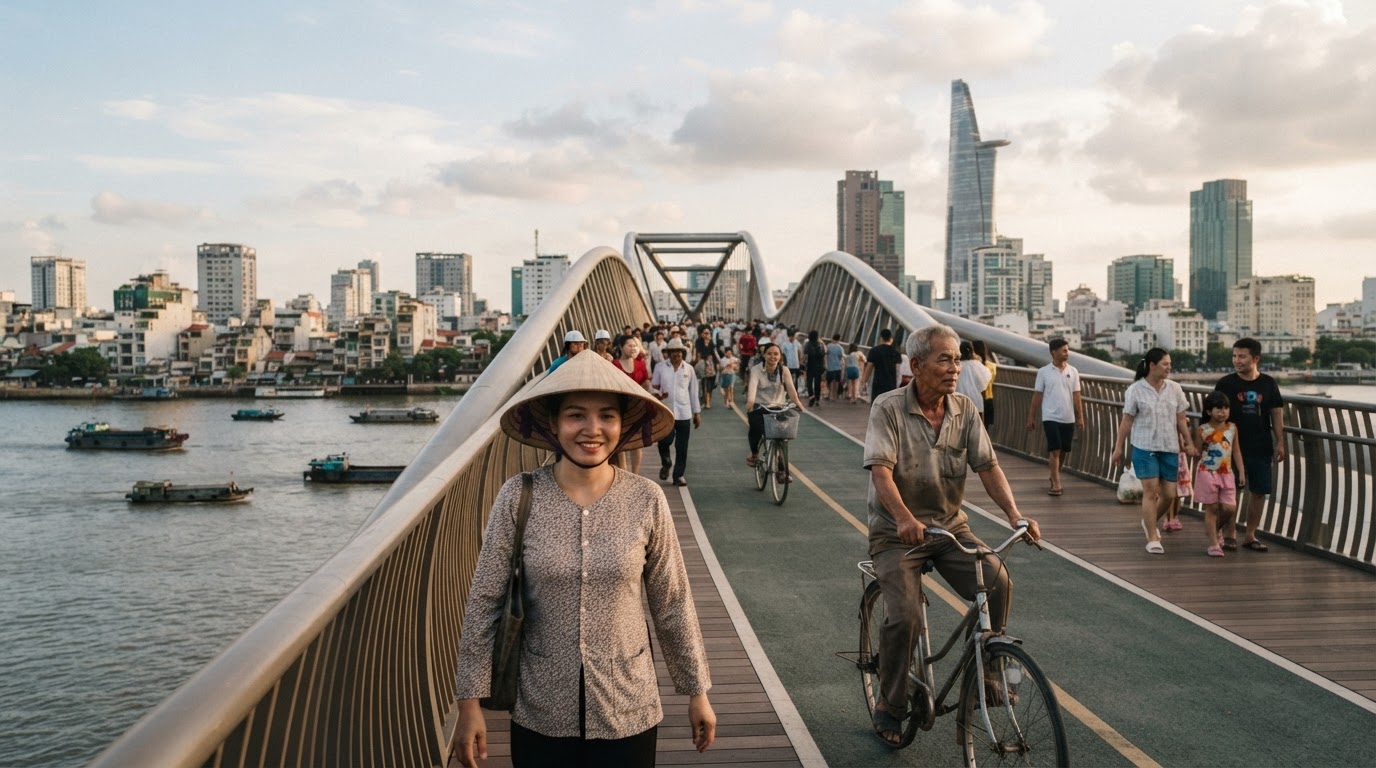
Municipal waterfronts across Southeast Asia frequently surrender their pedestrian accessibility to congested vehicle arteries and speculative real estate. Ho Chi Minh City interrupted that familiar pattern by linking a dedicated pedestrian bridge across the Saigon River, turning to southern Vietnam’s winding waterways and nipa palm groves for structural inspiration. Rather than adopting the generic steel geometries common to global infrastructure, municipal authorities selected a vernacular form intended to distinguish the city from regional peers. The crossing establishes a conscious contrast with the established waterfront models of Singapore and Bangkok.
That architectural choice fits within a broader municipal strategy to recast the metropolis. Planners have outlined a 100-year vision designed to elevate Ho Chi Minh City into an influential Asia-Pacific center, seeking parity with older commercial hubs. Parallel municipal measures, including proposals to enforce curbs on gasoline and diesel vehicles from mid-2027, signal an effort to reshape mobility across the urban core. Architectural landmarks and transport controls are meant to demonstrate administrative capability, yet their real significance lies in how differently this development philosophy operates compared with neighboring capitals.
Divergent Urban Playbooks
Singapore established its downtown pedestrian waterfront through tightly regulated state planning and immense capital allocation. Decades of land reclamation and strict zoning produced continuous public walkways around its central business zones, but those corridors were conceived primarily as functional conduits supporting dense financial districts. Public access was secured through top-down mandates, yet the resulting environment leaned heavily toward corporate architectural idioms that could exist in almost any developed economy.
Bangkok took a strikingly different path along its urban riverfront, where development remained largely dictated by private commercial interests. Speculative developers acquired fragmented parcels, constructing luxury condominium towers and sprawling shopping complexes that turned the water’s edge into private consumption corridors. Pedestrian connections along the riverbank remained sporadic and discontinuous, leaving Bangkok foot traffic subordinated to arterial expressways and commercial riverboats. The Thai capital generated commercial vitality, but its riverfront systematically excluded those seeking civic movement without commercial transactions.
Ho Chi Minh City is attempting to locate a deliberate middle ground between those two models. Deploying the organic geometry of southern nipa palms asserts a cultural identity that Singapore’s technocratic corridors deliberately omit, while retaining civic public ownership that Bangkok’s commercialized shoreline surrendered. The physical span connects severed municipal zones across the Saigon River, testing whether public space can anchor modern urban renewal before real estate speculation claims the surrounding riverbanks.
The Infrastructure Implementation Test
Engineering a symbolic pedestrian crossing across the Saigon River is vastly simpler than reorganizing metropolitan transit. Ho Chi Minh City continues to confront punishing surface congestion, where millions of two-wheeled and four-wheeled vehicles dominate daily commutes. While administrative plans propose curbs on gasoline and diesel vehicles from mid-2027, transitioning an entire urban population away from internal combustion engines requires secondary feeder transit, pedestrian shaded corridors, and sustained capital outlays.
Civic crossings risk becoming isolated architectural novelties when they lack organic integration into surrounding mass transit systems. A single walkway cannot resolve systemic bottlenecks across adjacent districts if commuter flows fail to connect smoothly with metropolitan rail lines or comprehensive walking networks. Without sustained municipal investment in neighboring walking links, the bridge risks functioning merely as an elevated promenade rather than a transformative piece of public transit.
Regional competition among Southeast Asian metropolises is increasingly fought over civic livability rather than raw commercial output. Ho Chi Minh City has demonstrated stylistic ambition by measuring its newest bridge against the urban landmarks of Singapore and Bangkok. Whether that symbolic distinction translates into enduring structural advantage depends entirely on whether municipal authorities can deliver the complex transit networks required beneath the canopy.
Sources
Newsletter
Pacific Daily
A curated briefing from Thailand, Asia-Pacific and the world.