Peripheral Storm Paths and the Real Cost of Near Misses in Northern Luzon
Typhoon Rosal bypassed direct landfall yet illuminated how maritime border zones absorb persistent exposure without structural relief
SINGAPORE
Offshore storm tracks across maritime waters frequently produce a deceptive sense of relief in central administrative capitals while inflicting protracted friction on outlying islands. When Typhoon Rosal, internationally named Champi, tracked east northeast of Northern Luzon without driving directly into the Philippine landmass, standard emergency classifications treated the trajectory as an avoidance of disaster. Yet geography dictates that peripheral maritime communities absorb the full weight of offshore systems long before and long after a storm center traverses regional tracking boundaries.
At 4 am on Friday, October 23, 2026, the storm was positioned 275 kilometers east northeast of Itbayat, Batanes. Even as atmospheric projections indicated that Rosal would exit the Philippine Area of Responsibility by Saturday, October 24, moderate to heavy rainfall continued across Batanes and adjacent reaches of Northern Luzon. The absence of a formal landfall obscured the reality on the ground: an offshore vortex still exerts sufficient energy to stall transport, disrupt fishing livelihoods, and isolate remote municipalities.
The Geography of Exposure
Administrative frameworks across maritime territories remain structurally anchored to the binary of landfall versus clearance. In capital centers like Manila, political attention and emergency mobilizations peak when a storm threatens dense urban populations, then dissipate rapidly once the barometric core veers away from primary economic corridors. For outer archipelagoes such as Batanes, however, an offshore transit of several hundred kilometers generates operational paralysis comparable to direct exposure.
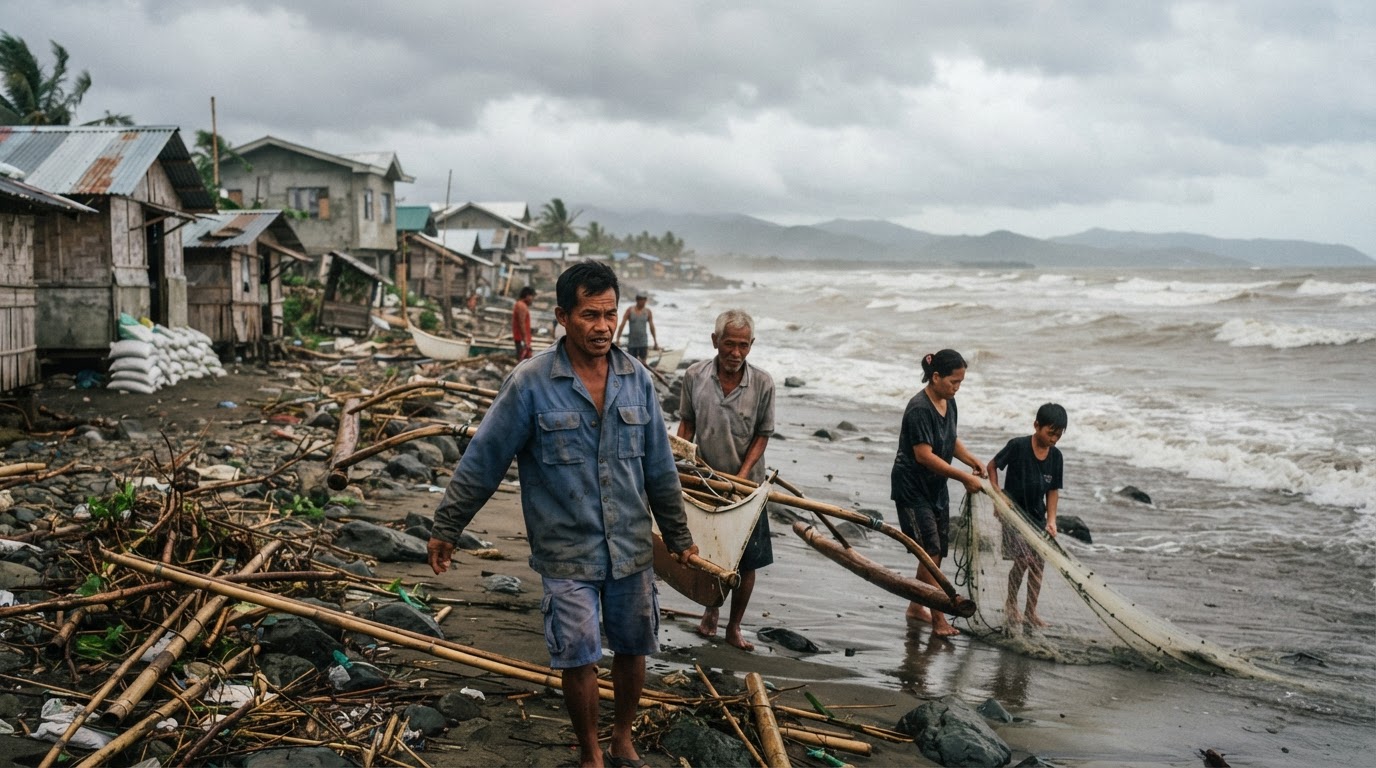
Offshore storm tracks maintain disruptive atmospheric bands across archipelagic fringes regardless of where the formal core travels.
This disconnect reveals an entrenched operational vulnerability. Remote island provinces sustain recurring economic interruptions without recording the catastrophic damage thresholds that unlock targeted national reconstruction budgets. Sea lanes close, inter-island cargo halts, and localized supply chains fracture under peripheral rainbands, yet macro indicators report that the nation was spared. The true economic drag of the storm season accumulates precisely through these sub-catastrophic events, where continuous disruption drains municipal reserves and depresses productivity without prompting broader policy adjustments.
Asymmetric Exposure and Municipal Attrition
Across broader maritime systems, disaster governance demonstrates sharply diverging capabilities in handling prolonged peripheral exposure. Capitalized logistics networks can absorb multi-day maritime standstills through diversified overland links and deep inventory cushions. Archipelagic jurisdictions, by contrast, possess almost no redundant transport infrastructure to offset prolonged gale conditions in maritime straits.
When a weather system like Rosal hovers off the coast for consecutive days, the primary damage is structural attrition rather than instantaneous destruction. Infrastructure on isolated islands suffers gradual deterioration from sustained moisture and coastal battering, while municipal budgets exhaust contingency funds on basic sustenance rather than long-term hardening. Because the headline narrative records a fortunate near miss, regional development planning rarely incorporates the true cost of sustained atmospheric friction on peripheral outposts.
National risk models continue to prioritize point-of-impact metrics over duration of exposure. So long as emergency response frameworks measure severity primarily by landfall location and peak central wind speeds, peripheral communities in Batanes will bear uncompensated administrative costs. The challenge facing disaster planning is not merely predicting where a cyclone makes contact, but redesigning fiscal support to address the slow exhaustion of territories trapped on the perimeter of offshore routes.
Sources
Newsletter
Pacific Daily
A curated briefing from Thailand, Asia-Pacific and the world.