Why Humanoid Ambition Still Runs Through Asian Foundries
Agile's European production plan highlights how physical robotics remains captive to East Asian fabrication and regional software rivalries.
SINGAPORE
Industrial automation has historically depended on immovable robotic arms bolted to factory floors, prioritizing repetitive precision over spatial agility. That established manufacturing doctrine faced a notable reorientation when Germany's Agile announced an ambition to produce up to 2,000 humanoid robots equipped with Nvidia processors. Disclosed alongside the NVIDIA GTC conference in Berlin on October 21, 2026, where Nvidia CEO Jensen Huang demonstrated 25 cm tall bipedal machines named Microducks, the initiative represents a deliberate push to migrate embodied artificial intelligence into physical assembly plants. Humanoid form factors have spent years confined to research facilities, celebrated for dexterity but sidelined by prohibitive unit economics and mechanical failure rates. Committing to a production run of 2,000 units indicates that enterprise suppliers view factory floor integration as a plausible medium-term horizon rather than an academic curiosity.
Yet announcing an assembly ceiling of 2,000 units highlights the peculiar midpoint at which industrial robotics currently pauses. This volume remains far too modest to constitute mass manufacturing, while extending well beyond experimental bespoke prototypes. For an ecosystem long conditioned to rapid software deployment, physical hardware imposes uncompromising friction. Motors overheat, gear assemblies wear under continuous loads, and balance control systems struggle with variable factory surfaces. Nvidia provides the computational capacity to interpret environmental inputs, but translating digital commands into reliable kinetic work remains an unproven proposition at commercial scale. Agile's projected run will test whether multi-purpose bipedal machines can justify their substantial capital cost against dedicated, single-purpose automation tools that already perform structured tasks without algorithmic hesitation.
The Pacific Hardware Nexus
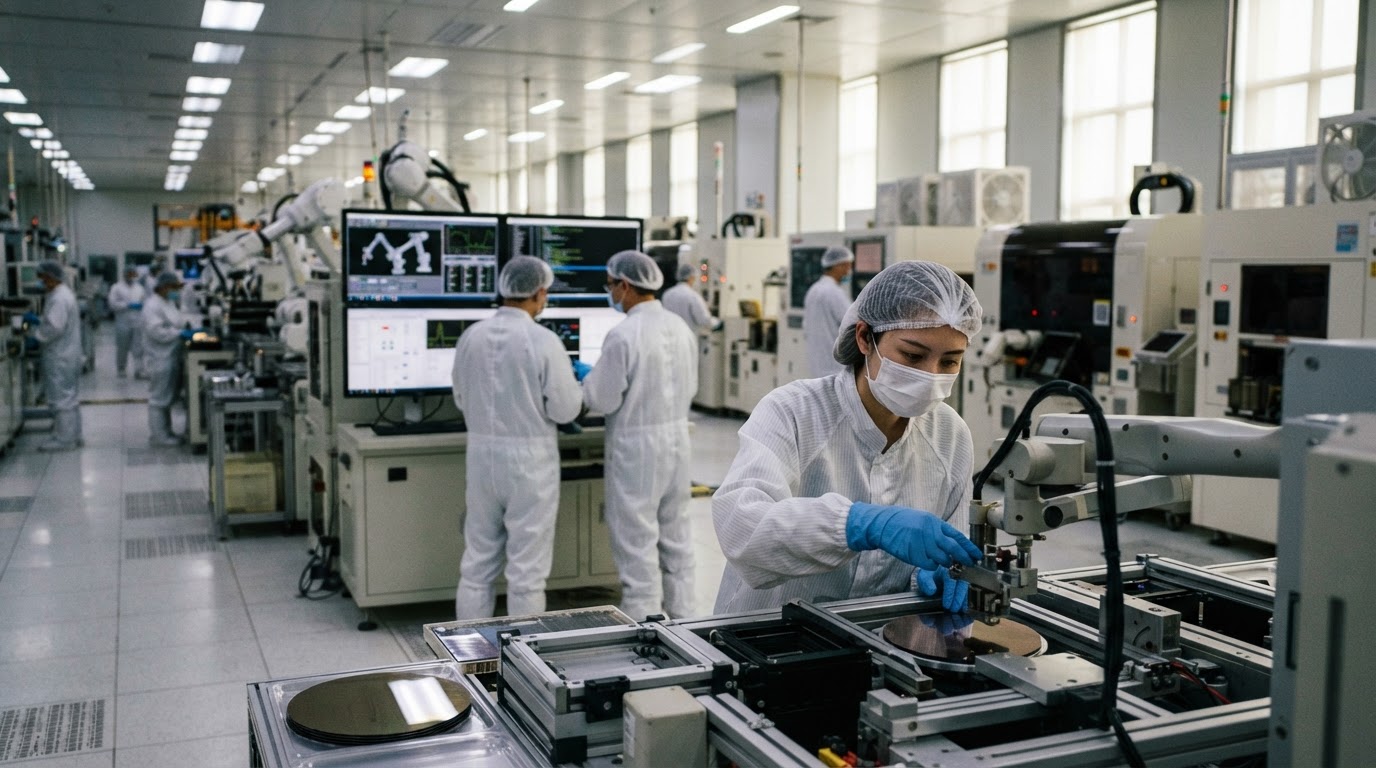
Although Agile positions its mechanical assembly within Germany, the material viability of this automation push rests squarely on Asian manufacturing infrastructure. Sophisticated robotic cognition requires cutting-edge silicon and advanced memory architectures that Western supply chains cannot deliver alone. That regional dependency became apparent when reports indicated that Samsung will utilize TSMC technology to manufacture next-generation memory chips destined for Nvidia computing systems. This unexpected operational convergence of longstanding industrial rivals across Taiwan and South Korea reveals how concentrated the underlying hardware production has become. European robotics developers may design the outer chassis, but the computational density required for real-time spatial navigation remains fundamentally tied to East Asian foundries.
Simultaneously, the competitive parameters governing this compute ecosystem are shifting across the Pacific. Rather than accepting complete dependency on dominant American chip architectures, alternative semiconductor pipelines are actively consolidating. In China, software laboratory DeepSeek partnered with Huawei on September 29, 2026, to develop specialized programming tools intended to reduce industrial reliance on Nvidia hardware. That collaboration signals an emerging bifurcation in how artificial intelligence systems will be programmed and deployed. As Asian competitors construct parallel software environments that operate outside proprietary Western frameworks, European hardware manufacturers hitching their production lines exclusively to single-source silicon risk being cordoned off from substantial global industrial markets.
Capital Discipline and Operational Realities
Investor appetite for capital-intensive artificial intelligence infrastructure is simultaneously undergoing severe repricing. Downstream enterprise deployments must increasingly prove immediate operating returns rather than relying on promotional enthusiasm. That financial wariness surfaced decisively on October 9, 2026, when Nvidia-backed infrastructure firm Firmus abandoned its planned 5 billion dollar initial public offering in Australia amid growing scrutiny over artificial intelligence profitability. When specialized data center ventures struggle to justify equity valuations of that magnitude, factory managers will subject multi-jointed humanoid robots to even harsher fiscal audits before replacing standard automated systems.
Agile's commitment to construct up to 2,000 humanoid robots with Nvidia highlights an industry determined to prove physical utility before investor patience deteriorates. Bridging the gap between stage demonstrations and grueling multi-shift manufacturing routines requires overcoming fundamental mechanical realities that software updates cannot rectify. Until these complex bipedal frames demonstrate that their operational uptime rivals the stationary tools already anchored across global factories, the commercial transition from digital intelligence to industrial utility remains unresolved.
Sources
Newsletter
Pacific Daily
A curated briefing from Thailand, Asia-Pacific and the world.