Singapore Brings Forward Mask Distribution as Atmospheric Pressures Mount
The activation of automated dispensing and community centres reveals the operational mechanics of civic containment under transboundary haze
SINGAPORE
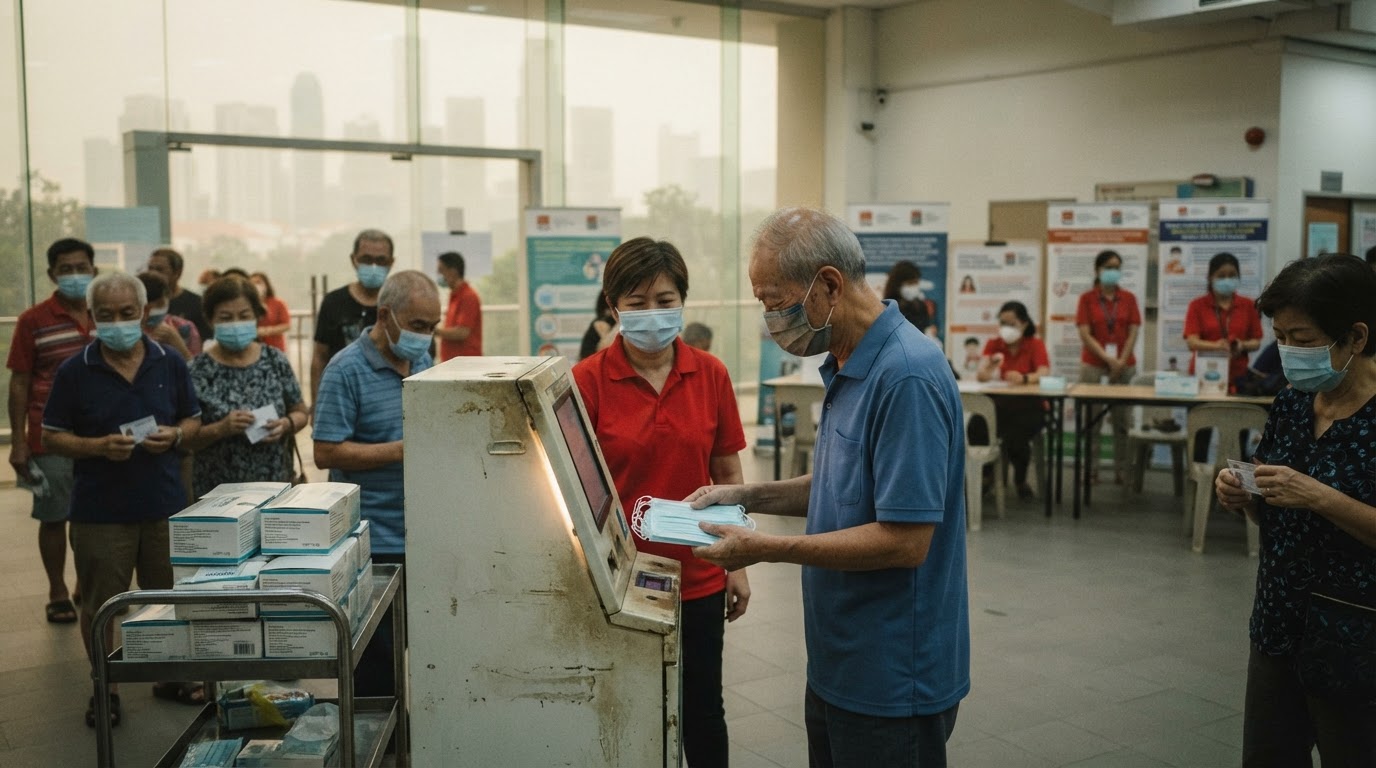
Municipal machinery shifted from passive monitoring to direct operational containment when Singapore triggered the distribution of protective equipment across transit nodes and residential hubs on 15 Oct 2026. The decision to release free N95 masks to individuals vulnerable to adverse health effects moved physical reserves directly into community channels. Distribution points opened at Bukit Panjang bus interchange and People's Association Community Centres, pairing automated vending machines with staffed counters to manage civilian flow.
Controlling ground-level exposure during regional atmospheric disruption requires predictable logistical channels. The Haze Task Force had established an intervention baseline tied to air quality markers, preparing mask deployment for vulnerable residents once the 24-hour PSI exceeds 200, or when the reading hits 201. Advancing that distribution schedule indicates that operational necessity overtook static index triggers. Rather than waiting for strict atmospheric markers to register across monitoring stations, municipal authorities chose to clear logistical pathways ahead of worsening conditions.
Spatial Infrastructure and Automated Dispensation
Designating People's Association Community Centres, commonly known as CCs, alongside public bus terminals reveals how urban infrastructure functions during an environmental crisis. Automated vending machines positioned along commuter paths reduce counter friction, permitting eligible groups such as the Pioneer Generation to collect respiratory gear without standing in administrative queues. Simultaneously, coordinating these distribution points with Social Service Offices ensures that lower-income households and individuals with mobility constraints retain direct institutional access.
Every emergency distribution network encounters friction where centralized inventories meet concentrated localized demand. Storing reserves in central warehouses guarantees supply integrity, but physical bottlenecks inevitably appear where commuter transit intersects with worsening haze. Crowds gathered at Bukit Panjang to collect protective masks on Wednesday as deteriorating air quality spread across residential districts. Routing thousands of people toward automated kiosks tests the spatial capacity of transit interchanges, requiring facilities to maintain normal transit throughput while processing continuous queues.
Preventive Containment Against Civic Friction
Critics of early physical distribution argue that releasing supplies before the 24-hour PSI exceeds 200 risks depleting stocks prematurely while exhausting community staff. Operating civic centres alongside automated vending machines incurs personnel costs, consuming staff hours that may be required if haze shelters open during prolonged periods of pollution. If regional winds shift and conditions clear rapidly, deploying equipment in advance risks misallocating organizational resources on an aborted event.
That argument neglects the severe downstream burden imposed on urban medical infrastructure when preventative barriers fail. Delaying mask deployment until regional monitors formally cross 201 leaves vulnerable populations exposed during the sharpest initial rise in airborne particulates. For elderly residents and individuals with underlying respiratory vulnerabilities, preventative containment requires fewer public resources than acute medical treatment in hospital wards. Supplying protective masks through automated terminals relieves pressure on primary care facilities, insulating neighbourhood clinics from sudden surges in respiratory distress.
The durability of this distribution network depends on whether automated dispensing can successfully support community welfare systems during prolonged exposure. Mechanical kiosks accelerate delivery speed, yet they cannot address complex social needs or deliver gear to residents who are unable to leave their homes. As environmental haze persists, the effectiveness of Singapore's response depends on whether automated transit kiosks and physical community networks can maintain coordinated throughput under sustained regional strain.
Sources
Newsletter
Pacific Daily
A curated briefing from Thailand, Asia-Pacific and the world.