Road Incident Spotlights Broader Issues for Transgender Individuals in Thailand
A drunk driving arrest in Bangkok, and the subsequent public reaction, reveal more than just a traffic violation; they touch on the economic vulnerabilities faced by a segment of Thailand's population.
SINGAPORE
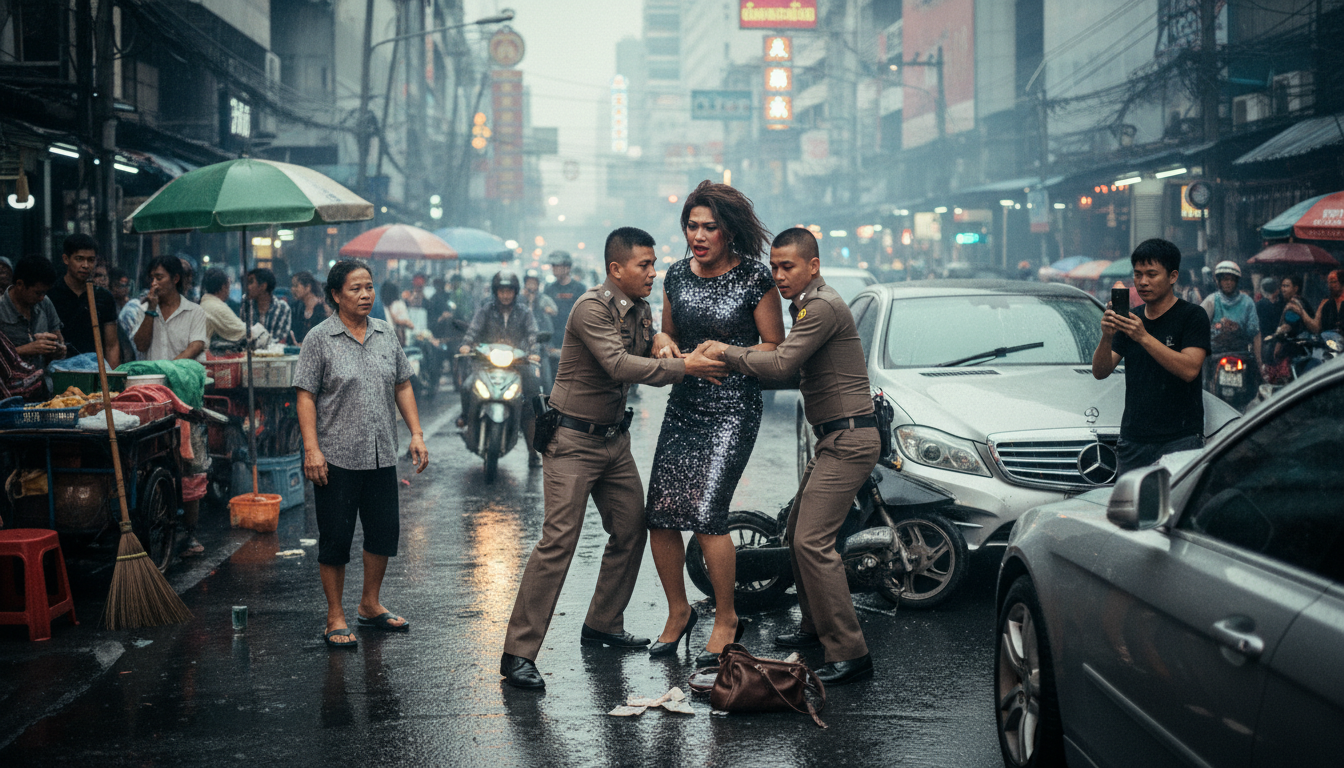
On August 26, footage circulated of a Thai transwoman arrested in Bangkok for drunk driving after a collision with a motorcycle. Traffic police officer Pawitchart Somjit shared this footage, which showed the driver, with an alleged 240mg% alcohol level, appearing to suck rather than blow into a breathalyzer. The incident, as reported by The Thaiger, became a public spectacle, raising questions beyond the immediate traffic offense.
The initial reports focus on the driver’s actions and the high alcohol concentration, which are serious violations. However, the public nature of the arrest, particularly the footage being shared by an officer, implicitly places a spotlight on the individual's identity. While the driver’s gender identity is part of the factual description, its prominence in the narrative, even in source headlines, suggests a layer of scrutiny that might not be applied universally. This focus can amplify existing societal pressures on transgender individuals in Thailand and the wider Asia-Pacific region.
From an economic perspective, such public incidents, particularly those involving law enforcement and media attention, can have disproportionate consequences. For many transgender individuals in the Asia-Pacific, securing stable, formal employment can be challenging. Reports from 2014 indicated that transgender groups in the region were already speaking out about health needs, and recent rulings in Japan and Hong Kong signal ongoing legal battles for rights, while in Indonesia, new laws have caused fear within the transgender community. These dynamics suggest a pre-existing vulnerability.
A public arrest, especially one that goes viral, risks further marginalizing an individual who may already face employment discrimination or social stigma. If this individual was, for instance, employed in the informal sector or in a role heavily dependent on public interaction, the reputational damage could translate directly into lost income. The underlying economic fragility becomes more pronounced when such events occur.
The officer's stated intention was to highlight the dangers of drunk driving. That message is clear and important. But the way the story unfolded in public, amplified by shared footage, risks reducing an individual to a stereotype, rather than focusing solely on the offense. The consequence for the driver is not just legal; it extends into their livelihood and social standing, potentially impacting their ability to maintain a monthly budget already under pressure. This incident, while specific, reflects broader societal challenges that shape the economic realities for many transgender people in Thailand, where legal protections often lag behind social visibility.
The immediate outcome for the driver will depend on the legal process. More broadly, however, the episode serves as a reminder of how individual missteps can intersect with social biases, creating magnified economic and personal repercussions for those already on the margins.
Sources
Newsletter
Pacific Daily
A curated briefing from Thailand, Asia-Pacific and the world.