Gold at ฿66,450: Why Thailand’s Most Familiar Store of Wealth Is Anything but Still
The price of gold in Thailand closed at 66,450 baht per baht-weight on October 12, 2026, amidst volatility in global financial markets and the baht's exchange rate. Although gold has long been an asset deeply intertwined with the lifestyles and financial security of Thai people across generations, its constantly fluctuating price serves as a reminder that preserving wealth requires more than just holding gold; it also demands an understanding of market mechanisms, trading costs, and the risks lurking beneath the gleam of this precious metal.
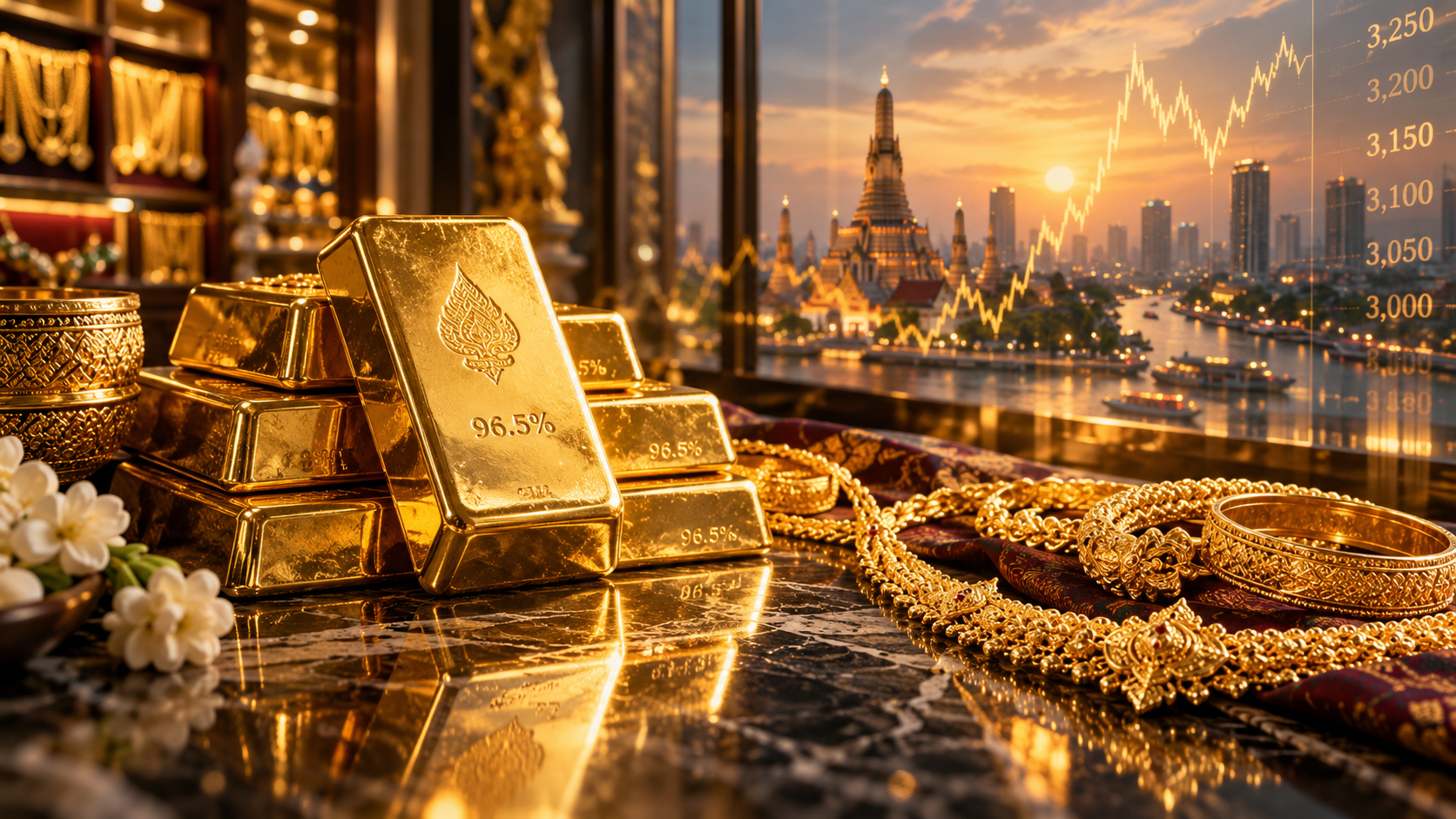
As gold prices fluctuate throughout the trading day, Thailand’s enduring fascination with the precious metal reveals a deeper relationship between household savings, global uncertainty and financial decision-making.
BANGKOK, THAILAND — Gold has long occupied a distinctive place in Thailand’s economic and cultural life.
It is purchased as an investment, exchanged during important family occasions, given as a symbol of prosperity and retained by households seeking a tangible form of savings.
Yet the metal’s traditional reputation for preserving wealth can sometimes obscure a less reassuring reality: its market price is anything but stable.
On October 12, 2026, Thailand’s Gold Traders Association recorded 12 price announcements, reflecting a succession of adjustments throughout the trading session.
At the final reported update, issued at 5:09 p.m. Bangkok time, the selling price for standard 96.5% gold bullion stood at ฿66,450 per baht-weight, while the buying price was ฿66,250.
The quoted selling price for 96.5% gold jewellery stood at ฿67,250 per baht-weight.
These figures illustrate how gold prices in Thailand can change repeatedly within a single day, creating different outcomes for buyers depending on when and how they enter the market.
A Market That Rarely Stands Still
The trading session began with a bullion selling price of ฿66,800 per baht-weight.
By the final recorded announcement, that figure had fallen to ฿66,450, representing a decline of ฿350 from the opening quotation.
The session was not a continuous downward movement.
Prices rose and fell during the day, demonstrating the sensitivity of the domestic market to international gold quotations and currency movements.
The association’s final announcement listed a reference international spot price of US$4,174 per troy ounce and an exchange-rate reference of approximately ฿33.63 per US dollar.
For consumers accustomed to thinking about gold exclusively in Thai baht, the relationship between these international benchmarks and local retail prices is essential.
Thailand does not determine the underlying international price of gold in isolation.
Its domestic quotations respond to a combination of global market conditions, exchange rates, purity standards and commercial pricing arrangements.
Why the Thai Baht Matters
International gold is commonly quoted in US dollars per troy ounce.
Thai gold, by contrast, is typically traded in baht-weight units, with local prices expressed in Thai baht.
A standard baht-weight of gold bullion represents approximately 15.244 grams, while the traditional baht-weight for gold jewellery is approximately 15.16 grams.
The distinction between the currency and weight measurement is particularly important for international readers unfamiliar with Thailand’s market conventions.
Because international gold prices are denominated in dollars, movements in the Thai currency can influence domestic prices even when the international gold quotation changes relatively little.
A weaker baht generally increases the local-currency cost of a given amount of dollar-priced gold, all else being equal.
A stronger baht can have the opposite effect.
Consequently, a Thai investor may experience a different price movement from someone monitoring the same metal in dollars.
Understanding both variables is more useful than following the global headline price alone.
Gold as an Investment and Cultural Asset
Thailand’s attachment to gold extends beyond portfolio management.
Gold jewellery remains deeply embedded in social traditions, including weddings, family celebrations and gifts associated with financial security.
Its appeal reflects more than aesthetic value.
Unlike many consumer goods, gold retains a recognised underlying commodity value and can be sold through an established network of dealers.
That liquidity has contributed to its reputation as an accessible store of wealth.
However, the distinction between possessing an asset with resale value and earning a reliable investment return should not be overlooked.
A rising market can benefit existing owners.
A falling market can expose recent buyers to losses, particularly when transaction costs and differences between purchasing and resale prices are considered.
Gold does not provide a guaranteed return, and its traditional role as a defensive asset does not eliminate short-term volatility.
The Real Cost of Buying Gold in Thailand
One of the most important considerations for consumers is the difference between buying gold bullion and purchasing gold jewellery.
Bullion pricing is generally more directly connected to the underlying metal value.
Jewellery purchases may incorporate additional charges associated with craftsmanship, retailing and product design.
These expenses can affect the amount recovered when the item is eventually sold.
On October 12, the association’s final quoted bullion buying and selling prices differed by ฿200 per baht-weight.
For investors, this spread represents an immediate consideration.
Even if the market price remains unchanged, a buyer who immediately resells bullion at the quoted buying price would ordinarily recover less than the initial purchase amount.
Jewellery transactions can involve additional pricing considerations.
Consumers should therefore distinguish between the posted jewellery selling price, the published reference or tax-base values and the actual amount a shop is prepared to pay when buying an item back.
The final resale amount can depend on applicable rules, the product and the retailer.
What About One Salung of Gold?
Searches involving the Thai unit salung (สลึง) reflect another distinctive feature of the local market.
One baht-weight equals four salung.
For standard bullion, one salung corresponds to approximately 3.811 grams.
A simple calculation using the final bullion selling quotation of ฿66,450 would place one-quarter of that reference price at ฿16,612.50.
However, this is only a proportional calculation, not a verified retail quotation for a one-salung product.
Actual prices can differ according to the type of gold, product size, fabrication costs and retailer policies.
For smaller purchasers, understanding this distinction helps prevent confusion between a reference metal value and the amount payable at the counter.
The Psychology Behind Gold’s Appeal
Gold occupies an unusual position in financial markets because its value is shaped by both measurable supply-and-demand factors and investor expectations.
During periods of economic or geopolitical uncertainty, some investors increase their interest in gold as a defensive holding.
Such demand can contribute to price movements, although gold may also decline during unsettled periods.
Interest rates, movements in the US dollar, central-bank activity and changing expectations about economic growth can all influence the international market.
For Thai households, the resulting price movements are experienced in a more immediate way.
A change in the daily quotation can affect the value of family savings, the cost of a wedding gift or the timing of an investment purchase.
This proximity to everyday financial decisions helps explain why gold remains a subject of persistent public attention.
Beyond the Daily Price
The most useful question for prospective buyers is not necessarily whether gold will be more expensive tomorrow.
It is whether the purchase makes sense within their own financial circumstances.
A person acquiring jewellery for a family celebration has different priorities from an investor seeking exposure to commodity prices.
Likewise, a household preserving emergency savings faces different risks from a trader attempting to profit from short-term price fluctuations.
Gold can play a role in long-term financial planning, but its suitability depends on liquidity needs, transaction costs, risk tolerance and the availability of other assets.
Thailand’s gold market reflects a continuing intersection of tradition and global finance.
Its appeal has survived generations of changing economic conditions, yet its prices remain sensitive to forces far beyond the boundaries of the Kingdom.
At ฿66,450 per baht-weight, the latest quotation is more than a number displayed outside a gold shop.
It is a reminder that even one of Thailand’s most familiar symbols of lasting value exists within a constantly changing financial world.
The metal may endure. Its price never stands still.
Newsletter
Pacific Daily
A curated briefing from Thailand, Asia-Pacific and the world.