Puerto Vallarta's Dual Attractions Reflect Shifting Tourist Desires
The juxtaposition of a pop star performance and a trash-fishing competition in a Mexican resort city illustrates a broader tension between established and emerging forms of visitor engagement.
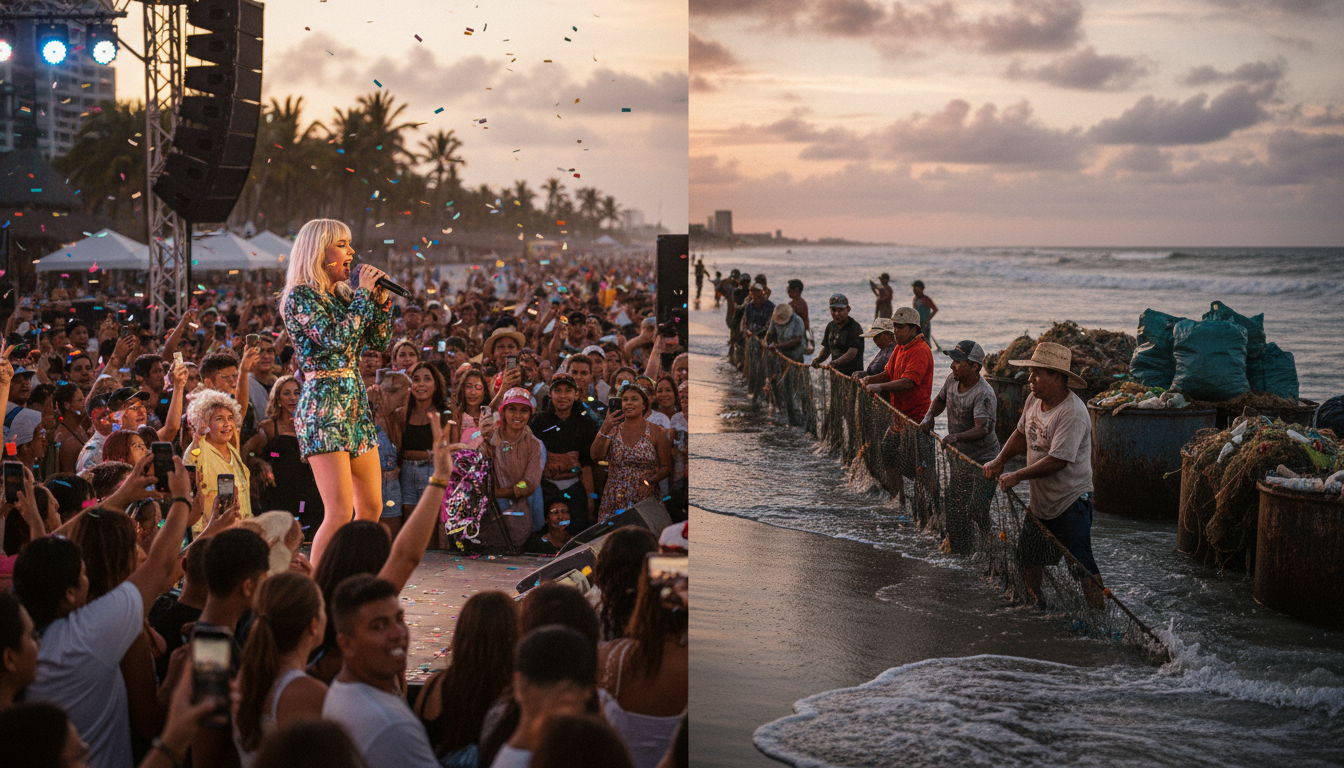
The October calendar for Puerto Vallarta, a coastal city in Mexico, presents a curious pairing for visitors: a performance by British pop star Robbie Williams alongside a trash-fishing competition. These events, occurring in a location also preparing for a PGA golf tournament and a maritime history exhibition, suggest a layered appeal for what is described as one of Mexico’s premier expat and tourist destinations. The city’s event scheduling, as reported on October 1, 2026, by Mexico News Daily, reveals an environment where traditional leisure activities coexist with niche, environmentally-conscious engagements.
Observing the varied offerings in Puerto Vallarta, it becomes apparent that the city is navigating distinct expectations from its visitor base. One segment seeks the familiar allure of international entertainment and established sporting events, reflecting a consumer habit focused on spectacle and celebrity. Another, perhaps smaller but growing, looks for experiences that resonate with contemporary concerns like environmental sustainability, even in a competitive format. This latter group often seeks participation and a sense of direct impact, moving beyond passive consumption of entertainment. The trash-fishing competition, an eco-friendly event at sea, stands as a clear signal of this emerging preference.
This duality is not unique to Mexico's Pacific coast. Across Southeast Asia, cities and resort areas often present similar contrasts, albeit with local variations. In Thailand, for instance, established tourism models continue to draw visitors with traditional attractions and large-scale entertainment, while a parallel movement sees increasing interest in community-based tourism, eco-retreats, and voluntourism focused on local issues. The habits of travelers are subtly shifting, moving from purely extractive leisure towards engagements that, at minimum, acknowledge local contexts or, at most, seek to contribute. This can be seen in how travelers choose accommodations, prioritize local cuisine, or seek out activities that offer a more grounded connection to the destination.
The challenge for destinations like Puerto Vallarta, and indeed many across the Asia-Pacific, lies in balancing these divergent demands. While the appeal of a major pop concert or a golf tournament remains potent, particularly for generating immediate economic activity and attracting a broad audience, the inclusion of events like a trash-fishing competition speaks to a different kind of value proposition. It highlights a destination's capacity for innovation in visitor engagement and its responsiveness to global conversations around sustainability. Yet, this balancing act is often complicated by environmental realities; Puerto Vallarta's location on the Pacific coast makes it susceptible to severe weather events, with hurricanes like Polo intensifying off its coast as recently as September 23, 2026, and Lidia hitting in October 2023. These environmental factors introduce an underlying fragility to all forms of tourism, regardless of their nature.
The presence of both the celebrity draw and the environmental clean-up on the same calendar reflects a subtle but significant evolution in what constitutes a desirable visitor experience. The question for urban planners and tourism boards is not simply what attracts people, but what kind of engagement they notice and remember, and how these choices reflect broader societal changes in how places are valued and consumed.
Sources
Newsletter
Pacific Daily
A curated briefing from Thailand, Asia-Pacific and the world.