Nagoya's Unmoored Games and the Shifting Asian Canvas
The decision to house athletes on a cruise ship at the Asian Games in Nagoya speaks to more than logistical challenges; it reveals a broader regional tension between ambition and reality.
SINGAPORE
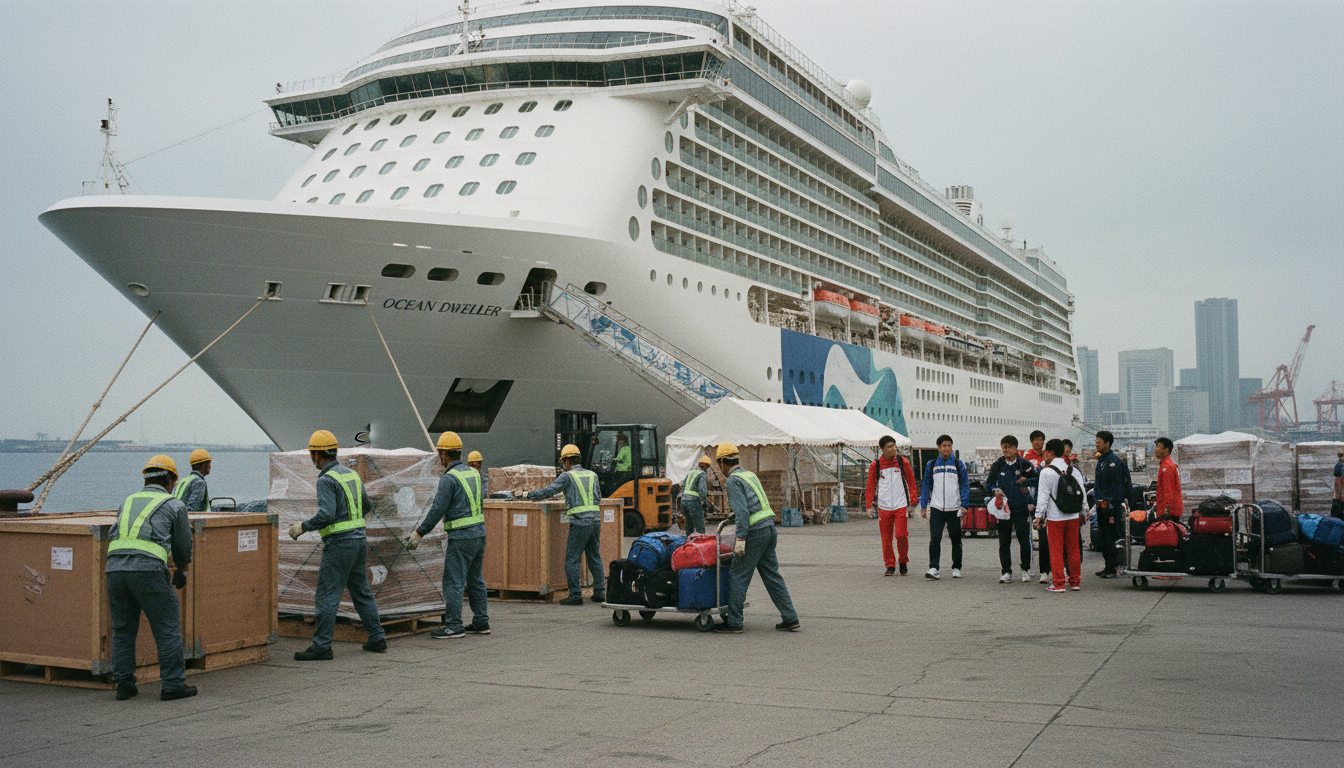
The cruise ship Costa Serena, berthed at Nagoya Port, now serves as an unexpected dormitory for athletes participating in the Asian Games 2026. This arrangement, confirmed by CNA Lifestyle on September 18, 2026, arises from the absence of a dedicated athletes' village, compelling organisers to rely on a combination of the ship, temporary wooden containers, and hotels for accommodation. Japan, preparing for thousands of athletes according to the Taipei Times on September 15, 2026, faces a distinctive challenge in how it welcomes its competitors.
To place athletes upon a vessel in a port suggests a particular kind of welcome, one that is both contained and transient. The Asian Games, often described as larger than the Olympics by The Straits Times on September 17, 2026, typically gather nations in a symbolic village, a temporary microcosm of regional unity. The choice of a cruise ship, despite Nagoya's capacity as a major urban centre, offers a different experience. It isolates participants, placing them on a self-contained island removed from the immediate rhythm of the host city. This physical separation, while providing a bed, also creates a distance, an implicit barrier between guest and host. The Straits Times also reported on September 18, 2026, that athletes are expressing mounting issues, suggesting that the current arrangements are not without strain.
Japan’s decision to adopt these distributed housing solutions – ships, containers, hotels – may stem from a strategic choice to avoid the significant investment required for a purpose-built village that would then need repurposing. This pragmatic approach, however, shifts the burden of integration. Instead of a single, unified campus designed for cultural exchange and athletic camaraderie, athletes are scattered across various settings. This dispersal, though perhaps economically rational, risks diluting the communal spirit often central to such large-scale sporting events. The question then becomes whether the Games are merely a series of competitions or a broader statement of regional identity.
The use of the Costa Serena suggests a particular vision of the Asian Games, one where the host city's primary offering is a venue for competition, not necessarily an immersive cultural experience for its transient population of athletes. It reflects a growing tension: the aspiration to host major international events against the practicalities of modern urban development and economic realities. The Games require cities to accommodate thousands, a logistical feat that historically necessitated dedicated infrastructure. When a nation like Japan, with its established infrastructure, resorts to such disparate housing, it asks of its athletes not just peak performance, but also a certain adaptability to an unmoored existence. This situation in Nagoya could mark a subtle but significant shift in how Asia-Pacific nations approach the hosting of these expansive, symbolic gatherings, signaling a move towards efficiency over traditional communal ideals.
The Asian Games typically gather nations in a symbolic village, a temporary microcosm of regional unity. The choice of a cruise ship offers a different experience.
This departure from the dedicated village model poses a distinct question for Thailand and other Asia-Pacific aspirants to international events: What is the true cost of hosting, beyond the balance sheets? Is it only the structures erected, or also the intangible sense of shared experience that defines such global spectacles? The image of the Costa Serena in Nagoya Port, a city that once stood as a beacon of industrial innovation, might just be a harbinger of how future international events will navigate the complex currents of national ambition and practical constraint, placing the emphasis not on rootedness, but on efficient, if detached, accommodation.
Sources
Newsletter
Pacific Daily
A curated briefing from Thailand, Asia-Pacific and the world.