Island Resorts Face the Structural Reality of the Shorter Indian Stay
Marriott pivots to regional weekenders in the Maldives, confronting the limits of villas built for solitary couples.
SINGAPORE
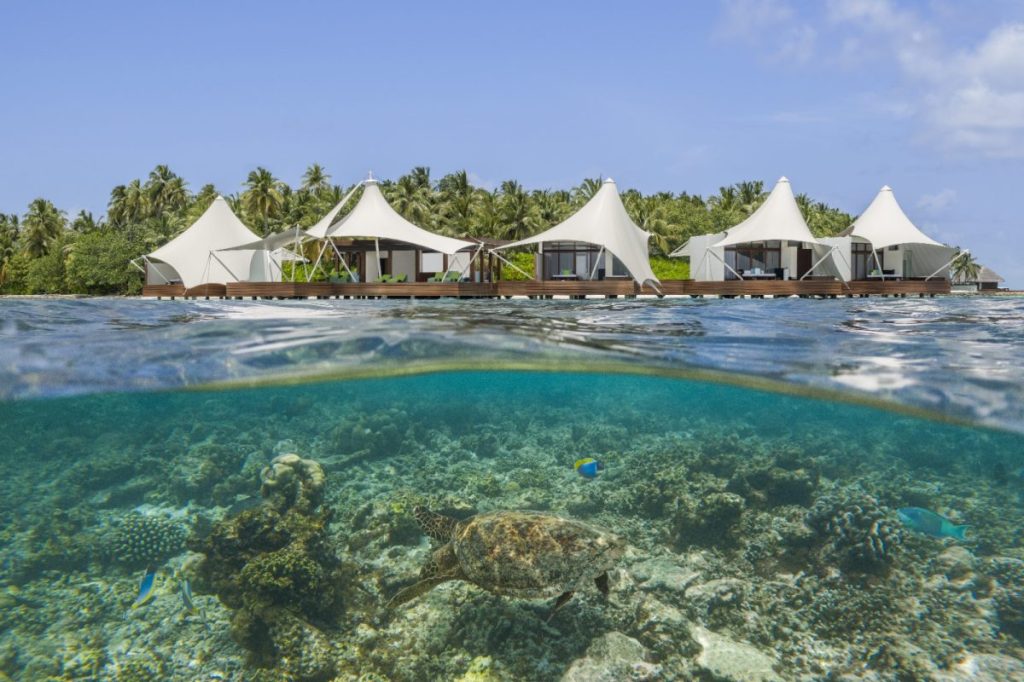
Island resorts built on solitary coral atolls function on an uncompromising spatial logic. Every overwater pavilion and timber deck assumes a specific visitor: a couple arriving on a long-haul flight, committed to remaining stationary for a week. When long-haul corridors severed in March following tensions in the Middle East, that structural assumption collapsed.
European and American travelers connecting through Gulf hubs stopped arriving. Silvio Rosenberger noted the operational shock that followed across the island properties: “We had an immediate drop in arrivals, but now we’re almost back to normal in terms of numbers, maybe not from the same markets,” Rosenberger explained. Aggregate numbers stabilized because guests from India stepped into the empty rooms.
Shifting Spatial Demands
Indian travelers are not simply substituting for departing Western vacationers. Their travel cadence demands an entirely different architectural layout. The traditional Maldivian resort was conceived for isolated romance, offering total privacy behind dense palm foliage and narrow timber walkways. Marriott International now seeks to capture Indian travelers booking short family breaks, multi-generational birthdays, and spontaneous long weekends.
That commercial pivot exposes a physical tension. A private villa designed for two quiet occupants performs poorly when hosting three generations under one roof. Communal gatherings require expansive dining verandas, shared living suites, and flexible interconnecting doors. Most Maldivian atoll compounds feature detached footprints scattered across shallow water. Moving six family members between isolated platforms under tropical heat strains the spatial efficiency of the property.
Dining facilities reflect the same operational friction. Western honeymooners favor quiet corners, low lighting, and fixed degustation schedules. Extended families traveling from urban centers across India require shared tables, continuous service, and flexible dining hours. Kitchens organized around European fine dining struggle to adapt to collective dining rhythms without noisy retrofits.
Early Check-In provisions also demand physical readjustment. Regional flights from Indian cities arrive on early schedules, leaving guests stranded in lobbies if accommodation turns over only in the late afternoon. Without dedicated hospitality lounges and day-use wash facilities, open-air arrival pavilions become holding pens rather than welcoming transit points.
The Limit of Quick Conversions
Corporate strategy can adjust guest targeting in a season. Physical structures, anchored into reef flats with concrete pilings, resist rapid transformation. In 2025, Marriott moved to invest in Concept Hospitality to widen regional distribution. Yet distribution networks cannot alter the square meters of a stilt villa.
Operators counter that luxury guests prize isolation above all else, regardless of nationality. Management teams argue that flexible service protocols, temporary furniture reconfiguration, and adjusted banquet menus can bridge the functional gap without expensive structural reconstruction. A villa deck can hold temporary seating; an adjoining suite can be unlocked.
Such operational improvisations have clear limits. When a property engineered for quiet couples attempts to host lively family reunions, spatial acoustic control breaks down. Sound travels unimpeded across water. A birthday celebration on one jetty reverberates directly into the bedroom of an adjacent pavilion.
Resort operators across the Asia Pacific region have treated rooms as interchangeable units on a balance sheet. The Maldivian pivot proves that guests do not just consume bed nights; they occupy space differently according to kinship habits and regional proximity. Until resort architecture reflects the social choreography of short-haul Asian travelers, the physical setting will continue to work against the guests it hosts.
Sources
Newsletter
Pacific Daily
A curated briefing from Thailand, Asia-Pacific and the world.