Bangkok's Flooding Reveals A Design Failure Beyond Record Rains
Unprecedented rainfall in Thailand's capital exposes how urban planning and infrastructure fall short for residents, even as air travel continues.
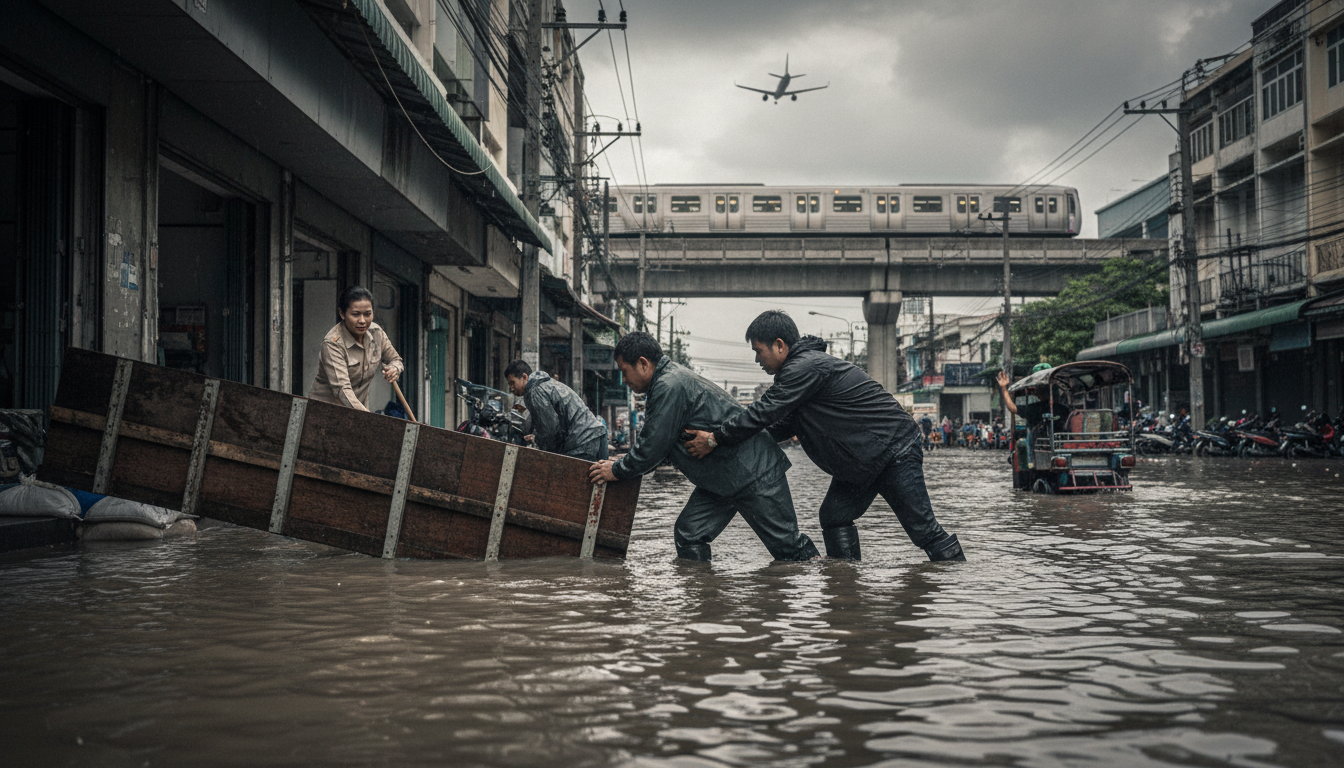
BANGKOK
Bangkok’s recent inundation, spurred by close to 300mm of rain in 48 hours, has placed all 50 districts into a flood disaster zone. While the official declaration came on September 26, the downpours began on September 24, affecting northern and eastern districts and canal-side communities most severely. Suvarnabhumi Airport (BKK) and Don Mueang International Airport (DMK) maintained flight operations, a contrast to the disruption experienced by the city’s ground-level inhabitants.
This event is presented as a consequence of "unprecedented, record-breaking downpours." However, attributing the widespread operational disruptions solely to the volume of rain overlooks a critical design question: how does a city, particularly one in a monsoon climate, function for its people when subjected to predictable climate stresses? The uninterrupted operation of airports, while a functional necessity for international connectivity, highlights a disparity in resilience planning. Infrastructure designed for global transit appears robust, yet the urban fabric intended for daily life falters under conditions that, while extreme, are not entirely unforeseen in tropical regions.
The declaration of an entire city as a disaster zone suggests a systemic vulnerability. The immediate impact is clear: widespread disruption for residents. But the persistent challenge lies in the relationship between urban form and environmental realities. When districts and communities built around canals become the "worst affected," it signals a disconnect. Canals, historically integral to Bangkok’s identity and a natural component of its drainage, appear to exacerbate rather than mitigate the problem in their current state, particularly when integrated into a rapidly expanding urban footprint.
The focus on record rainfall, while accurate, risks framing the issue as an act of nature alone. A city’s ability to absorb or divert water is not solely a function of precipitation levels. It is also a product of drainage capacity, land use planning, and the design of public spaces and residential areas. The continued functionality of major airports amidst widespread city-level paralysis invites an examination of whether urban investment prioritizes certain functions over the basic livability and resilience of its broader populace. This incident is not merely about water; it is about how infrastructure, designed to serve human needs, performs—or fails to perform—under environmental pressure.
Sources
Newsletter
Pacific Daily
A curated briefing from Thailand, Asia-Pacific and the world.