Hotel Initiatives for Breast Cancer Awareness: Design for Purpose or Passive Philanthropy?
Millennium Hotels' 'Threads of Care' in Singapore raises questions about how corporate philanthropy integrates with user experience in physical spaces.
SINGAPORE
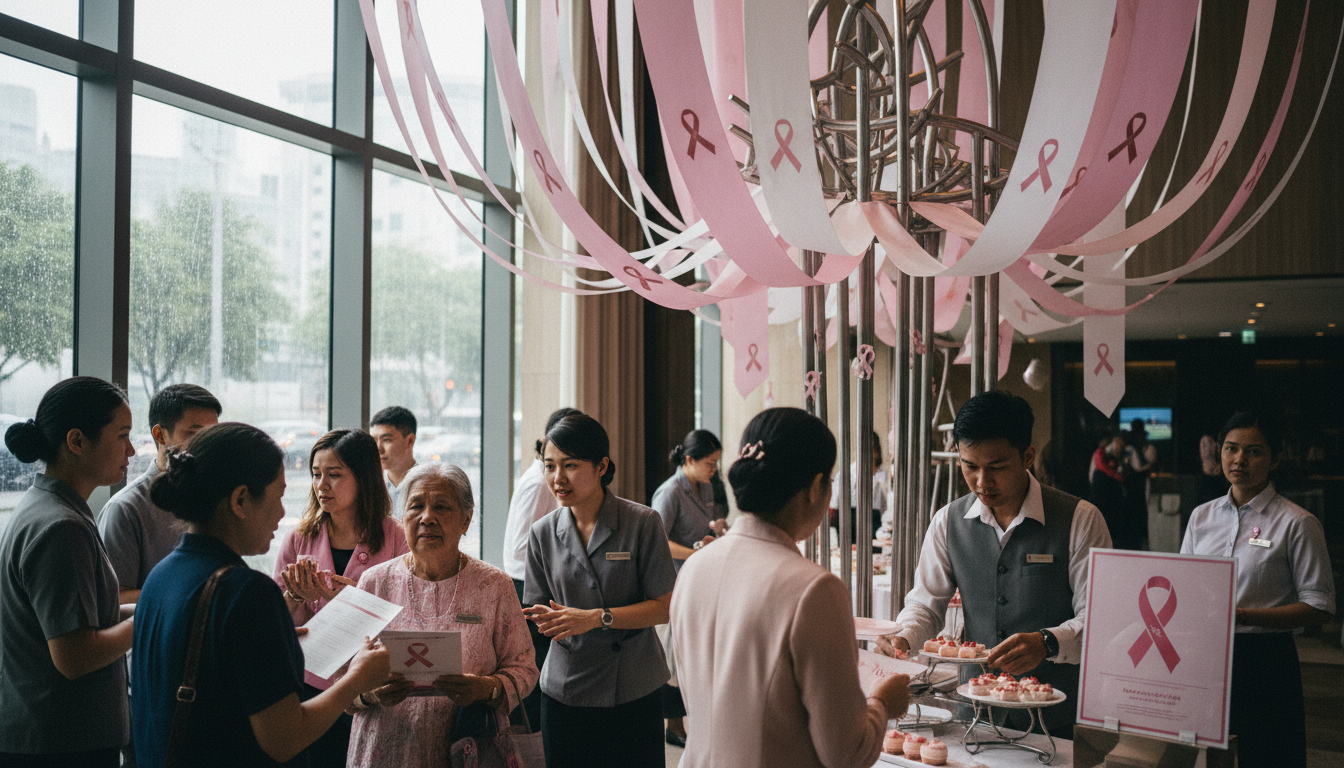
Millennium Hotels and Resorts (MHR) in Singapore is conducting a series of activities during October to support Breast Cancer Awareness Month, including a fundraising effort for the Breast Cancer Foundation (BCF). Under its Moments That Matter initiative, MHR’s six Singapore properties will each host a Threads of Care installation in their lobbies. These installations invite guests and members of the public to leave messages for individuals living with breast cancer, survivors, caregivers, and their families. Each hotel commits to donating S$1,000, equivalent to US$780, upon the installation's completion.
Such an approach warrants examination beyond its stated charitable intent. The concept places an interactive element within a hotel lobby, a space designed for transit, welcome, and often, understated elegance. The design challenge lies in integrating a participatory installation — one intended to evoke personal expression and communal support — into an environment that is primarily transactional. How effectively does a Threads of Care installation function within this context? Lobbies, by their nature, are public and often transient; they serve a broad spectrum of people, not all of whom may be attuned to or comfortable with a public display of personal sentiment.
The initiative relies on public engagement for its symbolic value. Participants can leave messages on the installations. While the gesture offers a platform for connection, the design choice to place this within a hotel lobby might limit its depth. A truly effective design for community engagement often requires dedicated, contemplative space, or at least a seamless integration that acknowledges the existing spatial flow and purpose. The primary users of a hotel lobby are travelers and temporary residents, whose focus is typically on check-in, check-out, or passage. The success of such an installation hinges on whether it truly draws people in, rather than merely existing as a decorative, albeit well-intentioned, fixture.
MHR has been recognized as Singapore's Most Valuable Hotel Brand for two consecutive years, according to a 2025 report. This position suggests a capacity for sophisticated design and guest experience management. The question then becomes whether the Threads of Care installations are designed to genuinely facilitate a meaningful emotional exchange or if they primarily serve as visible markers of corporate social responsibility. The commitment of S$1,000 per hotel is a fixed contribution. The impact of the installation itself, beyond this monetary pledge, depends entirely on its ability to resonate with its audience in an unexpected, public setting.
The challenge for corporate-led awareness campaigns in design-sensitive environments is to transcend mere visibility. The design of public-facing initiatives, particularly those tied to deeply personal causes like breast cancer, must be carefully considered for their efficacy in fostering genuine engagement, not just acknowledging a cause. The constraint that remains unresolved is how to genuinely integrate a sensitive, participatory element into a bustling commercial space without it becoming a token gesture, however well-meaning the intent.
Sources
Newsletter
Pacific Daily
A curated briefing from Thailand, Asia-Pacific and the world.