Enzo Balanger and the High-Performance Foiling Circuit Move Competition Capital to Perth
The French champion’s title defence at the Moth Worlds tests maritime engineering adaptation and southern venue economics.
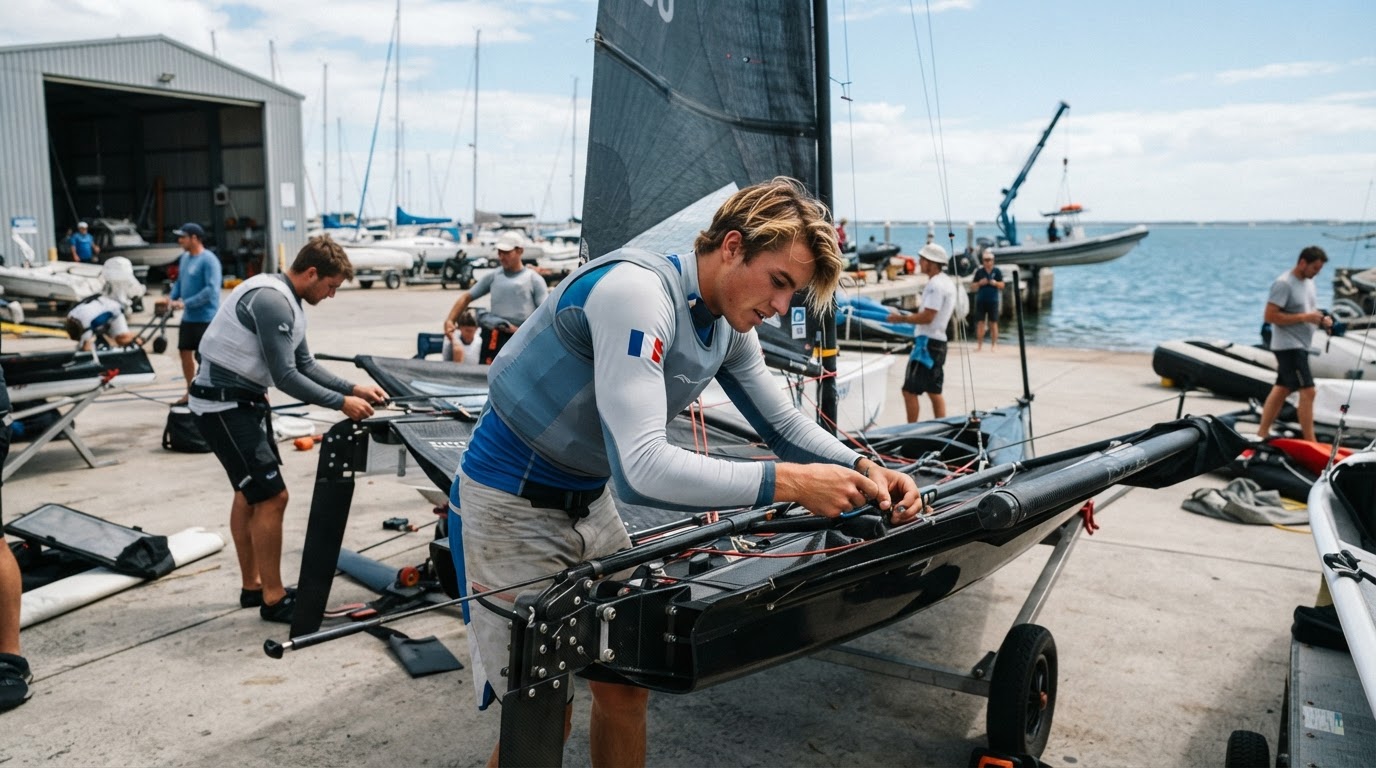
Enzo Balanger has arrived in Perth, Australia, with a title to defend and an engineering baseline to maintain. One year after becoming the first French sailor in history to win the Moth World Championship, his return to elite competition shifts the focal point of high-performance sailing away from domestic European circuits toward Australia.
Regattas of this classification do not function merely as athletic exhibitions. Foiling platforms like the International Moth operate as experimental design laboratories for maritime manufacturing, carbon-composite engineering, and aerodynamic control systems. When the fleet gathers in Perth, the contest tests not just tactical decision-making, but how well European technical programs adapt to southern oceanic realities.
Shifting Testbeds to Australian Waters
European sailing programs historically developed their technical baseline on local waters. Balanger breaking through as the first French champion altered that historical dynamic by proving that French performance development could secure the title. Defending a championship, however, demands a different technical posture than winning it.
Perth presents distinct hydrographic conditions that test the structural tolerances of modern hydrofoils. Foil design requires immediate trade-offs between lift, drag, and cavitation resistance. In calmer conditions, ultra-light components and extreme foil profiles yield measurable velocity gains. Off the coast of Australia, heavier sea states and volatile coastal winds impose mechanical loads that punish excessive structural minimalism.
Maritime engineering gains value only when technical design withstands harsher oceanic baselines.
Skeptics may argue that class racing remains fundamentally an individual contest decided by athletic endurance and tactical positioning. Helmsmen make micro-second balance corrections on the racecourse that no design team can automate. That perspective, however, separates the pilot from the capital asset. A sailor cannot out-sail a catastrophic foil failure or a cracked control linkage. Success in modern hydrofoiling dinghies relies on an interdependent relationship between athlete and equipment manufacturing.
The Commercial Demands of Elite Foiling
Hosting the Moth Worlds in Perth also carries economic implications for Australia. Elite sailing events attract technical syndicates, naval architects, and specialized composite fabricators. These participants bring technical spending and operational contracts to local boatyards and marine service hubs. Australia has long maintained a competitive marine trades sector, and staging world-class championships consolidates local testing facilities as global benchmarks.
Competitors who travel from France and across Europe to Australia face extensive logistical costs. Shipping high-precision carbon-fibre hulls, specialized rigs, and custom foil packages across hemispheres requires significant financial backing. For Balanger, repeating a championship victory requires maintaining sponsorship commitments and engineering support thousands of kilometres from his European technical base.
Balanger’s campaign in Australia highlights the continuous geographic dispersion of competitive maritime testing. If European design culture intends to retain supremacy in foiling technology, its platforms must operate successfully outside the sheltered waters where teams originally conceived them.
The outcome in Perth will ultimately reveal whether Balanger’s French development program has built a universal foiling platform or one restricted to specific sea conditions. The immediate constraint remains unresolved: engineering teams must continuously push composite strength to the absolute limit without triggering sudden structural failure when facing coastal winds.
Sources
Newsletter
Pacific Daily
A curated briefing from Thailand, Asia-Pacific and the world.