Maritime Leisure Along the Gulf of Thailand Masks Unresolved Coastal Contradictions
The staging of the Eastern Seaboard Regatta 2026 demonstrates how private waterfront enclaves manage regional recreational waters while public coastal policy remains absent.
SINGAPORE
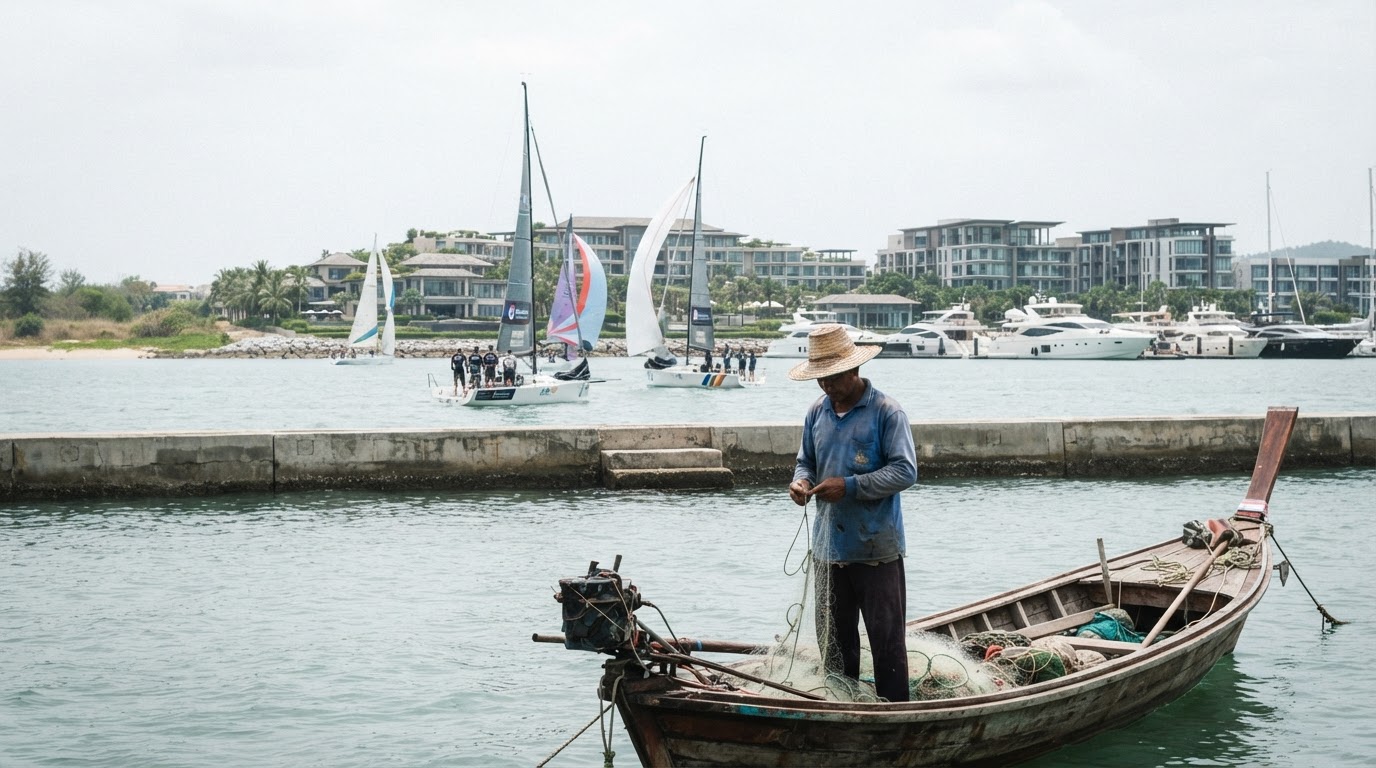
Private recreational perimeters along the Gulf of Thailand operate detached from municipal planning. According to promotional event accounts, the staging of the Eastern Seaboard Regatta 2026 saw the beach fronting the Royal Varuna Yacht Club function as a focused gathering space prior to the official start of competition. Yet that temporary social concentration underlines an enduring institutional contradiction. Thailand has formally concentrated resources on transforming its eastern shoreline into an industrial and logistics corridor, leaving non-commercial maritime sporting facilities almost exclusively within legacy private hands.
The resulting property structure concentrates maritime access behind private institutional boundaries. While event notices characterize the regatta as a wide civic assembly, physical entry to competitive sailing continues to require private club affiliation or private craft ownership. Public administrative records confirm that state economic planners designate coastal tourism as a priority sector. In practice, however, authorities allocate virtually no capital to municipal launchways or open-access nautical infrastructure, effectively outsourcing competitive maritime representation to an autonomous elite enclave.
Capital Allocation Along the Littoral Fringe
Littoral geography across the Asia-Pacific region is finite and contested. Heavy industrial shipping channels, container logistics facilities, and deep-water commercial ports systematically displace unmonetized civic access. Because Thai industrial policy historically prioritized commercial throughput over civic shoreline access, non-state sailing societies assumed functional control of the nation's competitive maritime profile.
Public authorities celebrate regional maritime prestige while delegating foundational access to private coastal enclosures.
This structural division generates a clear policy tension. Tourism bodies depend on events at venues such as the Royal Varuna Yacht Club to project nautical competence across regional sports markets. Yet statutory coastal frameworks provide no structural links to municipal transport systems or accessible public beachfronts. Club managers assume the operational expense of mounting fixtures like the Eastern Seaboard Regatta, but this dynamic insulates maritime decision-making from broader public participation.
The Limits of Institutional Prestige
Club administrators contend that private institutional tenure represents the sole viable mechanism for sustaining international race management standards. Their operational argument carries weight. Without private investment, dedicated staff, and private maintenance regimes along the Gulf of Thailand, competitive fleets would lack adequate race committee management and secure moorings that municipal agencies are neither equipped nor funded to supply.
Operational capability, however, does not resolve structural exclusivity. Inferences drawn from current land-use allocations show that relying on self-funded clubs preserves an asymmetrical shoreline economy, where logistics terminals and high-net-worth recreational compounds divide the coast into closed jurisdictions. Once regatta schedules conclude, the immediate social footprint dissolves, leaving the underlying property division firmly entrenched. The unresolved policy question is whether central planners will establish municipal maritime access points, or continue permitting private club perimeters to define national maritime presence.
Sources
Newsletter
Pacific Daily
A curated briefing from Thailand, Asia-Pacific and the world.