Spain High-Speed Collision Exposes Operational Limits of Automated Rail
The fatal crash on the Madrid-Andalusia alignment challenges assumptions that digital train control eliminates collision risk on heavily trafficked passenger corridors.
SINGAPORE
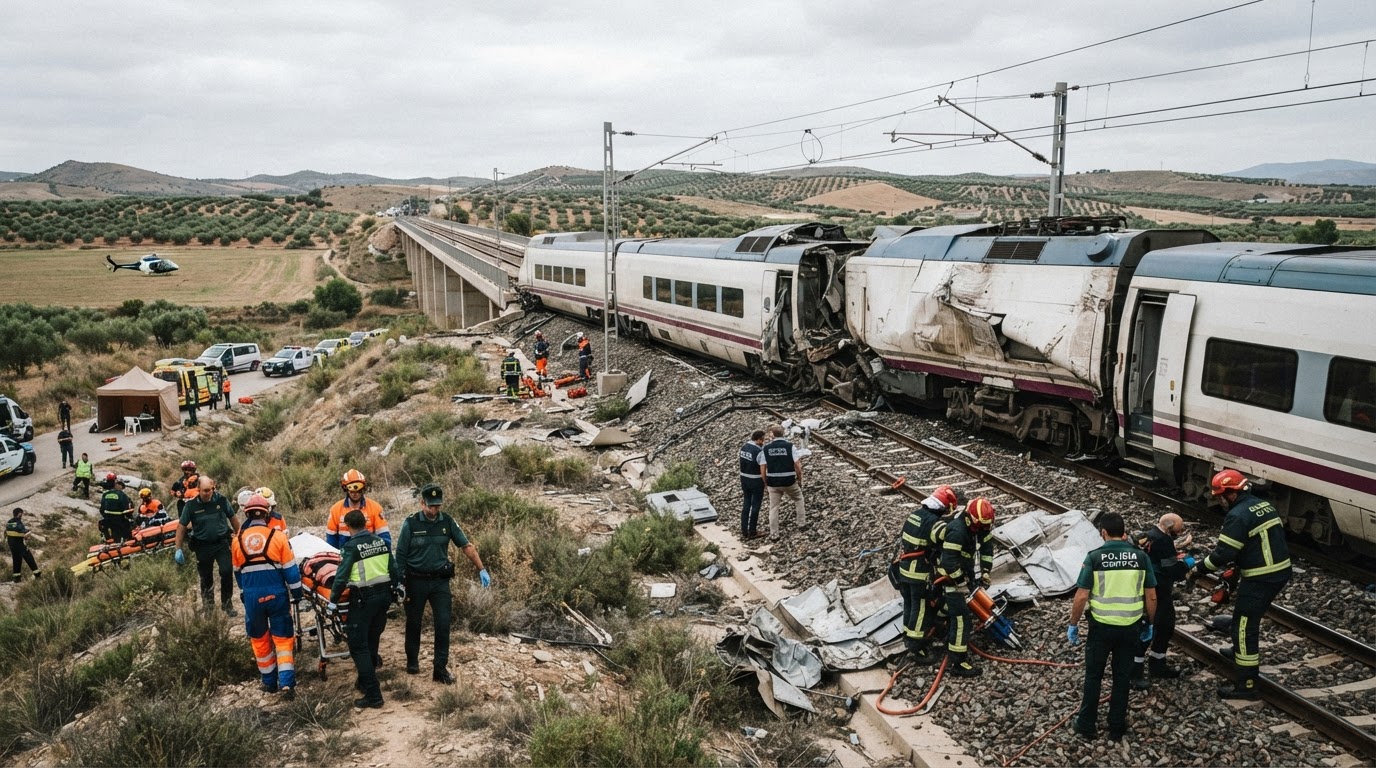
Modern high-speed rail development was founded on an absolute operational premise: digital signalling and automated separation make trunk-line collisions functionally impossible. When two passenger convoys collide along an active high-speed corridor, that technological certainty collapses. On Wednesday, Oct 28, 2026, at least 10 people died after two high-speed trains collided near Urda in Castilla-La Mancha. Regional authorities, including Esther Padilla, directed emergency services to an alignment connecting Madrid to Andalusia where carriages had derailed across elevated structures and down trackside embankments. Visual records from Castilla-La Mancha Television and Europa Press photographer Juanma Jiménez documented severe kinetic deformation along a line historically celebrated as a pillar of European infrastructure modernisation.
Passengers aboard the service, including Miguel, described immediate devastation as coaches sheared from the track bed. Collisions on dedicated passenger lines are not standard operational anomalies. Unlike legacy freight networks that accommodate varied axle weights and manual scheduling buffers, dedicated high-speed infrastructure operates within severe temporal tolerances. Automated train control systems are built precisely to prevent track conflicts by applying intervention braking long before opposing movements occupy the same territorial block. When that protective barrier fails, the breakdown touches the core technical integrity of the network.
Technical Redundancy Under Pressure
Transport ministries around the world have positioned high-speed networks as optimal replacements for domestic aviation, directing billions into automated trunk corridors. Planners routinely argue that digital transponders and continuous telemetry remove human fallibility from locomotive operations. Yet the physical reality of heavy trainsets moving at elevated speeds means that automatic train protection must perform without error at every interlocking point.
Operational demand complicates this equation. Across heavily utilised corridors, operators face relentless structural pressure to compress headways, run more trainsets, and minimise turnaround windows. While physical civil works like viaducts and track subgrades remain stable over decades, the digital architecture governing switches, transponders, and automated train control demands rigorous inspection cycles. If maintenance routines miss degraded trackside sensors or corrupted dispatch data, automated safety nets fail silently. High-speed rail corridors cannot sustain aggressive service density without absolute precision in hardware recertification.
The Repercussions for Asian Expansion
For transport authorities across China and the wider Asia-Pacific, the catastrophe in Spain carries vital strategic lessons. Over the past two decades, Asian states have constructed the largest high-speed networks on earth, staking economic mobility on the assurance that centralized digital dispatch guarantees systemic safety. The collision near Urda demonstrates that technical automation does not insulate an operator from basic physics or the risks of system fatigue. Building thousands of route kilometres is an exercise in capital mobilisation, but maintaining automated telemetry over decades requires institutional vigilance that cannot be compromised to meet traffic quotas.
Rail authorities often assume that modernized signalling eliminates the risk of disastrous track conflict. That conviction can breed complacency regarding sensor deterioration and software fail-safes. When operational timetables take precedence over stringent component maintenance, the margin for error narrows dangerously. If train protection software misreads a block status or fails to enforce automatic braking, crews have virtually no physical ability to stop a high-velocity trainset in time.
Spanish investigators in Urda must identify the exact telemetry sequence, dispatch directive, or physical switch failure that allowed two trainsets to occupy the same track section. The broader institutional inquiry must look deeper. The critical tension facing high-speed rail planners in Europe and Asia alike is whether network authorities can maintain uncompromising maintenance standards while pushing operational density to its absolute limit.
Sources
Newsletter
Pacific Daily
A curated briefing from Thailand, Asia-Pacific and the world.