The Asymmetry of the Archipelagic Warning
Typhoon Condition III across the northern reaches of the Marianas exposes the structural gap between territorial administration and remote island reality.
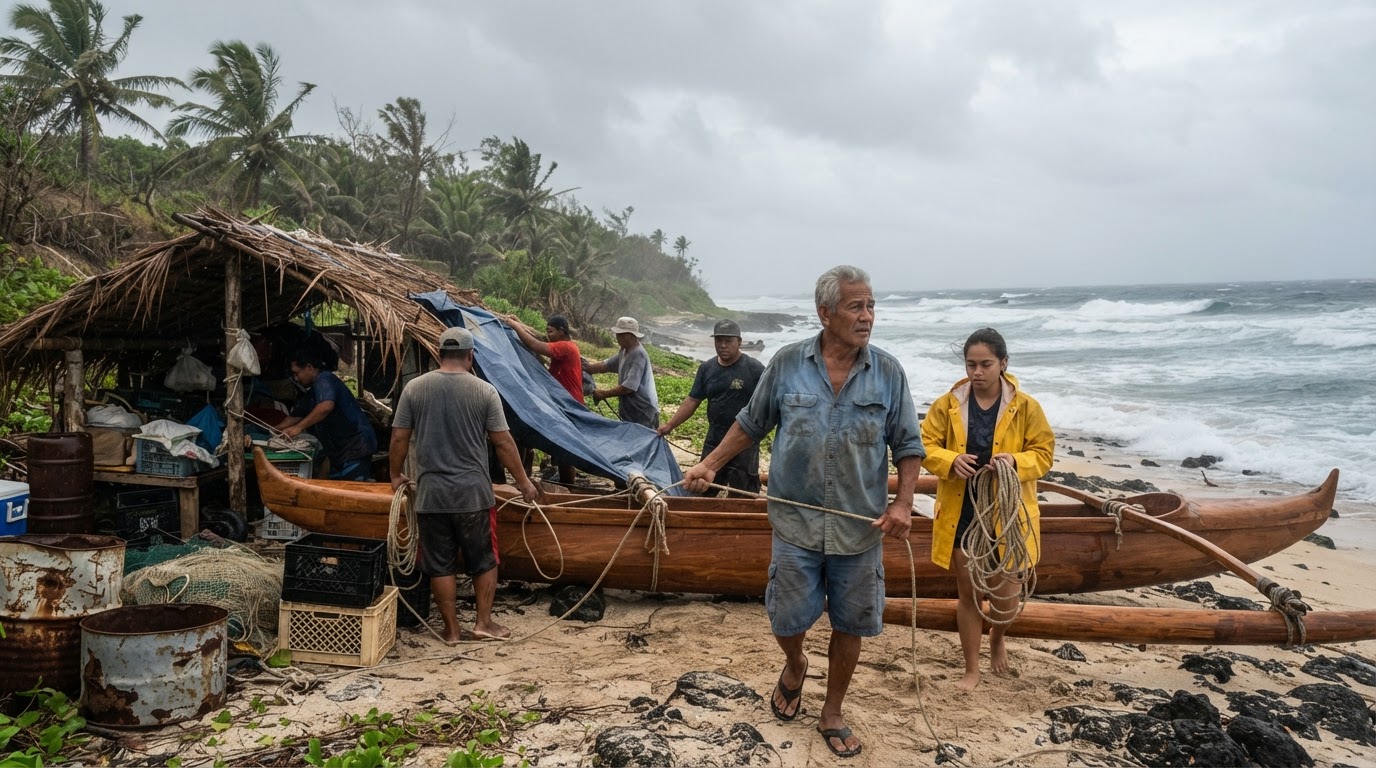
Civil defense across oceanic territories operates on an administrative fiction that geography quietly dismantling. When an emergency alert issues from a territorial capital, the wording presumes every coordinate within the jurisdiction participates equally in the apparatus of public safety. Yet the center that issues the decree commands institutional depth, whereas an isolated northern periphery must weather the identical hazard with little beyond its immediate terrain.
That divergence emerged clearly when authorities in the Commonwealth of the Northern Mariana Islands issued a typhoon warning for the CNMI's Northern Islands. In-fa, evaluated as a category 4 typhoon at 1pm Wednesday local time, recorded maximum sustained winds of 140 miles per hour while tracking west-northwest at 10 miles per hour. Forecasters warned the system could intensify into a super typhoon on Wednesday night. With the storm positioned roughly 905 miles east of Saipan, CNMI Governor David Apatang declared Typhoon Condition III for Agrihan, Pagan, and Alamagan, signaling destructive winds of at least 74 miles per hour were possible within 48 hours.
Distance and Administrative Parity
The declaration of Typhoon Condition III serves a defined legal function. Standardized alerts establish an operational calendar, telling municipal departments when administrative monitoring must transition into shelter protocol. Bureaucratic uniformity carries clear legal logic, ensuring executive authority activates before open water becomes impassable.
Yet administrative symmetry obscures physical reality. The open sea between the administrative center on Saipan and the northern islands measures hundreds of miles. On the primary civic islands, an escalation in alert status prompts public shelter openings and utility shutdowns. Across Agrihan, Pagan, and Alamagan, where infrastructure is minimal, the protocol initiates little more than individual endurance. Emergency management models quietly presuppose secondary civic systems that isolated volcanic outposts do not have.
Formal parity conceals practical division when oceanic distance separates the desk issuing an alert from the outpost absorbing the wind.
When a cyclone bearing sustained winds of 140 miles per hour heads toward remote settlements, a 48-hour notice window offers thin utility. Maritime re-supply halts immediately as ocean swells build, while long-distance evacuation over water becomes hazardous in deteriorating weather. Condition III marks the official start of administrative vigilance, but it simultaneously indicates the point where northern outposts become isolated from central support.
The Limits of the Protocol
This gap does not stem from administrative neglect. Territorial leaders cannot compress ocean expanses, nor can meteorologists dismantle the vulnerability of small landmasses lying directly within typhoon alleys. The administrative machinery operated as designed: forecasters measured atmospheric velocity, the executive branch applied the statutory classification, and the advisory went out within the prescribed timeline.
The friction lies instead in the governing premise of disaster management. Modern civil frameworks treat risk reduction as primarily an informational challenge, operating under the assumption that issuing timely warnings satisfies the core responsibility of collective protection. But a broadcast cannot reinforce a shelter or bridge open ocean. For Agrihan, Pagan, and Alamagan, the approach of severe weather remains an isolated physical trial rather than a connected territorial response.
As In-fa charts its path across the western Pacific, the system highlights an unresolved tension in archipelagic governance. A warning mechanism can declare civic parity across distant coordinates, but it cannot deliver shared shelter. The protocol reaches the outer reef in seconds, while the physical security of the state remains tethered to the center.
Sources
Newsletter
Pacific Daily
A curated briefing from Thailand, Asia-Pacific and the world.