Pacific Athletic Capital Confronts an Asymmetric Divide
Fiji Bulikula's breakthrough and the men's rout expose the uneven institutional foundations of regional rugby league
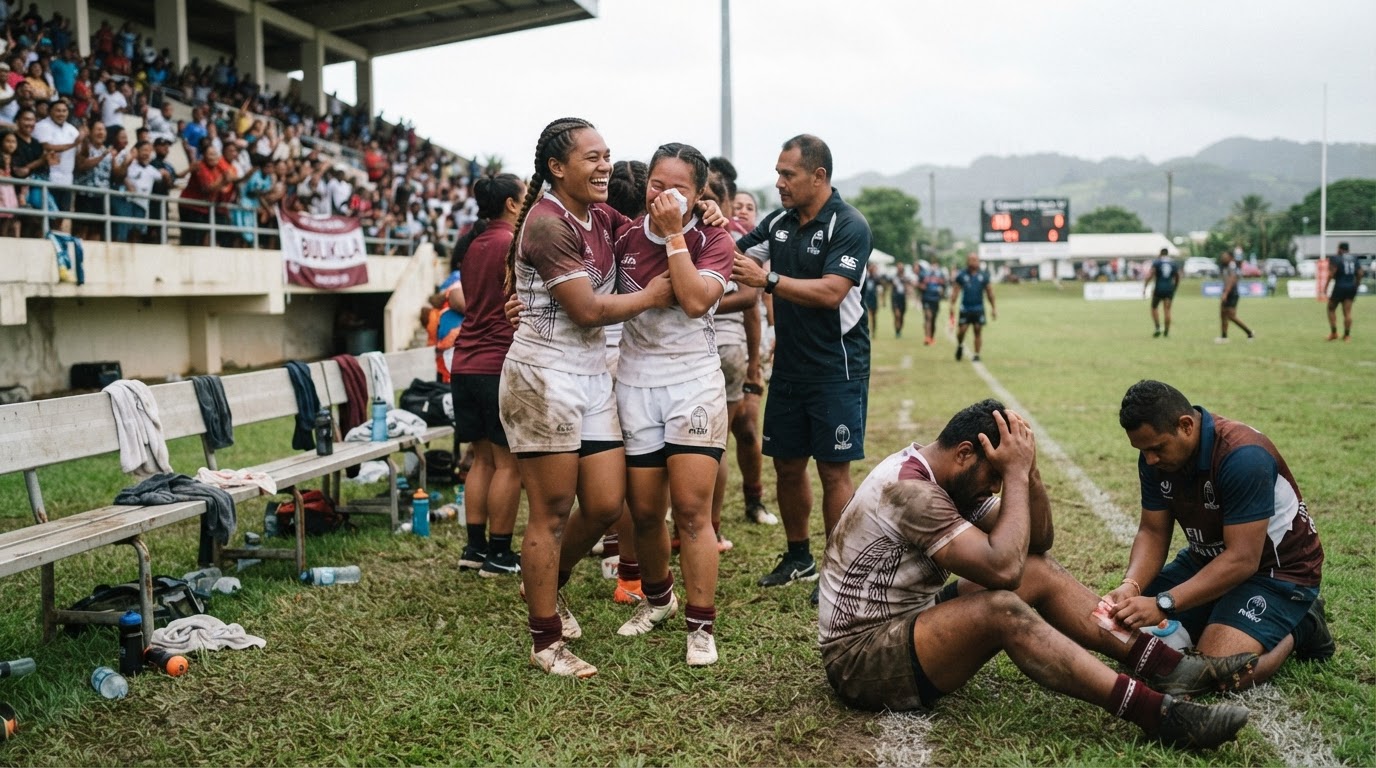
Pacific athletic prominence routinely outpaces the institutional capital of the island societies that produce it. When the Fiji Bulikula defeated France 54-6 at Cbus Super Stadium on Saturday afternoon, the women secured a historic Rugby League World Cup semifinal berth through clinical line running and defensive discipline. Hours later at the same venue, the Fiji Bati men suffered a 78-0 defeat against the New Zealand Kiwis, conceding eight tries and a 48-0 deficit across the first 40 minutes before five further tries completed the rout. The sharp divergence across a single afternoon exposed the structural volatility that defines international competition for island nations.
Men's rugby league has leaned on talent from Fiji and Samoa across Australian competitions for decades, yet domestic development across the home islands contends with persistent resource deficits. The Fiji Bati's loss against New Zealand demonstrated what happens when squad assembly confronts an opponent backed by mature professional depth. New Zealand converted physical pressure into eighty unanswered points, exposing the operational gulf that separates established national programs from sides dependent on decentralized player pools. Athletic commitment cannot compensate for the absence of institutional continuity when elite fixtures intensify.
Unequal Footing in the Pacific Basin
The Bulikula's campaign presents a compelling structural counterpoint. France entered the contest with organized domestic competitions, yet Fiji's women established absolute control to produce their commanding 54-6 victory in the third round. Having already measured themselves against the New Zealand Kiwi Ferns and the PNG Orchids earlier in the 2026 tournament, the Bulikula displayed tactical poise and superior contact management. Their progression alters the competitive hierarchy of the women's tournament, proving that deliberate coordination can rapidly elevate a developing squad.
Raw athletic talent cannot shield an island squad when metropolitan opponents command deeper organizational reserves.
Some analysts argue that the women's international tournament remains in an early stage of development, allowing smaller nations to close competitive margins far more quickly than in the mature men's game. That counterargument holds measurable validity. Decades of entrenched professionalism in men's rugby league have created vast cumulative advantages in conditioning, technical specialization, and team preparation, compounding the margin of defeat seen against the Kiwis. Yet attributing the Bulikula's breakthrough purely to relative tournament youth overlooks how targeted preparation enabled them to surpass France and the PNG Orchids.
The Cost of Institutional Asymmetry
Regional sports diplomacy across Oceania often treats island participation as self-sustaining cultural expression. Metropolitan institutions celebrate Pacific representation on the field, even as the underlying economic returns remain concentrated outside the islands. Professional talent from Fiji and Samoa sustains elite Australian leagues, but domestic sporting bodies back home must operate under acute financial boundaries. When national rosters assemble for World Cup fixtures, they carry immense domestic expectations without the sustained material backing enjoyed by Australia or New Zealand.
Saturday's contrasting outcomes at Cbus Super Stadium leave Fijian rugby league navigating two divergent realities. The Bulikula have earned an unprecedented semifinal appearance, demonstrating how focused execution can challenge international opponents and reset domestic expectations. Conversely, the Fiji Bati face an unsettling reckoning after an eighty-point shutout by New Zealand revealed the limits of ad hoc national preparation. Island athletic programs can generate individual brilliance and sudden breakthroughs, but sustaining parity against metropolitan wealth remains an unresolved structural barrier.
Sources
Newsletter
Pacific Daily
A curated briefing from Thailand, Asia-Pacific and the world.