The Downgraded Storm Deception on the Pacific Coast
Administrative alerts slacken when cyclones lose wind speed, precisely where accumulated rainfall poses the greater hazard.
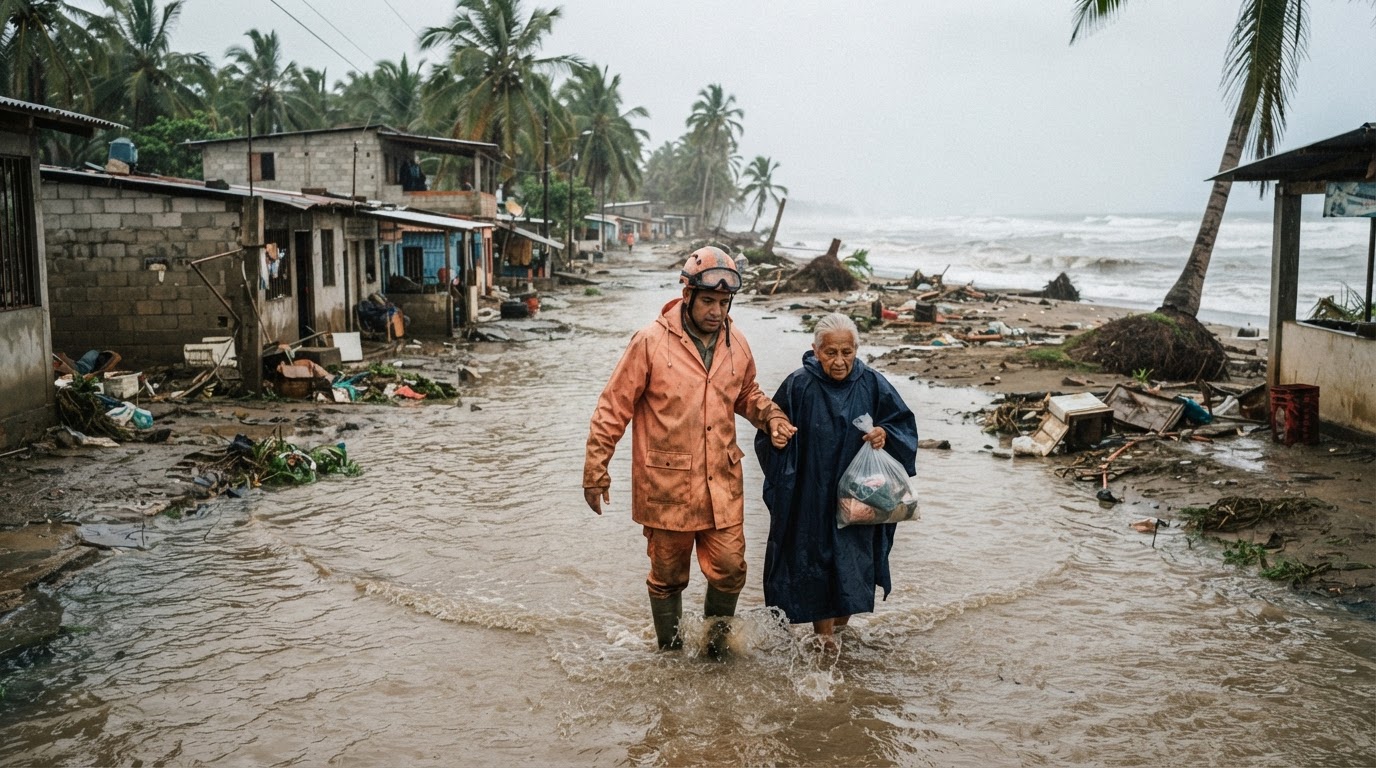
A cyclone loses its structural name the moment its sustained winds subside, yet the physical terrain beneath it preserves every drop of water it ever carried. Both conditions exist simultaneously along the Pacific Rim, but disaster management frameworks consistently treat them as mutually exclusive.
According to the National Meteorological Service, Tropical Storm Vance was tracked approximately 365 kilometers west-southwest of Cabo Corrientes in Jalisco and 390 kilometers west-southwest of Punta Mita in Nayarit, carrying sustained winds of 65 kilometers per hour. Forecasters at the U.S. National Hurricane Center anticipate that Vance will lose convective structure and degenerate into a post-tropical remnant low before approaching the Sinaloa coast between Thursday and Friday. Because landfall as an intact tropical storm appears improbable, the prevailing administrative inference is that the crisis has evaporated. That reaction reflects an institutional habit: civil agencies monitor wind speed, while ground populations confront volume.
Hydrological records indicate that downgraded systems routinely inflict greater aggregate disruption than their categorisation suggests. The National Meteorological Service projects rainfall totals between 75 and 150 millimeters across central and southern Sinaloa, Nayarit, Durango, the southern tip of Baja California Sur, and the Jalisco coastline. When 150 millimeters of rain falls on drainage basins already primed by Hurricane Simon earlier in October, soil absorption reaches an immediate limit. Surface runoff ceases to filter and begins to surge.
The Flawed Metric of Wind Speed
This contradiction stems from how risk is codified. Warning apparatuses respond mechanically to cyclonic nomenclature. When Vance showed potential for rapid intensification toward a Category 3 hurricane off western Mexico, maritime alerts mobilized along formal lines. Once the storm's vortex deteriorated into a remnant low, the regulatory posture relaxed.
Topography does not register wind categories.
The steep elevations spanning Nayarit, Sinaloa, and Durango convert slow-moving atmospheric moisture into sudden alluvial discharge regardless of isobar concentration. A downgraded depression that stalls over mountain slopes frequently displaces villages and tears out transport links far more comprehensively than a compact, high-velocity gale whose eye sweeps through within three hours. By equating disaster severity with aerodynamic force, public administration fosters a false sense of security at the precise moment hillside saturation approaches failure.
The Logic of Structural Defense
Municipal planners offer a coherent defense of this posture. Structural resilience—the ability of electrical grids, warehouse roofs, and commercial shipping facilities to withstand mechanical force—is determined directly by dynamic wind loads. Organizing a coastal zone for a major hurricane requires an extensive logistical footprint, from mandatory port shutdowns to civic evacuations. Diverting those exact resources to every diffuse rain band would rapidly exhaust regional budgets. From an administrative perspective, prioritizing wind velocity is an unavoidable triage method.
Wind scales define emergency mobilisations, but cumulative watershed volume dictates physical survival.
That administrative defense, however sensible on paper, fails against the environmental reality of the Pacific basin. Saturated earth operates on accumulated history, not operational calendars. Precipitation from Vance falling across river valleys already swelled by Hurricane Simon guarantees immediate inundation, regardless of whether the incoming system retains tropical storm status. The storm will reach Sinaloa officially stripped of its threatening label, leaving emergency agencies administratively vindicated while the lowlands contend with the water.
Sources
Newsletter
Pacific Daily
A curated briefing from Thailand, Asia-Pacific and the world.