Cyclone Xavier Exposes the Physical Limits of Pacific Warning Systems
Institutional forecasting across the Northern Cook Islands functions as designed, yet remote atolls face the reality of severe weather with few structural buffers
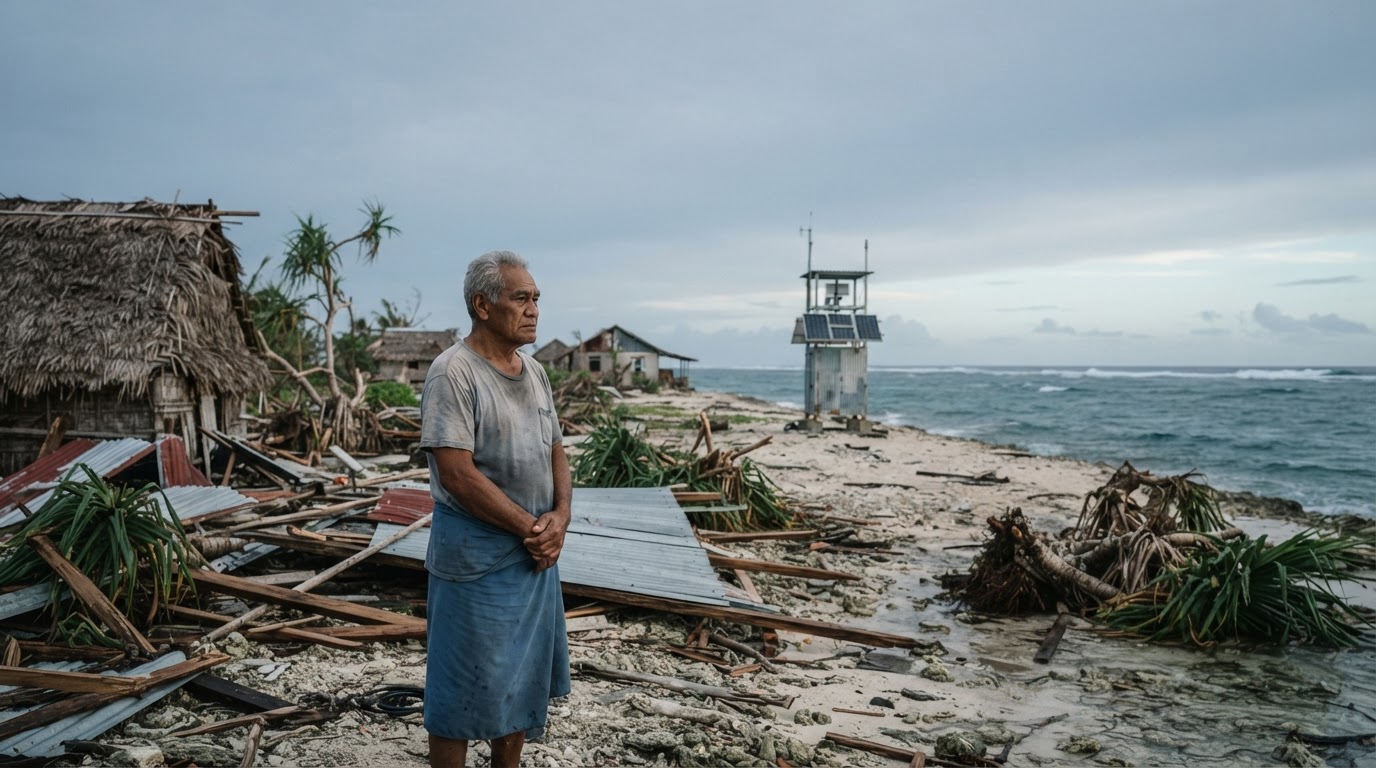
When Tropical Cyclone Xavier intensified into a category 2 system, meteorological agencies across the South Pacific executed their established protocols with expected precision. The Fiji Meteorological Service projected that Xavier would escalate into a severe tropical cyclone by Tuesday, tracking steadily westward within the Northern Cook Islands. Concurrently, the Cook Islands Meteorological Service issued a formal tropical cyclone alert for Pukapuka and Nassau, warning residents of damaging gale-force winds, heavy rain and thunderstorms. Forecast models and inter-agency advisories performed their technical functions smoothly. The actual capability of isolated communities to absorb severe weather events, however, remains defined by strict material boundaries that administrative warnings cannot alter.
Institutional reporting from regional meteorological centres reliably tracks low-pressure systems across thousands of kilometres of open ocean. For decades, Pacific meteorological cooperation has concentrated on refining alert timelines, ensuring that authorities in Suva and Rarotonga can identify storm paths and broadcast hazards to outlying island groups. With Xavier, this forecasting apparatus operated without delay, delivering advance warnings of severe intensification before the cyclone crossed populated areas.
The Preparedness Deficit
Official directives issued to Cook Islanders highlight the acute vulnerability inherent to low-elevation atolls. Residents on Pukapuka and Nassau were advised to secure loose items around their homes and properties, while fishermen were told to avoid putting out to sea in unsafe conditions. These protective instructions represent sensible, practical precautions during the onset of gale-force squalls. At the same time, such measures underscore the stark disproportion between domestic-scale preparation and the physical forces of a severe tropical cyclone.
Securing residential items can prevent secondary projectile damage during moderate winds, but it provides no barrier against torrential rainfall, extensive maritime surge, or prolonged atmospheric pressure drops. In isolated northern territories such as Nassau and Pukapuka, where natural elevation is minimal and physical infrastructure is sparse, basic domestic securing constitutes almost the entirety of the local defense. The regional tracking apparatus succeeds in delivering early intelligence, yet that information ultimately transfers the operational burden of survival entirely onto household-level adjustments.
Structural Exposure Across Dispersed Geography
Regional monitoring demonstrates that early notification alone does not resolve the logistical isolation of small atolls. When the Fiji Meteorological Service indicates rapid intensification from category 2 into a severe storm, the operational response window for isolated populations contracts immediately. Outlying locations cannot build hardened sea defences or execute large-scale evacuations on a matter of hours or days. Marine activities cease as fishermen remain ashore, preserving life but halting food gathering and local transport precisely when communities must ready themselves for extended isolation.
The operational response window contracts immediately when forecasting services confirm rapid storm intensification over isolated outposts.
Sustained atmospheric tracking by regional bodies provides indispensable lead time, but early warning systems have outpaced physical protective capabilities on the periphery. Xavier's progression westward across the Northern Cook Islands demonstrates that administrative coordination can successfully map impending hazards without fundamentally reducing community exposure to damaging winds and rain. Until infrastructure investments match the reach of regional meteorology, low-lying outposts remain reliant on rudimentary domestic preparations to withstand severe environmental shocks.
Sources
Newsletter
Pacific Daily
A curated briefing from Thailand, Asia-Pacific and the world.