What Stored Industrial Waste Reveals About Community Risk in Samut Sakhon
The discovery of over 200 tonnes of suspected aluminium dross points to persistent gaps between industrial warehousing and everyday neighbourhood safety.
SINGAPORE
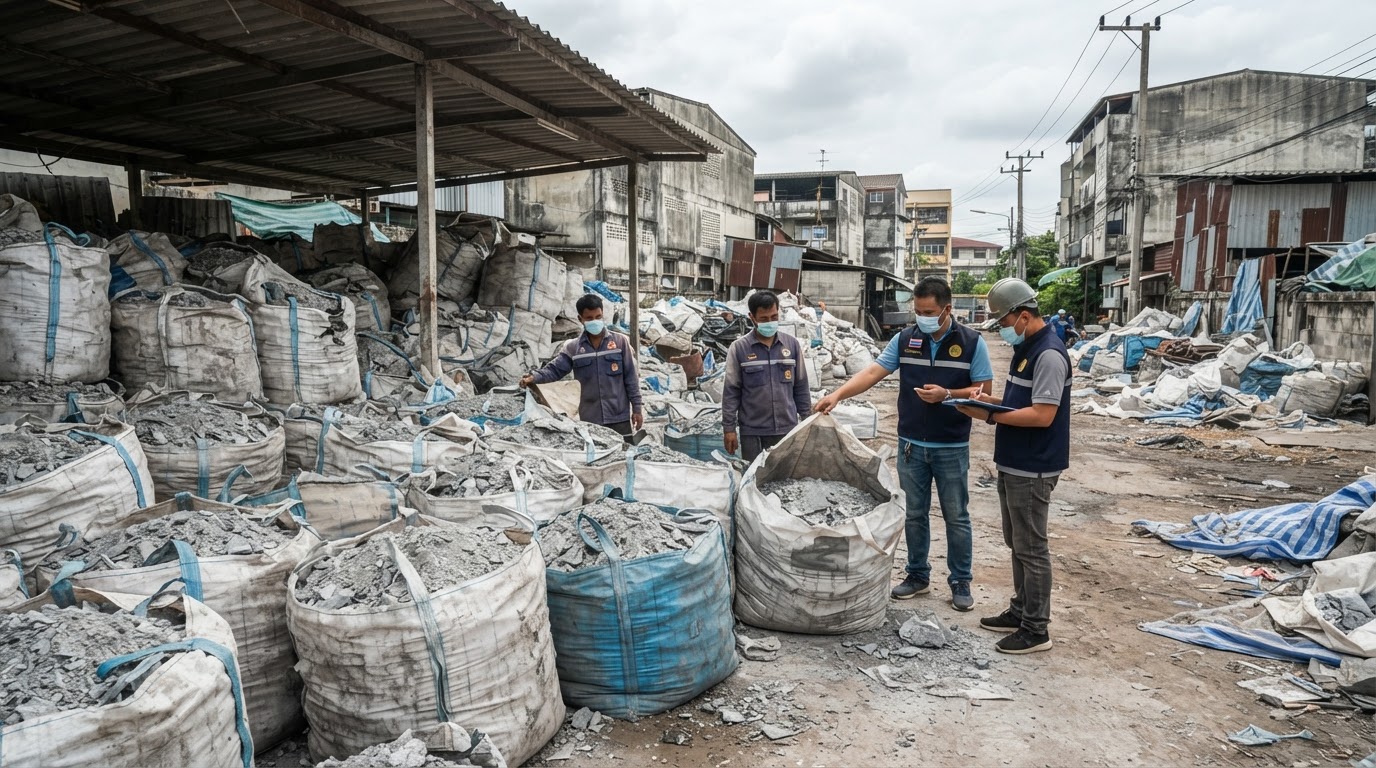
Corrugated warehouse doors in mixed industrial belts conceal their contents until an irregular smell drifts outside. That barrier gave way in tambon Na Di of Muang district in Samut Sakhon, where neighbours reported suspicious deposits of commercial refuse accumulating behind closed gates. Acting on those complaints, an inter-agency team inspected the compound on Friday and seized more than 200 tonnes of suspected aluminium dross stored in large sacks across the warehouse floor.
The physical raid brought together officers from the Samut Sakhon industry office, the Department of Special Investigation, the Pollution Control Department, and partner administrative bodies. Photographic records released by the Samut Sakhon public relations office documented piles of greyish-black industrial material stacked under the roof. On the official ledger, the intervention represents a successful containment action. For households along the perimeter fence, however, the official presence confirmed that unverified industrial byproducts had been resting within breathing distance of their daily lives.
Aluminium dross forms during smelting and refining. Left dry in certified repositories, the compound remains stable. Exposed to ambient moisture or rainwater leaks, the material can generate toxic ammonia gas and hazardous runoff, transforming an ordinary commercial storage shed into a quiet community hazard. In practical terms, that chemical reality alters ordinary domestic routines. Families living beside commercial properties find themselves re-evaluating open windows, garden soil, and well water without knowing how long the material sat unchecked.
Enforcement Gaps Behind Closed Warehouse Doors
Commercial warehousing often operates on light oversight until local vigilance forces state intervention. The involvement of the Department of Special Investigation alongside environmental inspectors suggests authorities viewed the accumulation not as a routine clerical mismatch, but as a deliberate circumvention of hazardous waste controls. Peripheral subdistricts frequently offer cheap floor space to middlemen who quietly accept factory residues outside established industrial zones.
Industry logistics, to be sure, can produce genuine bottlenecks. Transporters sometimes use transitional depots to hold materials while waiting for recycling paperwork or clearance from destination refineries, meaning not every unlicensed stockpile stems from predatory dumping. Delays in processing can strand heavy cargo far longer than initial transit timetables anticipate.
Yet that operational defence collapses when tested against residential exposure. When a business cuts costs by avoiding certified hazardous storage, it effectively transfers the physical burden to neighbouring households. Those families receive no notice, no air monitoring, and no defensive infrastructure. When waste accumulation reaches hundreds of tonnes, commercial friction becomes public exposure.
The Lingering Cost for Peri-Urban Neighbourhoods
Padlocking a compound threshold leaves the hard work unresolved. State agencies must now direct certified extraction, chemical analysis, and transport to licensed processors. Until every bag departs and soil sampling rules out secondary contamination, local residents carry the private burden of not knowing what settled into their immediate environment.
The episode in Samut Sakhon points to a systemic breakdown in preventative monitoring. Relying on community complaints turns ordinary householders into unpaid pollution inspectors. Long-term public safety in expanding suburban perimeters will ultimately depend on whether industrial supply chains face automated tracking before hazardous mounds force neighbours to call for help.
Sources
Newsletter
Pacific Daily
A curated briefing from Thailand, Asia-Pacific and the world.