The Weaponisation of the Classroom Feed
An alleged axe assault in Sarawak exposes the widening gulf between institutional perimeter security and sovereign digital moderation
SINGAPORE
Perimeter defence has long anchored institutional safety doctrine across Southeast Asian schools. Administrative control depended on physical boundaries. Gates, visitor registries, and staff patrols established a verifiable divide between the campus and the external environment. That protective architecture lost its operational utility when physical assault converged directly with automated broadcast in Kuching, Sarawak.
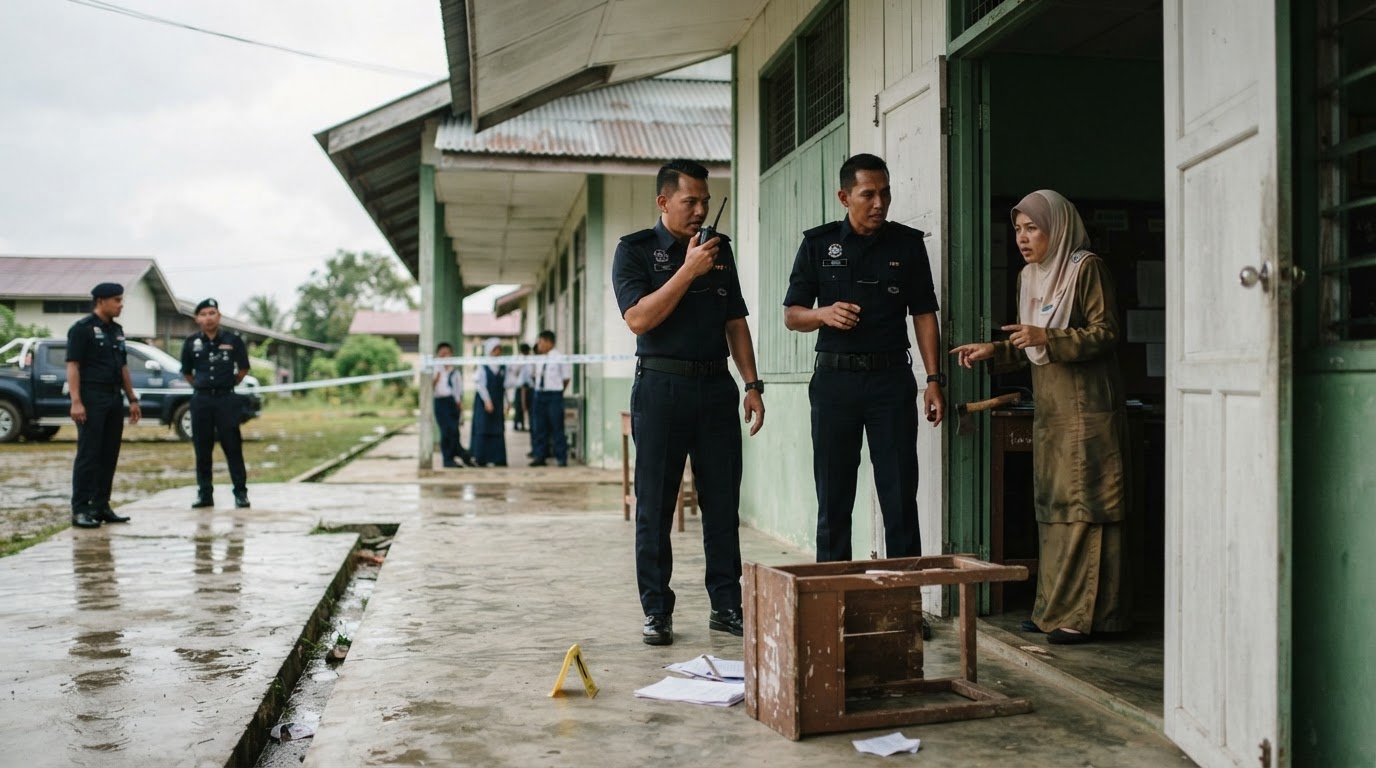
According to reports from Malaysian police, officers arrested a 16-year-old student who allegedly attacked a teacher with an axe at a private school while livestreaming the encounter on Facebook. The police account specifies that the youth strapped a mobile telephone to his head to broadcast the incident. That mechanical configuration matters. It indicates that the physical assault was staged explicitly to generate an unmediated visual transmission, turning an enclosed educational space into an open distribution studio.
Historically, institutional violence yielded retrospective evidence. Investigators reconstructed classroom crimes from fixed closed-circuit surveillance tapes, forensic measurements, and bystander recollections gathered after the event had concluded. Operating a live feed directly from a perpetrator's body introduces an entirely different capability. Digital devices in Malaysian classrooms have routinely been regulated as pedagogical tools or simple disciplinary distractions, managed through school rules rather than lethal threat frameworks. Yet when consumer hardware functions as an operational transmission rig, institutional barriers collapse.
The Broadcast Mechanism
Commercial streaming platforms operate on engagement metrics that prioritise immediate video delivery. By contrast, platform content moderation depends on automated filters and retrospective user reports that inherently lag behind transmission. This structural latency creates a predictable window of operational impunity. During that interval, an attacker controls an uninterrupted broadcast corridor. Law enforcement personnel and campus administrators measure their physical emergency responses in minutes. Digital protocols deliver raw visual trauma across borders in fractions of a second.
Advocates of student-centred pastoral intervention argue that hardware bans miss the underlying psychological grievances driving juvenile aggression. They contend that confiscating phones addresses the technical instrument rather than the root cause of behavioural failure. That objection carries moral weight, but it misinterprets the strategic shift. A broadcast rig does not simply record an impulse; it actively alters the perpetrator's calculation. The prospect of guaranteed, instantaneous visibility creates an audience dynamic that standard disciplinary structures were never designed to deter.
Jurisdictional Limits
This dynamic highlights an intractable problem for regional governance. When an alleged violent crime is streamed live from an institution in Kuching, physical apprehension by Malaysian law enforcement resolves only the immediate territorial threat. The digital recording persists. Within seconds, algorithmic loops replicate the feed across offshore servers, messaging networks, and overseas mirrors long before host platforms execute takedown requests.
Territorial sovereignty remains confined by national borders, but the digital infrastructure facilitating the transmission remains governed by private entities operating under separate legal frameworks. Southeast Asian regulatory approaches alternate between punitive device restrictions and reactive takedown demands. Neither posture addresses the reality that standard consumer hardware provides individuals with sovereign-grade broadcast capabilities. Educational institutions possess neither the technical intercept equipment nor the jurisdictional authority to police encrypted data exiting their classrooms.
The resulting crisis is structural rather than procedural. Institutional administrators carry a domestic legal responsibility to maintain classroom safety, yet they lack the technical tools to halt live visual exploitation conducted through external commercial platforms. Until educational authorities confront the reality that mobile broadcasting capabilities have outpaced the mechanical protections of perimeter gates, classrooms across the Asia-Pacific will remain vulnerable to violence designed primarily for the lens.
Sources
Newsletter
Pacific Daily
A curated briefing from Thailand, Asia-Pacific and the world.