Pacific Sporting Realignment Accelerates in Port Moresby
Fiji's emphatic victory over Papua New Guinea marks an operational shift in women's rugby league hierarchy across Oceania.
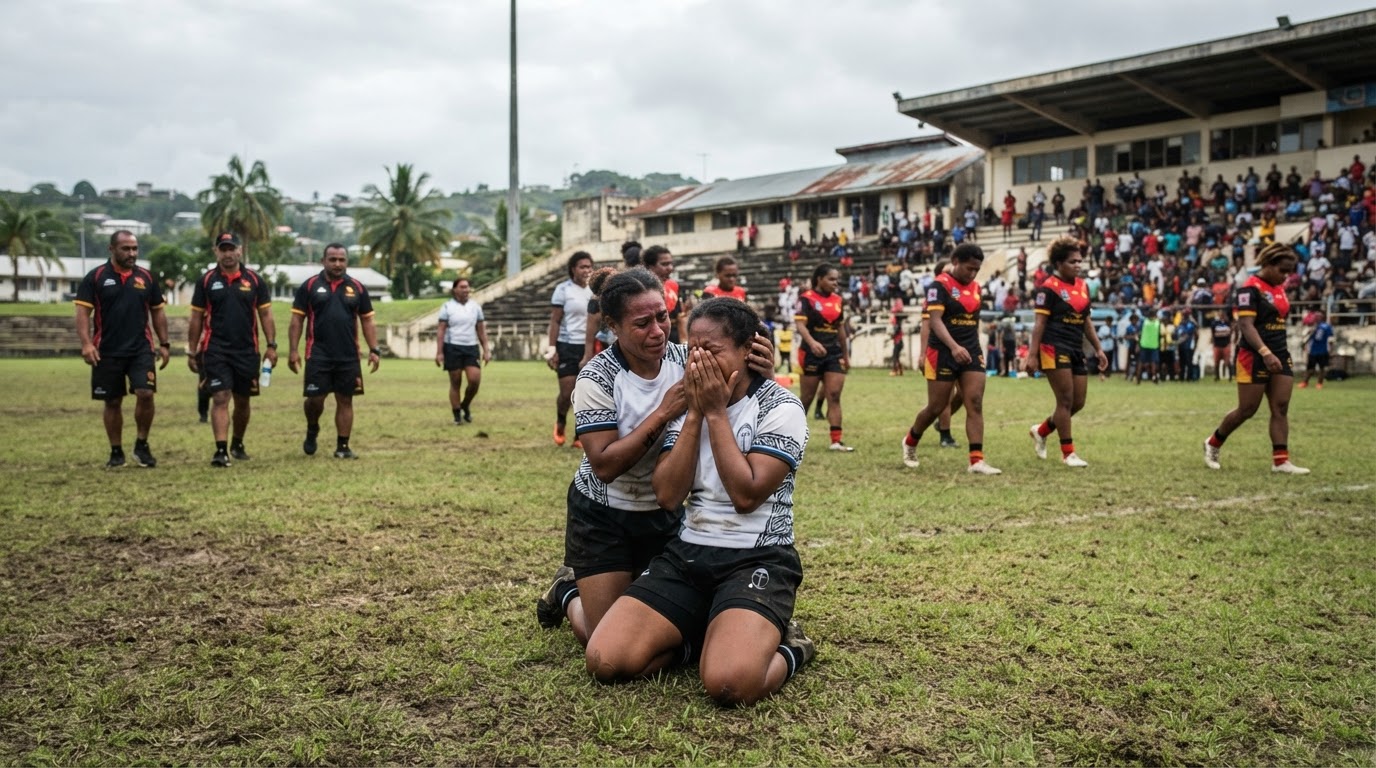
International rugby league across Oceania has long rested on an entrenched administrative hierarchy, where established test nations dictate competitive standards while Pacific neighbours navigate uneven domestic pathways. That historical pattern broke decisively on Saturday at the National Football Stadium in Port Moresby. Playing their second fixture at the 2026 Rugby League World Cup, the Fiji Bulikula dismantled the host Papua New Guinea Orchids by a margin of 40-4. Building a commanding 30-0 lead before halftime with five tries, the debutant Fijians neutralised the structural advantage of a hostile home ground to secure their first tournament win. The result challenged the assumption that hosting rights and state patronage provide an immediate guarantee of international superiority.
Context matters when assessing this outcome against established regional benchmarks. The Fijians entered round two following a narrow 12-18 opening loss to New Zealand, a traditional heavyweight whose institutional systems have dominated women's test football alongside Australia. That tight opening defeat proved that Fiji could match elite standards under structured pressure. Papua New Guinea, meanwhile, carried both hosting responsibilities and considerable domestic expectations into Saturday afternoon. Instead of an evenly contested struggle between emerging peers, the Bulikula delivered seven tries across the match, conceding only a single unconverted response to leave the Orchids effectively stranded at the bottom of the group.
Shifting Competitive Foundations
Examining this shift reveals divergent trajectories across three key Pacific markets. In Papua New Guinea, where rugby league serves as an unmatched national obsession and prominent political instrument, the Orchids have enjoyed sustained state and institutional visibility. Saturday demonstrated that domestic enthusiasm does not automatically translate into defensive structure against opponents armed with sharper technical discipline. A 30-point deficit by the break exposed fundamental vulnerabilities in managing high-tempo possession. The hosts found themselves unable to reset defensive lines once the visitors established forward momentum, illustrating the operational distance between local popularity and tournament durability.
Fiji presents a contrasting institutional model that warrants careful attention. Long celebrated for men's representation through the Fiji Bati, Fijian women's rugby league historically operated with minimal infrastructure compared to regional rivals. Making their debut in the world meet at the tournament, their ability to push New Zealand within six points before overwhelming Papua New Guinea signals an accelerated development curve. Tactical execution, rather than sheer individual athleticism, drove the Bulikula to control territory from the opening minute in Port Moresby. The performance indicates that targeted athletic pathways can yield rapid competitive returns, even without extensive domestic league traditions.
Physical dominance without administrative consolidation will not alter international tournament dynamics over the long run.
In Australia and New Zealand, administrators observe these results with calculated interest. For southern governing bodies that direct the financial engine of the code, a competitive Pacific bracket offers compelling broadcast inventory and strategic regional engagement. France has struggled to match the physical baseline demonstrated by Pacific sides, effectively shifting the competitive axis of international competition toward Oceania. A vibrant Pacific rivalry validates commercial expansion, yet it also increases administrative pressure on legacy authorities to share technical resources and governance access with emerging neighbours.
Institutional Constraints Unresolved
Sceptics will note that one dominant victory cannot confirm a permanent transfer of regional authority. Papua New Guinea retains the demographic scale and single-sport focus required to overhaul its performance systems, while tournament math leaves Fiji with significant hurdles before any potential semi-final qualification is confirmed. Beating an unsettled host nation on an emotional afternoon remains fundamentally different from dethroning the entrenched systems of Australia. Structural depth across an entire tournament roster requires multi-year financial underwriting that group-stage victories alone cannot guarantee.
Resource distribution remains an enduring problem across the region. While international bodies celebrate the competitive spectacle at the National Football Stadium, elite player welfare and coaching pipelines across Fiji and Papua New Guinea still rely heavily on fragmented funding models. A historic 40-4 scoreline illustrates athletic capability, yet it leaves unaddressed whether domestic governing bodies can convert sudden tournament success into sustainable professional structures. Without permanent institutional backing, the gap between flashes of brilliance and enduring dominance will remain wide.
Sources
Newsletter
Pacific Daily
A curated briefing from Thailand, Asia-Pacific and the world.