Maritime Isolation and the True Cost of Pacific Storm Readiness
Tropical Cyclone Wati reveals the administrative vulnerability of scattered island territories operating beyond continental logistical reach
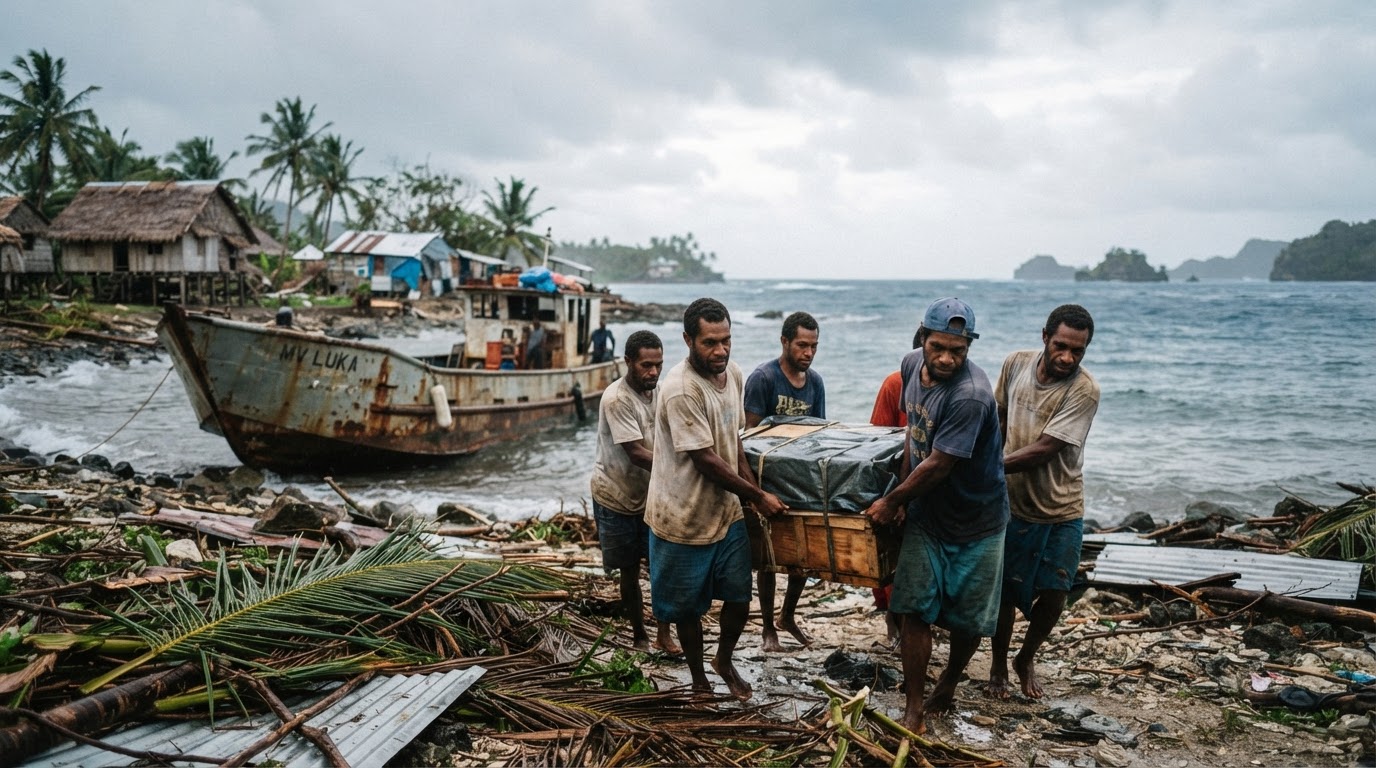
State capacity in the open ocean is governed by geography rather than policy proclamations. When Tropical Cyclone Wati intensified into a Category 2 system inside Cook Islands waters, meteorological tracking records registered sustained winds reaching 100km/h and gusts climbing to 140km/h near its centre. Official monitoring placed the storm approximately 130km south of Suwarrow, tracking across maritime expanse while models projected potential escalation to Category 3 by Sunday. These figures describe atmospheric physics. For outlying governance outposts across the Northern Cook Islands, however, the immediate operational reality is defined by sudden isolation.
Distance punishes island infrastructure.
The Cook Islands Meteorological Service initiated wide-ranging alerts spanning the Cook Islands territory, mobilizing Emergency Management Cook Islands to alert local administrative councils across fragmented atolls. When open maritime systems move between scattered populations, the disruption precedes direct physical impact. Long-range maritime cargo links stop immediately. Community councils across Palmerston and Aitutaki must commit irreplaceable local provisions long before sea conditions indicate whether outer perimeter reefs will withstand the seasonal swell. The administrative challenge is clear: remote atolls cannot rely on outside reinforcement during oceanic transit halts.
Continental Models and Territorial Friction
Regional disaster analysis frequently applies continental response models to dispersed oceanic domains where they simply fail. Continental systems absorb severe weather disruptions through overland supply lines, shared regional energy grids, and terrestrial military redeployments. Consider concurrent developments across the Americas. When Hurricane Simon reached Category 4 status off the coast of Mexico, civil authorities initiated protective boarding protocols across major municipal centres including Puerto Vallarta. Similarly, Hurricane Isaias advanced against the Gulf Coast as a Category 2 system before making landfall, where state institutions deployed emergency resources across extensive road corridors. Continental geography allows central governments to project relief inland along redundant transport channels.
Island archipelagos operate under fundamentally different logistical constraints.
In the Cook Islands, emergency coordination directed through EMCI cannot call on overland convoys or rapid overland asset transfers. Every outlying administrative outpost must survive on its own pre-positioned reserves once open waters close to navigation. Territorial stewardship over vast maritime exclusive economic zones demands that tiny populations maintain surveillance and presence on remote boundaries like Suwarrow. Yet maintaining that presence during an active cyclone relies on fragile telecommunications links and finite local reserves. Evidence shows that when sea conditions halt routine inter-island movements, central administration fractures into isolated communal outposts.
The Real Logistics of Ocean Governance
Policy statements issued by broader Pacific governance bodies regularly prioritize climate adaptation funding without addressing the severe mechanics of maritime transit. External capital guarantees little when severe ocean states sever local shipping for weeks. As Tropical Cyclone Wati tracks southeast over open waters, local administrators must calculate whether early evacuation justifies depleting scarce fuel stocks that cannot be replenished until ocean swells abate. This is the persistent governance dilemma of the South Pacific.
Physical distance converts routine meteorological warnings into severe administrative isolation long before gale winds reach vulnerable reef lines.
Effective resilience across the Pacific rim cannot be measured by emergency declarations formulated in capital cities. It is determined by the physical endurance of isolated communities and the security of their maritime lifelines. Tropical Cyclone Wati demonstrates that while monitoring agencies accurately measure storm intensity, the sovereign burden of sustaining remote oceanic territories remains permanently constrained by the sheer logistical expanse of the Pacific basin.
Sources
Newsletter
Pacific Daily
A curated briefing from Thailand, Asia-Pacific and the world.