The Trans-Tasman Rugby Deficit Exposes Australia's World Cup Strategy
Success against lower-tier touring sides masked the technical divide separating the Wallabies from New Zealand ahead of their home tournament
SINGAPORE
Domestic turnarounds in Australian rugby can look mathematically convincing while leaving the structural divide across the Tasman Sea untouched. Australia entered October 2026 carrying five consecutive test victories under coach Les Kiss, an early sequence that led national planners to project genuine recovery for the Wallabies. Yet history in this fixture has consistently penalized short-term optimism, and consecutive defeats against New Zealand have abruptly restored regional competition to its long-standing baseline.
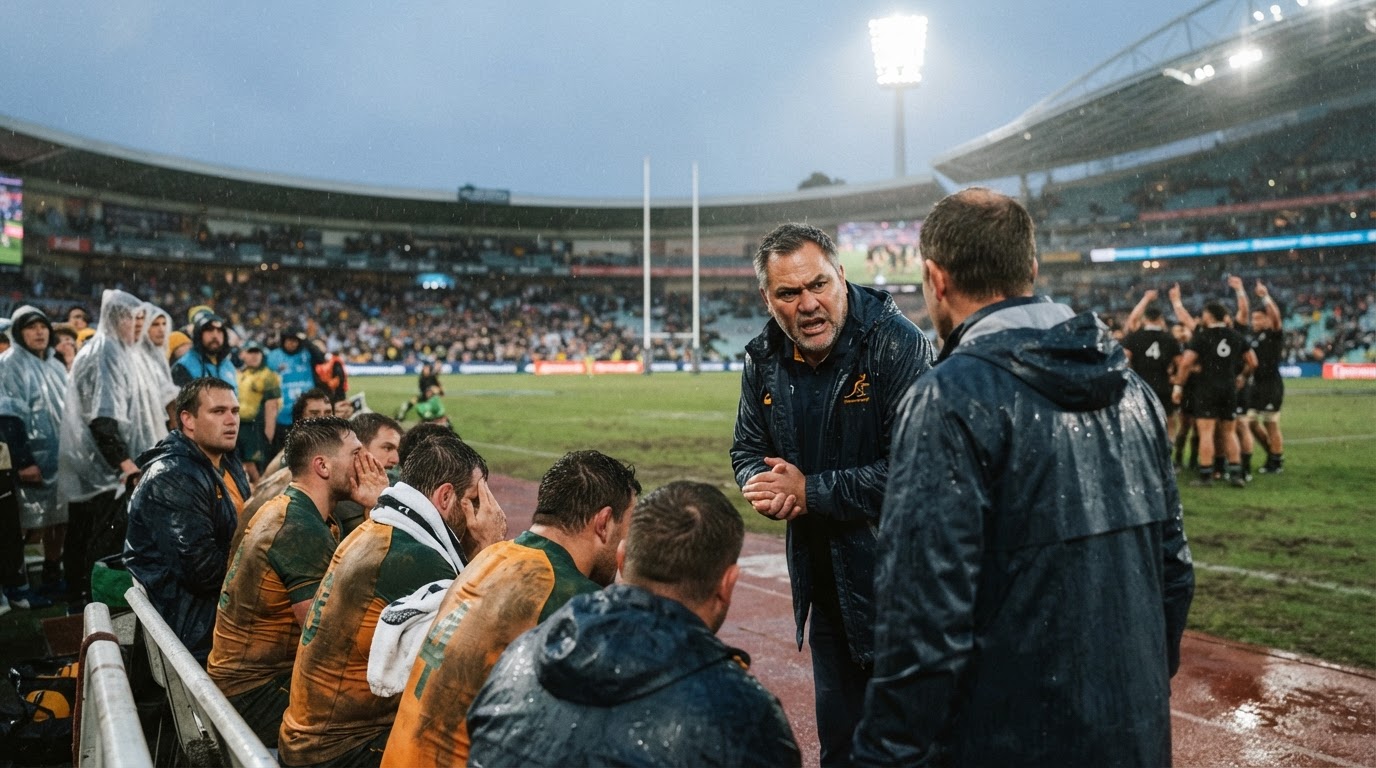
The initial phase of Kiss's tenure banked significant public goodwill. Managing five international fixtures without defeat generated commercial confidence, drawing a crowd of 73,000 spectators to Stadium Australia on Saturday. Ticket holders arrived seeking tangible proof of parity after a 50-19 humiliation away at Eden Park. Instead, back-to-back defeats in the Bledisloe Cup demonstrated that core tactical execution had failed to bridge the gap with the regional benchmark.
The Limit of Early Momentum
Administrative authorities managing the sport in Australia structured Kiss's mandate around institutional stability ahead of hosting the Rugby World Cup. Early test schedules offered controlled domestic conditions against rebuilding opposition, allowing strategic planners to project progress without testing squad depth under sustained pressure. New Zealand, by contrast, operates with tactical continuity that exposes defensive misalignments within minutes.
The five-test cushion allowed officials to postpone institutional adjustments that elite international competition inevitably forces to the surface.
Match records from Eden Park documented severe breakdowns in territorial management during phase play, while the return fixture in Sydney confirmed these deficiencies were systemic rather than incidental. Sustained phase pressure from New Zealand dismantled Australian set-piece coordination. The analytical inference is straightforward: momentum achieved against intermediate opponents provides an unreliable metric for tournament readiness. Physical dominance at the breakdown consistently favoured New Zealand, restricting Australian backline distribution and exposing tactical hesitation.
Reassessing Tournament Delivery
Strategic planners now face immediate calendar constraints. The Wallabies must travel for an intensive season-ending tour of Europe, where different styles of forward attrition will test Kiss's tactical adaptability under severe logistical pressure. Correcting technical execution while touring foreign venues represents an acute administrative risk, particularly as public scrutiny intensifies.
Defenders of the coaching staff reasonably point to the brief duration of Kiss's tenure, noting that systemic squad development requires multiple international cycles rather than immediate turnarounds against the world's most consistent side. Five consecutive wins did reflect operational improvements in squad discipline and player conditioning compared with preceding seasons. Yet tournament planning operates against rigid deadlines, and host status at the Rugby World Cup leaves negligible margin for protracted rebuilding campaigns.
The unresolved dilemma facing Australia lies between public expectations and structural capacity. Assembling 73,000 supporters at Accor Stadium demonstrated enduring commercial engagement, but spectator enthusiasm cannot manufacture technical cohesion against elite opposition. Until the Wallabies solve New Zealand's relentless phase discipline across eighty minutes, domestic sports authorities remain trapped between commercial projections for a home World Cup and the stubborn competitive hierarchy of the Asia-Pacific corridor.
Sources
Newsletter
Pacific Daily
A curated briefing from Thailand, Asia-Pacific and the world.