Haze in Western Singapore Exposes the Fragile Arithmetic of Open-Air Commerce
When the Pollutant Standards Index enters hazardous territory, street-level hawkers absorb the bill for unhedged environmental shocks.
SINGAPORE
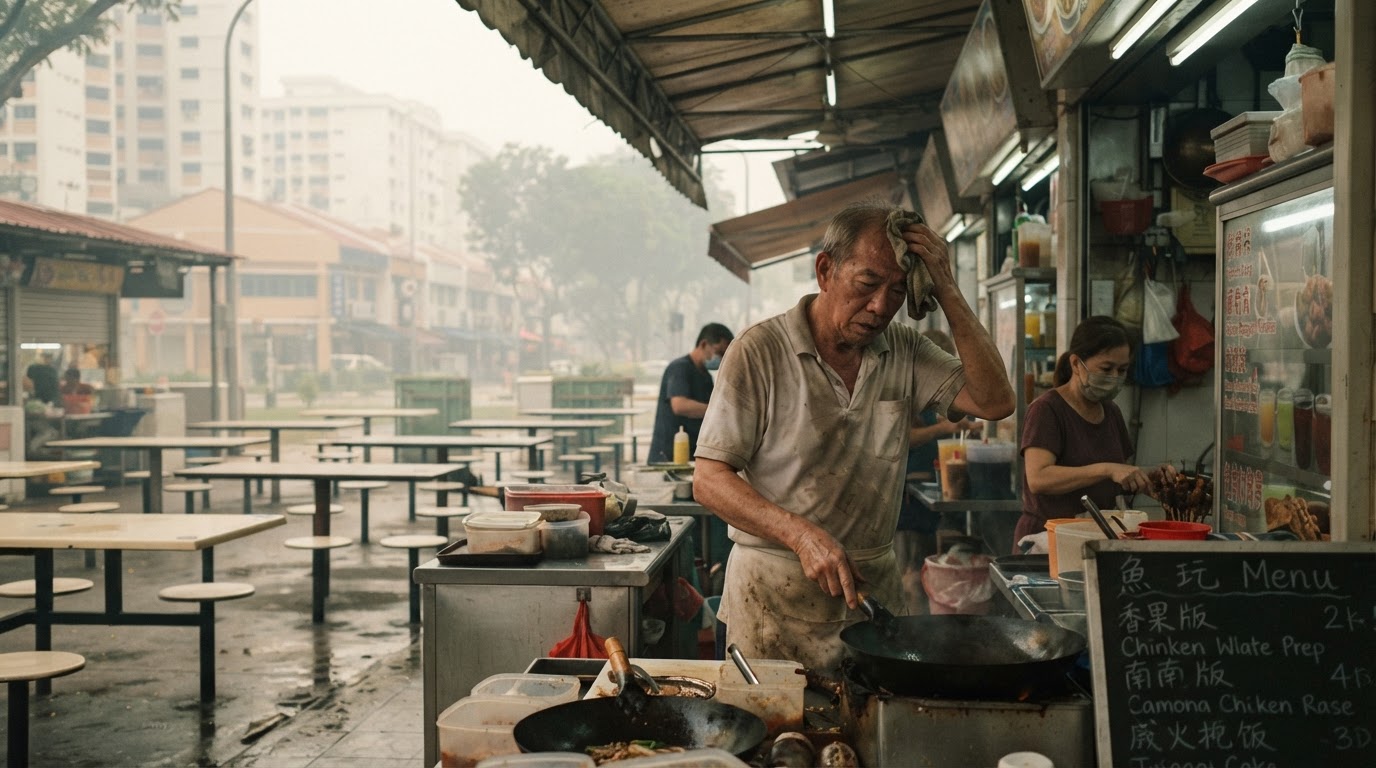
Clean air functions as an unpriced operational subsidy for open-air retail. When it disappears, the unit economics of street-level hospitality break immediately. Official environmental readings confirmed that western districts registered severe atmospheric pollution on Sunday, Oct 18, 2026, with the Pollutant Standards Index climbing to 230. That reading pushed air quality into the very unhealthy classification. On Jurong West Street 61, pedestrians cleared out. Footpaths emptied as residents retreated into enclosed transit hubs or stayed home altogether.
Air pollution is not an abstract ecological issue for neighborhood merchants. It represents an instantaneous supply and demand disruption that cuts daily revenue. Street dining relies entirely on brisk customer throughput to balance thin margins against relentless overheads. When ambient air turns hazardous, the open storefront model fails.
At Jurong West Hawker Centre, operators including Mr Yong Yoon Chin confront fixed financial obligations alongside empty tables. Most small hawkers do not possess balance sheets capable of cushioning sustained footfall collapses. When dining patronage drops by an estimated 70 percent across peak hours, perishable ingredients spoil quickly and staff wages generate no return. Unlike suburban shopping complexes that rely on centralized mechanical ventilation, open food pavilions have no physical barriers against airborne particulate matter.
Disparity in commercial insulation
This division underlines an operational divergence between enclosed and ventilated retail formats. Air-conditioned malls filter outdoor pollutants and absorb displaced diners seeking meals, capturing market share simply by virtue of physical design. Uninsulated food stalls, by contrast, take an immediate revenue penalty. Rent commitments, utility costs, and supplier payments do not adjust downward when the sky turns gray.
These local disruptions compound wider financial stresses that have weighed on small hospitality venues throughout 2026. Earlier records indicated crude oil reached USD 100, which drove up baseline transport charges and raw ingredient supplies across regional distribution chains. Forcing an acute drop in patron traffic onto an already tight cost structure tests how long family-run food businesses can endure repetitive pollution spikes.
Policy responses reflect the severity of the economic and civic fallout. Prime Minister Wong warned of firm action on Oct 15, signaling Singapore's diplomatic pressure over transboundary haze. Yet interstate legal discussions progress slowly, while particulate matter travels instantly across borders. Atmospheric analysts note that air quality conditions remain dynamic, but that dynamism offers zero planning certainty for a stallholder preparing perishable ingredients at five in the morning.
The unhedged merchant
The central issue is financial incidence: who pays for regional environmental failure? Micro-retailers operate on high volume and tight cash flow. Erase pedestrian presence from the pavement, and profitability evaporates before lunch service finishes. Independent stallholders cannot buy financial hedges against smoke drifting across the straits, nor can they purchase commercial insurance policies that pay out when pollution indexes spike.
Every jump in the Pollutant Standards Index operates like an unannounced tax on open-air trade. Weather patterns may shift and clear the western sky in the coming days, but the structural vulnerability of street dining remains. The survival of community hawking ultimately depends on whether regional enforcement can halt burning before customers permanently migrate into climate-controlled malls.
Sources
Newsletter
Pacific Daily
A curated briefing from Thailand, Asia-Pacific and the world.