Elite Football and the Manufactured Illusion of Permanence
Liverpool's routine dismantling of Brighton exposes how industrialised football substitutes interchangeable celebrity for institutional continuity
SINGAPORE
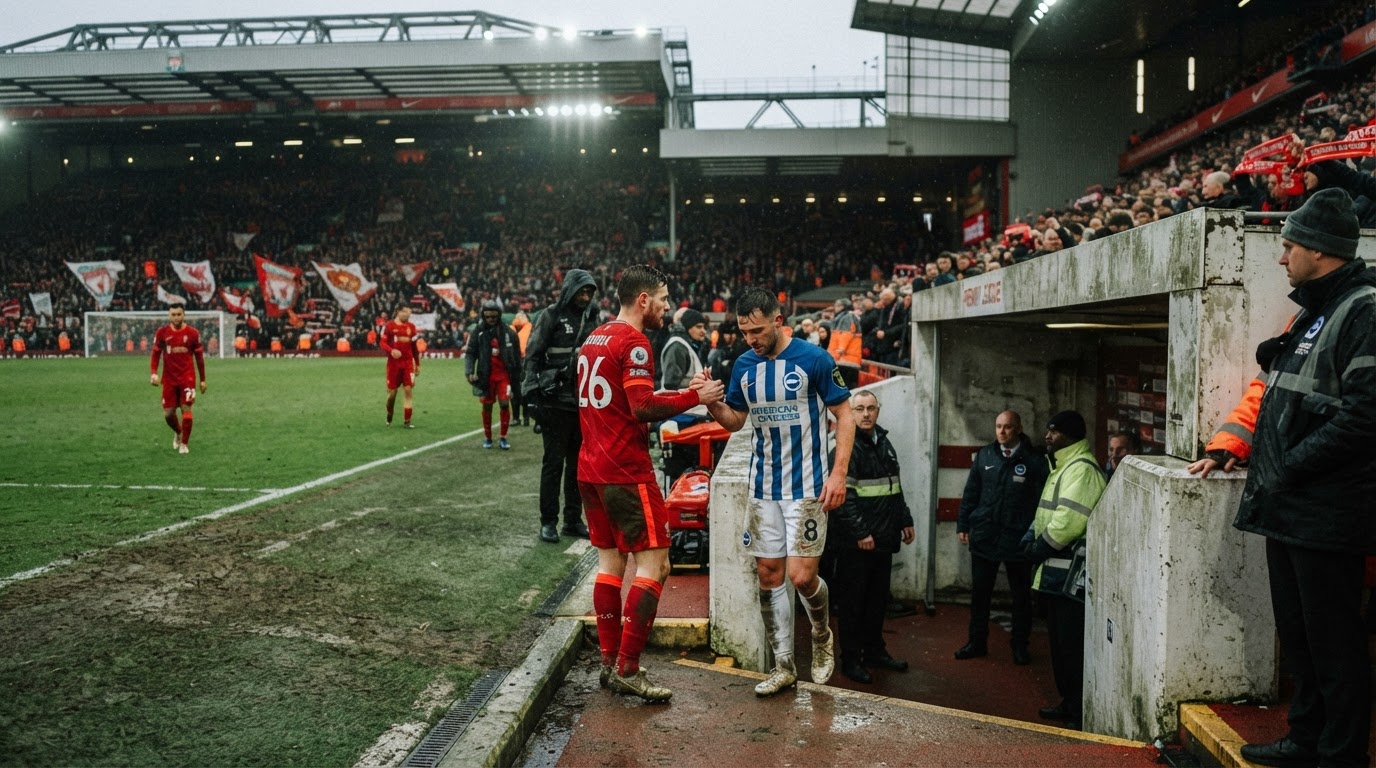
Elite professional football routinely presents spectators with an apparent contradiction: every managerial transition is framed as an existential rupture, yet modern sporting institutions absorb personnel turnover with mechanical regularity. On October 25, 2026, Liverpool defeated Brighton & Hove Albion 2-0 at Anfield in a Premier League fixture that appeared to validate a fresh phase of tactical regeneration. Alexander Isak converted Liverpool's second goal past Bart Verbruggen, while an earlier own goal drew celebrations from Florian Wirtz, Milos Kerkez, Alexis Mac Allister and Bradley Barcola. Manager Andoni Iraola acknowledged the final whistle on the touchline with familiar expressive choreography, confirming how quickly the competitive apparatus has settled.
Yet beneath the celebratory surface of an autumn league fixture sits an unresolved tension in how modern sport is consumed. Distant broadcast viewers, particularly across Asian television markets where the Premier League commands substantial attention, are invited to invest emotional capital in historical club identity and bespoke managerial personality. Commercial football sells the idea that competitive excellence flows from a proprietary civic ethos native to Liverpool. The match, however, points toward a different institutional reality: the sheer financial fungibility of elite European sporting infrastructure.
The Commodity of Cohesion
The modern football enterprise maintains its aura not through preservation, but through an unsentimental capacity to replace its constituent parts.
Consider the operational lineup deployed on the pitch. The celebratory group surrounding the opening strike brought together Mac Allister, Wirtz, Barcola and Kerkez, while Isak supplied the finishing blow against Verbruggen. This arrangement reflects neither local cultivation nor long-standing institutional continuity. Instead, it demonstrates an aggressive capital deployment mechanism designed to acquire finished technical assets across international borders and integrate them into an existing framework. When Iraola orchestrates such an ensemble, the operational efficacy is apparent, but it remains fundamentally detached from the regional roots that the club's heritage marketing persistently evokes.
Conventional match commentary often treats tactical adjustments as philosophical revelations. Pundits praise structural pressing, defensive transitions and coordinated rotations as though they represent organic moral virtues rather than predictable outputs of immense balance-sheet disparities. Brighton & Hove Albion arrived at Anfield possessing tactical coherence and rigorous preparation, yet the structural gap between sustained global revenue machines and mid-tier competitors remains evident over ninety minutes. Wealthy institutions can absorb errors, maintain depth across positions, and rely on the cumulative probability of individual technical execution to decide the result.
Global Consumption Without Agency
For viewers throughout the Asia-Pacific region, who form a major demographic foundation of modern broadcast audiences, this dynamic carries an acute irony. Regional supporters serve as economic pillars for an enterprise whose operational core remains anchored in the United Kingdom. The names on the team sheet rotate with clinical efficiency—yesterday's figures supplanted by Wirtz, Isak or Kerkez—yet the consumption pattern remains static, demanding loyalty toward an abstraction whose primary objective is corporate self-perpetuation. Spectators across regional markets finance an elite entertainment apparatus that treats their attachment as an annuity rather than a reciprocal relationship.
One counterargument holds that technical brilliance justifies itself regardless of corporate provenance. Supporters purchase access to supreme athletic competence, and Liverpool under Iraola indisputably delivers high-calibre athletic theatre. Aesthetic excellence, in this view, supersedes questions of commodification, offering fans an uncompromised standard of sport that smaller domestic leagues cannot replicate.
That defence, however, appears to confuse execution with durable meaning. When victory becomes an engineered probability reinforced through concentrated capital, the emotional compact that initially sustained football's cross-border appeal faces gradual erosion. Liverpool secured three points and reinforced their table position at Anfield, demonstrating how efficiently modern football replaces its heroes, while leaving the question of institutional belonging increasingly unresolved for the global public watching from afar.
Sources
Newsletter
Pacific Daily
A curated briefing from Thailand, Asia-Pacific and the world.