Why Singapore’s Stained-Glass Revival Is More About Labor Than Nostalgia
Amateur makers flocking to Project Lumen reveal an appetite for physical friction in a city built on digital speed.
SINGAPORE
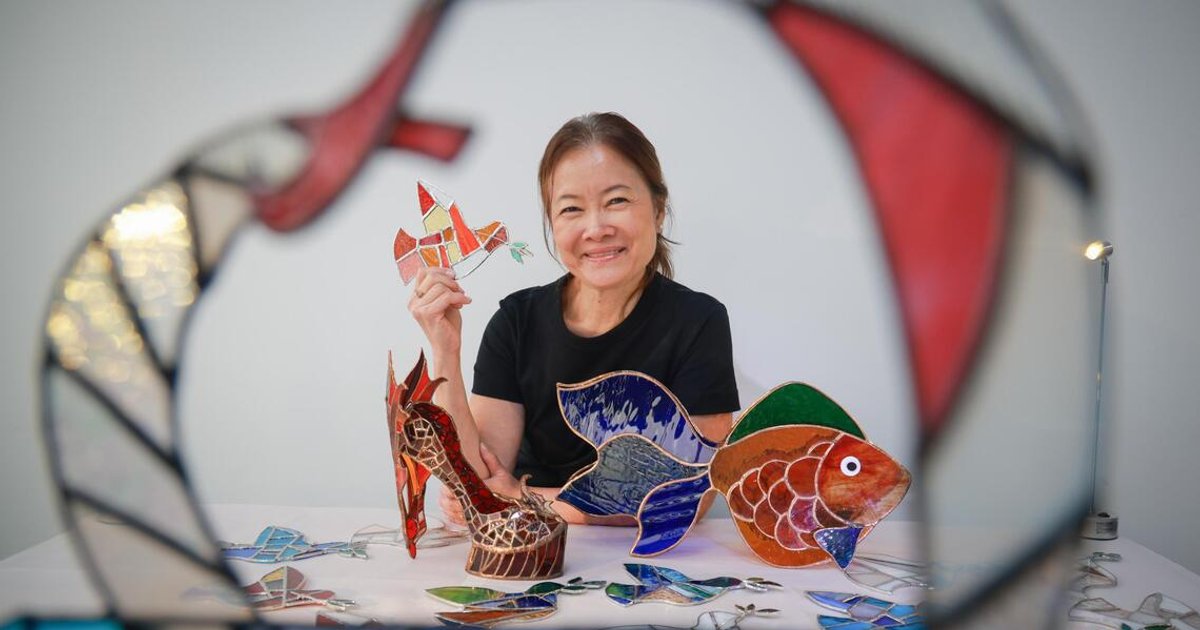
Stained glass functions by converting unpredictable exterior illumination into deliberate interior discipline, joining brittle colored panes through rigid solder lines. When suspended beneath the artificial ceilings of commercial real estate, however, the medium encounters an entirely different spatial logic. At the Ion Art Gallery within Ion Orchard, an installation titled Project Lumen gathers two hundred handcrafted glass doves, remaining on view until Oct 27. The assembled flock represents an intriguing intersection between slow artisanal technique and high-density retail circulation.
Behind the exhibition stands artist Felicia Yong, whose earlier portfolio focused on large commissions that included churches. Her current practice spans her Bukit Batok studio and classroom settings at the Nanyang Academy of Fine Art Centre for Lifelong Learning. Yong now instructs multi-generational cohorts of non-specialists: engineers, researchers, a retired lawyer, and mother-daughter pairs assemble cut glass under her direction. Their presence signals a notable shift in how specialized craft survives within modern urban centers.
From Monumental Craft to Amateur Workshop
Stained glass historically belonged to institutional monuments and religious assemblies, requiring capital, permanent walls, and years of guild training. Transporting such methods into continuing education programs inevitably alters their social meaning. In Singapore, where urban development prioritizes prefabricated efficiency and rapid structural renewal, manual glass assembly offers an uncommon encounter with fragile material resistance. Cutting colored glass demands careful physical pressure, deliberate posture, and an acceptance of inevitable breakage.
Yet the popular framing of this movement as a comprehensive revival invites careful qualification. Hobbyist participation does not automatically constitute the resurrection of a self-sustaining architectural trade. The engineers and researchers populating Yong's workshops are not training to restore historic civic infrastructure or construct municipal windows; they are seeking tactile creative respite from corporate administration. When craft migrates into lifelong learning centres, it often transforms from an economic production method into an avenue for personal self-expression.
The Demands of Material Resistance
That distinction does not diminish the cultural resonance of the resulting artifacts. By drawing two hundred glass doves together inside Ion Orchard, Project Lumen brings intimate handwork into direct contact with high-volume consumer traffic. Retail spaces typically celebrate seamless surfaces and immaculate corporate finishing. Yong's exhibition introduces irregular hand-soldered joints, subtle chromatic variations, and the visible labor of amateur hands into that polished environment.
Visitors observing the installation confront an unresolved tension at the heart of modern metropolitan culture. An affluent, highly optimized workforce will spend evening hours mastering unforgiving antique techniques, seeking the tangible weight of physical accomplishment that abstract office labor systematically denies them. Whether this impulse can sustain stained glass beyond the confines of boutique classrooms remains doubtful, but the immediate motivation is unmistakable. The appeal lies precisely in the fact that glass does not bend to modern haste, requiring patience that contemporary urban systems rarely afford.
Sources
Newsletter
Pacific Daily
A curated briefing from Thailand, Asia-Pacific and the world.