The Shifting Canvas: South Korean Artists Beyond the K-Pop Frame
Seoul’s concurrent solo exhibitions reveal how its cultural influence is diversifying beyond global music phenomena.
SINGAPORE
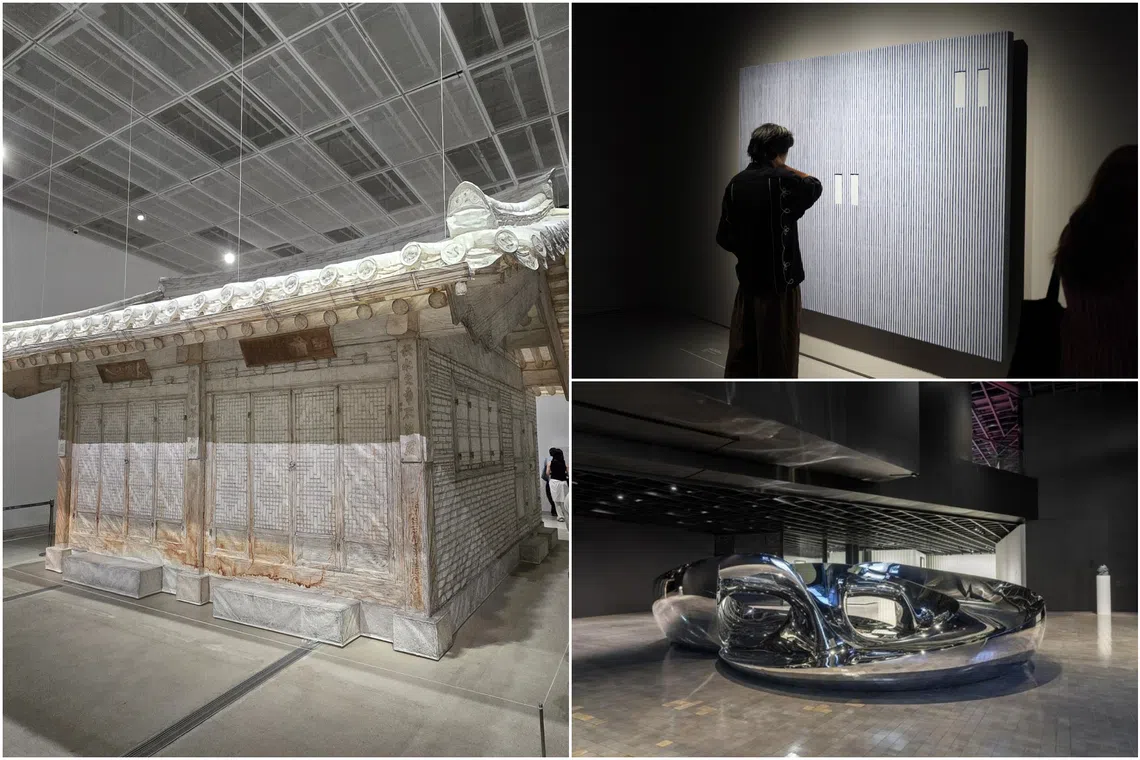
The art world's attention has gravitated towards Seoul this autumn, not for the usual K-pop spectacle, but for a convergence of significant solo exhibitions by South Korean artists. Do Ho Suh, Park Seo-Bo, and Koo Jeong A are all currently showcasing major works in the city, aligning with international art events such as the Gwangju Biennale and Frieze Seoul. This constellation of art, highlighted by The Straits Times Life on September 16, 2026, presents a telling shift in the mechanisms of South Korean cultural export.
For years, the global perception of South Korean culture has been significantly shaped, if not dominated, by its popular music. Names like BTS’ Jungkook, appearing on international Rolling Stone covers as reported by Yonhap News Agency on December 9, 2025, or BTS’ RM, the first Korean solo artist to reach the Billboard 200 Top 3 in December 2022, have become synonymous with the nation’s cultural reach. This success, often driven by highly visible individual stars, has created a powerful, if somewhat singular, narrative about South Korean influence abroad.
However, the current emphasis on fine art, particularly the deeply personal and conceptually rich works of artists like Do Ho Suh — whose exhibition features large-scale fabric and hanji recreations of his homes, including thread drawings from a Singapore residency — signals a deliberate broadening of this cultural dialogue. Park Seo-Bo’s joint show with Vietnamese artist Huong Dodinh highlights his Dansaekhwa technique, while Koo Jeong A explores sensory experiences and spatial perception. These are not phenomena designed for mass consumption in the same way pop music is; their impact is often more subtle, requiring sustained engagement from the audience.
This is not to say that the era of K-pop’s global dominance is waning. The commercial and artistic force of its music industry remains considerable. Yet, the deliberate curatorial choice to present these artists concurrently suggests a strategic diversification. It allows for a more nuanced international understanding of South Korean creativity, moving beyond the immediate, catchy appeal of pop music and into the realms of contemporary art that challenge and provoke in different ways.
### Culture Beyond Commercial Appeal
The implications for Asia-Pacific are clear: South Korea is actively cultivating multiple avenues for cultural exchange, ensuring that its influence is not solely reliant on the cycles of popular trends. While the immediate audience for a solo art exhibition may be smaller than that for a K-pop concert, the long-term impact on cultural discourse and critical appreciation can be profound. It demonstrates a commitment to showcasing a broader spectrum of national talent, suggesting a future where South Korean cultural capital is measured not just by chart performance, but by its contributions to global artistic movements.
The current moment, with its dual focus on established and emerging artistic voices, asks us to consider how cultural power is constructed and perceived. It offers a counter-narrative to the prevailing idea that only the most commercially viable forms of expression can achieve international recognition, pointing instead to a more complex and multifaceted cultural diplomacy. The challenge remains how effectively this expanded artistic narrative can integrate with, and perhaps even reshape, the existing global perceptions of South Korean culture.
Sources
Newsletter
Pacific Daily
A curated briefing from Thailand, Asia-Pacific and the world.