Tripartite Arms Diplomacy and the Economics of Strategic Hedging
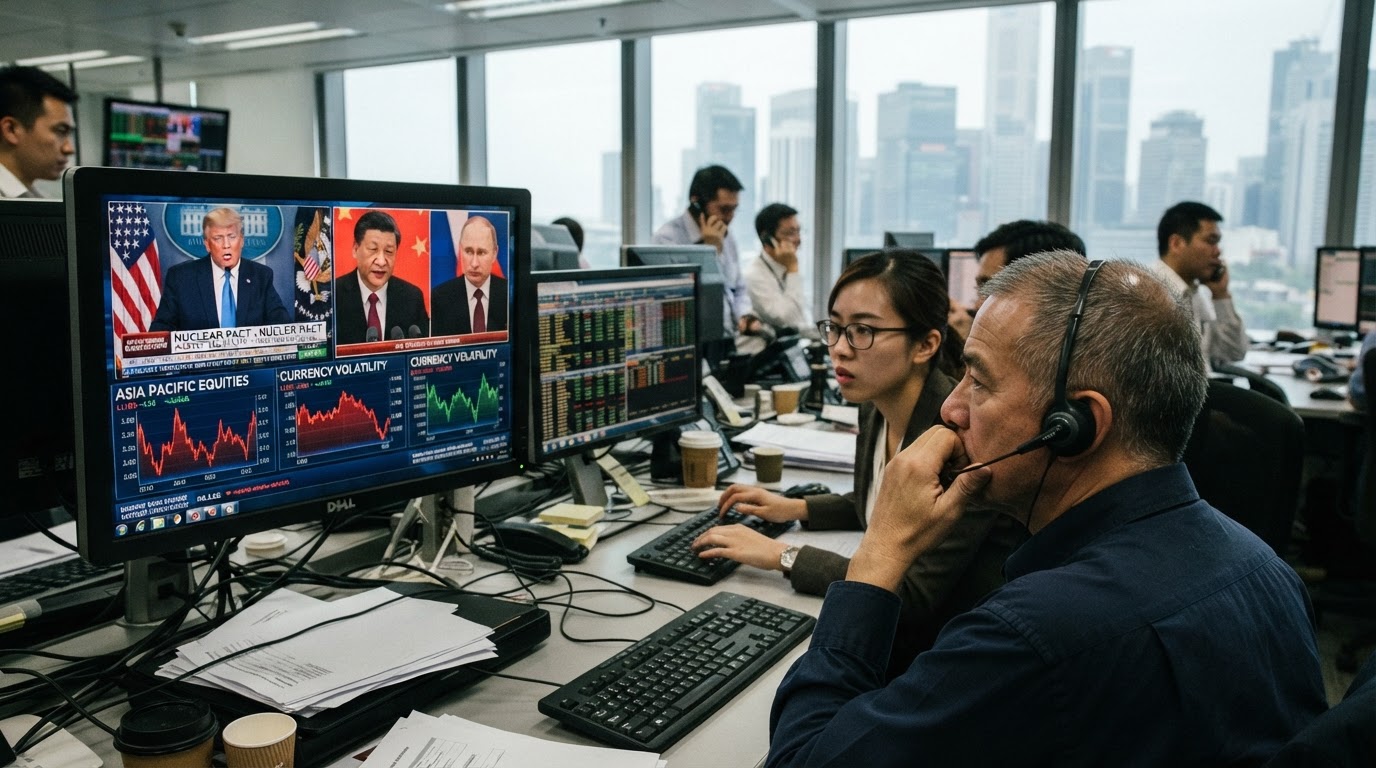
Donald Trump signals interest in direct nuclear bargaining with Xi Jinping and Vladimir Putin, yet conflicting sovereign incentives leave Asia-Pacific capital markets facing persistent uncertainty.
SINGAPORE
WASHINGTON — Direct trilateral negotiations between the major powers alter strategic risk calculations faster than bilateral diplomatic channels. On Monday, Oct 19, US President Donald Trump announced that he remains open to convening a tripartite summit alongside Chinese President Xi Jinping and Russian President Vladimir Putin as early as next month. The immediate premise rests on a unified agenda concerning non-proliferation, with Trump stating, "We would have it to talk about nuclear weapons and denuclearisation." By proposing that Washington, Beijing, and Moscow sit at a single table, the declaration establishes a distinct diplomatic signal across the Asia-Pacific corridor.
Yet the structural incentives facing each capital point in conflicting directions. For the United States, drawing China into an established arms-control framework alongside Russia addresses the expansion of strategic parity across the Pacific. Washington operates under the pressure of fiscal commitments, where sustained regional deployments require heavy budgetary allocation. A joint trilateral meeting offers the White House an opportunity to consolidate diplomatic leverage and extract bilateral concessions on broader commerce and regional security without escalating domestic defence expenditure.
Beijing operates under an entirely different balance sheet. China has historically resisted tripartite arms negotiations, arguing that its strategic arsenal remains distinct from the stockpiles maintained by Washington and Moscow. For President Xi Jinping, accepting an invitation to negotiate alongside Donald Trump and Vladimir Putin risks locking Chinese military development into an asymmetrical baseline. Chinese industrial planning relies on strategic ambiguity to secure sea lanes and maintain regional deterrences. Agreeing to formal constraints without reciprocal economic concessions or verified reductions from the other two powers presents little tangible return for Beijing.
Moscow views the dynamic through another aperture. For President Vladimir Putin, trilateral talks reaffirm Russia's status as an indispensable global counterweight. A three-way summit disrupts diplomatic isolation and elevates Moscow into a direct arbiter between the United States and China. Yet Russian strategic incentives require securing economic relief and commercial access rather than accepting standalone nuclear limits.
Shifting Capital Allocations
Regional supply chains and corporate investment committees evaluate these diplomatic overtures through sovereign risk premiums. When sovereign leaders propose unprecedented trilateral formats, capital allocations in intermediate manufacturing centres do not immediately adjust. Factory owners and cross-border trade operators in Southeast Asia understand that high-level summits rarely yield rapid institutional treaties. Instead, the immediate effect is defensive posture preservation. Companies manage sovereign friction by dispersing capital across multiple regulatory jurisdictions rather than betting on diplomatic detente.
We would have it to talk about nuclear weapons and denuclearisation,
Consider the operational counterargument. Skeptics of persistent tension suggest that direct leader-to-leader interaction between Trump, Xi, and Putin could establish a diplomatic floor. If personal negotiations bypass institutional gridlock, sudden progress on non-proliferation could stabilise regional shipping corridors and lower geopolitical compliance costs for multinationals across the Asia-Pacific. A formal framework would remove tail risk from energy markets and industrial shipping routes.
The Unresolved Bargaining Friction
That reading discounts the institutional divergence driving each sovereign entity. Tripartite summits cannot resolve underlying conflicts when the fundamental bargaining units remain misaligned. Nuclear weapons are tied directly to conventional deterrence, regional sea routes, and industrial self-reliance. While a meeting next month would present a compelling diplomatic spectacle, it does not alter the domestic industrial mandates governing Beijing, Moscow, or Washington.
Commercial stability in the Asia-Pacific therefore does not depend on whether a tripartite meeting takes place next month. It depends on whether any of the three capitals demonstrates a structural willingness to link sovereign military limitations to durable trade concessions. Until verifiable terms emerge from Washington, Beijing, or Moscow, global supply chains will treat the prospect of trilateral summits as political signaling rather than an inflection point for cross-border investment.
Sources
Newsletter
Pacific Daily
A curated briefing from Thailand, Asia-Pacific and the world.