Taiwan's Arizona Office Reflects Targeted Economic Integration Beyond Formal Diplomacy
The opening of Taiwan's new Phoenix office, driven by semiconductor supply chain considerations, signifies a deliberate effort to embed Taiwan within critical American industrial sectors, underscoring evolving strategic priorities over conventional diplomatic expansion.
SINGAPORE
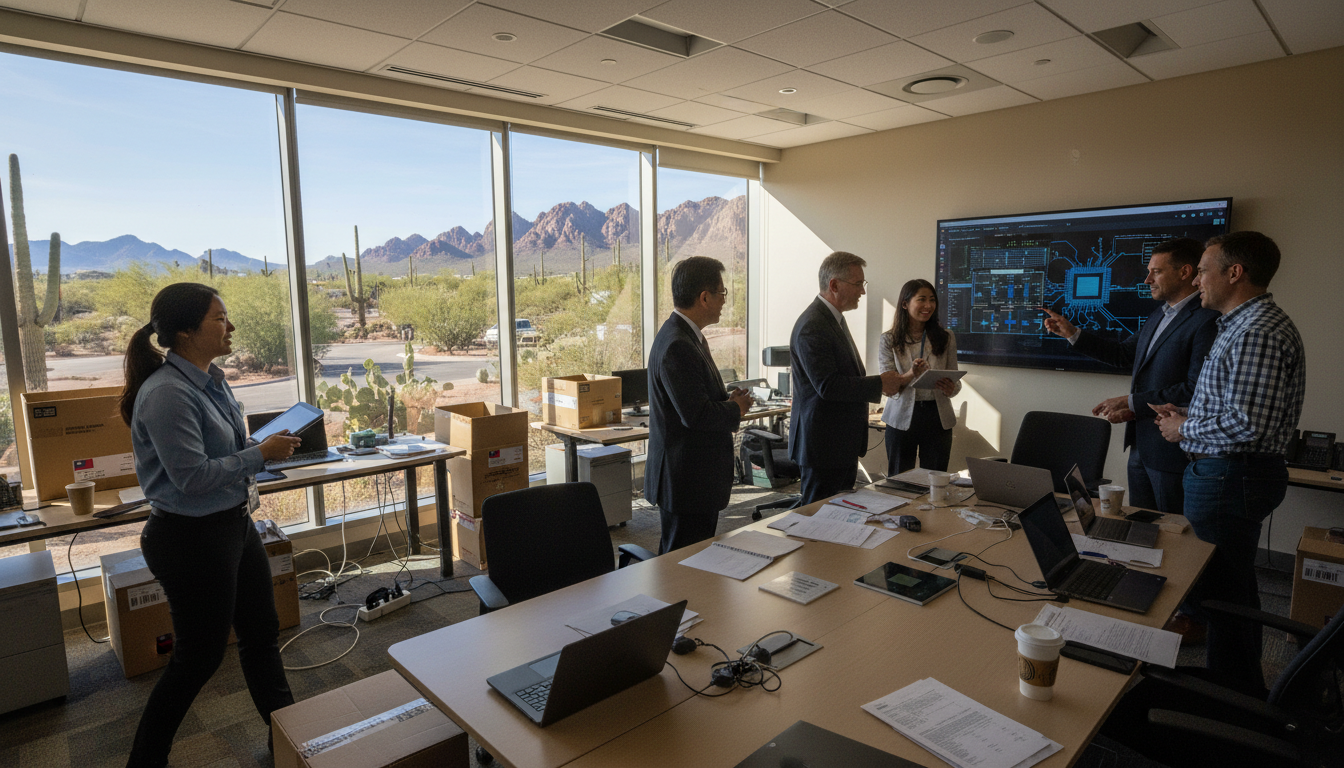
On October 3, 2026, Taiwan's foreign minister will attend the opening of a new office in Phoenix, Arizona [1, 2]. This event follows earlier reports, including one from January 18, 2026, indicating planning for such an office [4]. It also occurs months after Oklahoma opened a trade office in Taipei on July 4, 2026 [3]. The establishment of this Arizona presence marks more than an expansion of diplomatic footprint; it reflects a targeted strategic reorientation.
Taiwan's emphasis on Arizona, a state with significant semiconductor manufacturing investment, illustrates a calculated effort to deepen economic ties directly with specific American industrial centers [2]. The Japan Times reported on October 3, 2026, that the foreign minister's visit aims to deepen economic ties, indicating the primary driver [2]. This approach moves beyond broad national-level agreements to embed Taiwan within the supply chains of critical industries, particularly semiconductors. The office functions as a capability for direct engagement with American stakeholders in a sector vital to both economies, rather than merely a symbolic presence. The intent is to facilitate trade and investment flows that align with national industrial priorities, reflecting a shift from generalized diplomatic outreach to sector-specific integration.
This trend aligns with a broader pattern of industrial repositioning. Asian tech firms, as Reuters noted on July 13, 2026, are seeking to follow companies like SK Hynix, though foreign investors may become more selective [6]. Taiwan's move into Arizona positions it to mitigate such selectivity by offering direct engagement and demonstrating commitment to shared economic ecosystems. The investment in a physical presence suggests a long-term strategic calculation regarding supply chain resilience and technological leadership, particularly given the ongoing global competition for semiconductor dominance.
The concentration on economic ties with specific American states could be viewed as a prudent diversification strategy. This focus also raises questions about the scope and balance of Taiwan's broader international engagement. Focusing on one industry and one region risks overreliance, potentially overlooking emerging opportunities or vulnerabilities in other geographical or economic spheres. While the immediate benefits of such focused engagement are clear, the long-term implications for Taiwan's global economic and political diversification remain to be fully observed. The challenge for Taiwan will be to leverage these new specific ties without allowing them to narrow the breadth of its external relations.
The office opening represents a concrete step in Taiwan's strategy to secure its economic future by aligning with American industrial policy in a critical sector. The action itself, rather than any statement, indicates a change in how Taiwan approaches its international economic integration. The unresolved tension lies in how this focused engagement balances against the imperative for a broader, more resilient global presence.
Sources
Newsletter
Pacific Daily
A curated briefing from Thailand, Asia-Pacific and the world.